

“Diophantus opens up a world of arithmetic and algebra no less rich and colourful than Euclid’s geometry.”
— I. G. Bashmakova
Diophantus’ problem of dividing the number 100 is one of the number-theoretic problems preserved in his Arithmetica. Written in the 3rd century CE, this work contains 189 problems with solutions in the six surviving books and is considered the first systematic work on algebra.
Statement of the problem
Divide the number 100 in two different ways so that:
- The larger part of the first division is twice the smaller part of the second division.
- The larger part of the second division is three times the smaller part of the first division.
Diophantus’ problem is a classic example of finding rational solutions to a system of indeterminate equations. It illustrates his characteristic approach: searching for rational solutions to indeterminate equations, now called “Diophantine equations”.
Diophantus used distinctive methods that can be reconstructed from the surviving problems. Although he did not use modern algebraic notation, he effectively employed substitution and elimination of variables.
Historical background
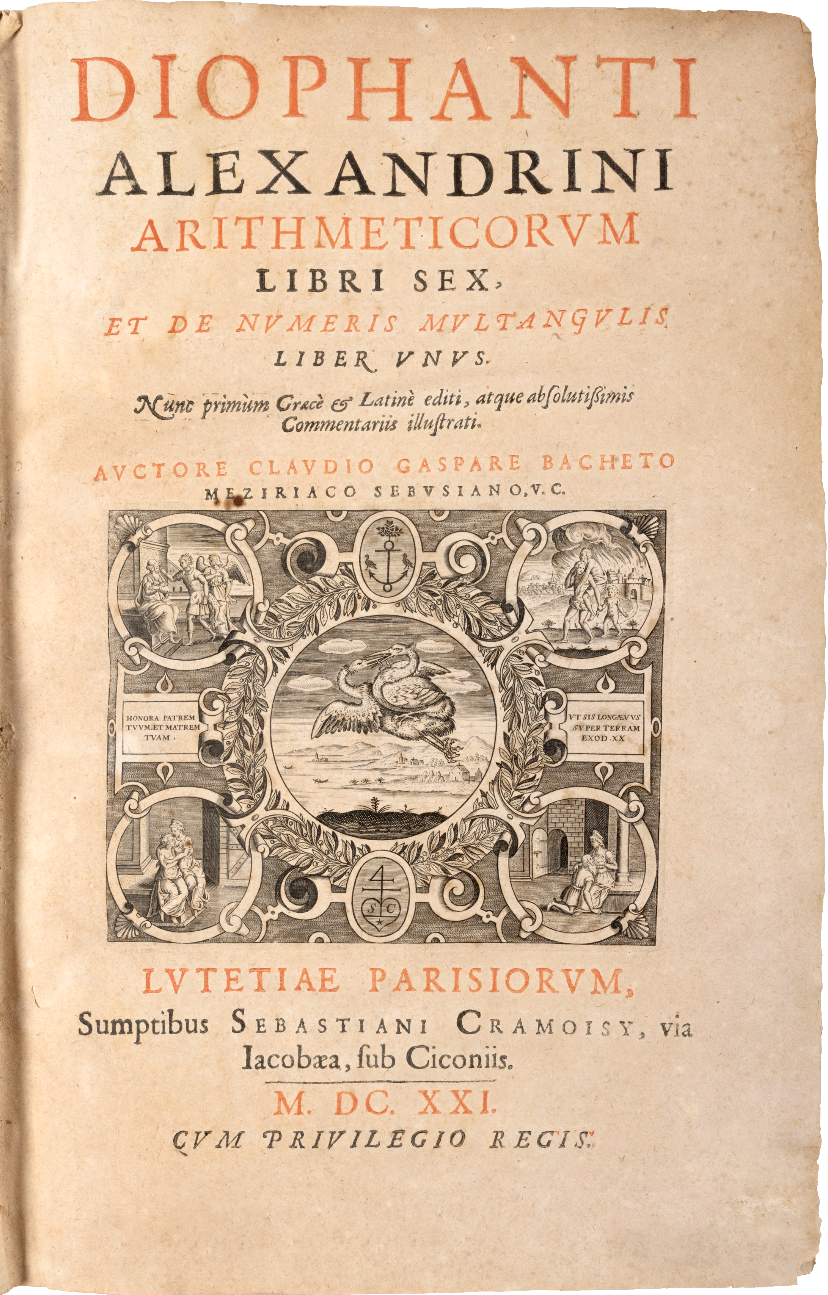
Much of the world’s knowledge of Diophantus’ Arithmetica came through Claude-Gaspard Bachet’s Latin translation, published in 1621. This translation, accompanied by commentaries, inspired Pierre de Fermat to formulate his famous Last Theorem.
“Cubem autem in duos cubos… resolvi non posse”, Fermat wrote in the margins of Bachet’s edition.
Diophantus’ problems are more than algebra exercises: they form a historical bridge to modern mathematics. Try solving his problem yourself before comparing your solution with Diophantus’ own method. You will find yourself in the company of an ancient algebraist who worked long before equations took their present form.
Solution
For this problem, Diophantus’ approach might look as follows. First, we formalize the conditions.
Let:
- the first division be: 100 = a + b (where a > b);
- the second division be: 100 = c + d (where c > d).
The conditions translate into equations:
- a = 2d
- c = 3b
- a + b = 100
- c + d = 100
This system of four equations in four unknowns can be solved. All the variables can be expressed in terms of b:
- d = 100 − 3b
- a = 2d = 200 − 6b
- a + b = 200 − 6b + b = 200 − 5b = 100, b = 20
We find the remaining unknowns:
- a = 100 − 20 = 80
- c = 3b = 60
- d = 100 − 60 = 40
Answer
- First division: 100 = 80 + 20.
- Second division: 100 = 60 + 40.