

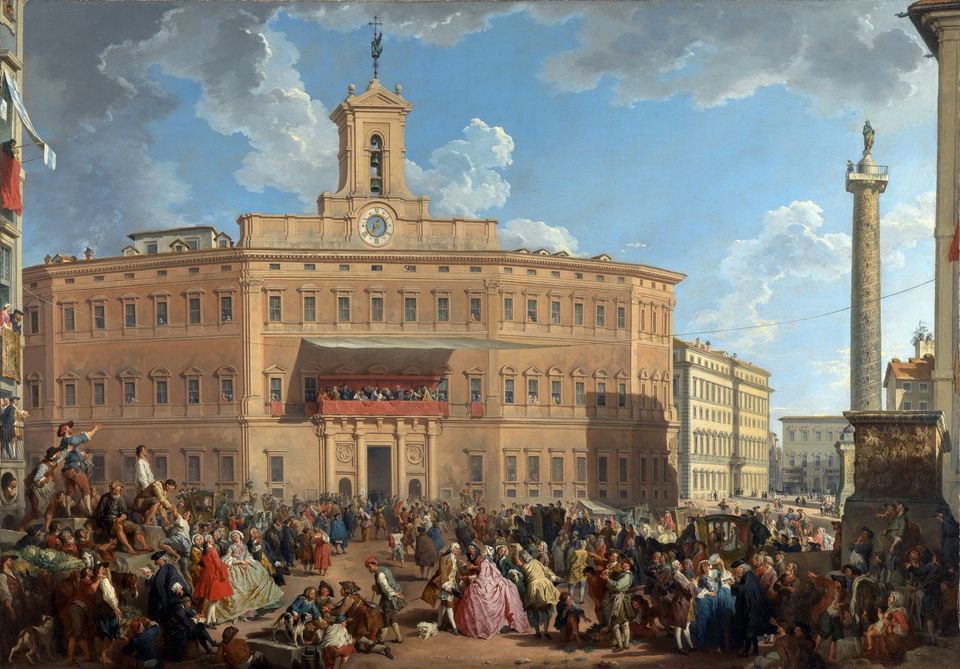

The famous Genoese lottery originated in Genoa in the 17th century. From the 18th century onwards, it was played and flourished in Italy, France, Germany and other countries. The Italian writer Matilde Serao (1856–1927) gave a vivid description of the Genoese lottery in her story “The Lottery Drawing”.
The first mention of the lottery in literature dates to 1620.
Its rules were as follows. Players bought tickets bearing numbers from 1 to 90. Tickets could have 1, 2, 3, 4 or 5 numbers. 5 winning numbers were drawn from the 90 available. Players could bet on 1 number (a single), 2 numbers (ambo), 3 numbers (terno), 4 numbers (quaterno) or 5 numbers (quinterno).
On the day of the draw, 5 tokens were taken from a bag containing tokens numbered from 1 to 90. Winning tickets were those containing all the numbers on the tokens drawn.
A player who guessed correctly received their stake multiplied by 15 for a single, by 270 for an ambo, by 5500 for a terno, by 75000 for a quaterno and by 1 000 000 for a quinterno.
Use the classical probability formula to find the probabilities of these wins. Try solving the problem yourself first, and only then compare your result with the answer below.
Historical background
The widespread game of lotto is a variation of this lottery. Filling in four numbers is called “kvartira” (“apartment”), a corruption of the word “quaterna”.
Many people tried to become rich by playing this lottery. Almost none succeeded.
Events in the Republic of Genoa in 1515 also reveal the origin of the word “lottery”. In the 15th century, elections to Genoa’s local governing body, the Great Council, selected 90 candidates by voting. In the final round, only the 5 most worthy candidates had to be chosen.
To obtain the fairest possible result, a special drawing of lots was adopted using the formula “5 out of 90”, thus giving the final vote to Lotto, which means “Fate” in Italian.
Answer
| i | Stake multiplier | p_i |
|---|---|---|
| 1 | 15 | \dfrac{\binom51}{\binom{90}1}=\dfrac1{18}\approx0.055555 |
| 2 | 270 | \dfrac{\binom52}{\binom{90}2}=\dfrac2{801}\approx0.002497 |
| 3 | 5500 | \dfrac{\binom53}{\binom{90}3}=\dfrac1{11748}\approx0.0000851 |
| 4 | 75000 | \dfrac{\binom54}{\binom{90}4}=\dfrac1{511038}\approx0.0000019 |
| 5 | 1000000 | \dfrac{\binom55}{\binom{90}5}=\dfrac1{43949268}\approx0.00000002275 |
Probabilities of winning in the Genoese lottery
- The total number of lottery outcomes equals the number of combinations of 90 taken 5 at a time.
- For a single, the number of favourable combinations equals the number of combinations of 89 taken 4 at a time.
- For an ambo, the number of favourable combinations equals the number of combinations of 88 taken 3 at a time.
- For a terno, the number of favourable combinations equals the number of combinations of 87 taken 2 at a time.
- For a quaterno, the number of favourable combinations equals the number of combinations of 86 taken 1 at a time.
- For a quinterno, the number of favourable combinations equals the number of combinations of 85 taken 0 at a time, namely 1.
The table gives the ratios of these combinations in reduced form.