

The Greco-Persian Wars took place in the fifth century BCE. The united Greek city-states won victories over King Darius’s forces at Marathon in 490 and over Xerxes at Salamis in 480. After victory, Athens became the political and cultural centre of ancient Greece. The late fifth and early fourth centuries BCE are called the “Golden Age of Athens”. Remarkable scholars worked there: Anaxagoras, Democritus, Hippias, Theodorus, Hippocrates, Plato and Aristotle. Plato’s famous Academy (380 BCE) and Aristotle’s Lyceum (335 BCE) were established as prototypes of future universities.
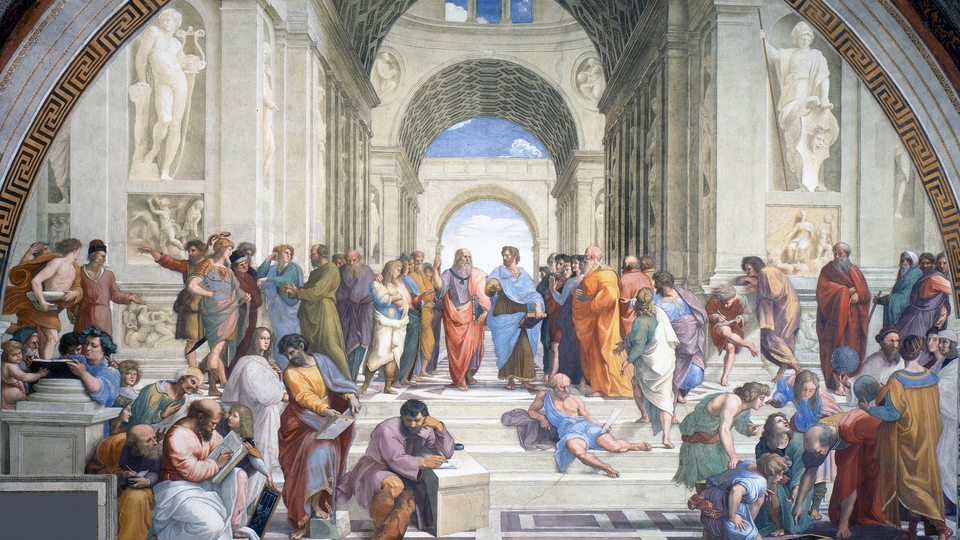
Plato (429–348 BCE) organised his Academy in Athens, where the world of ideas was studied. Mathematics was regarded there as a prerequisite for philosophy. According to legend, an inscription at its entrance read: “Let no one ignorant of geometry enter here.”
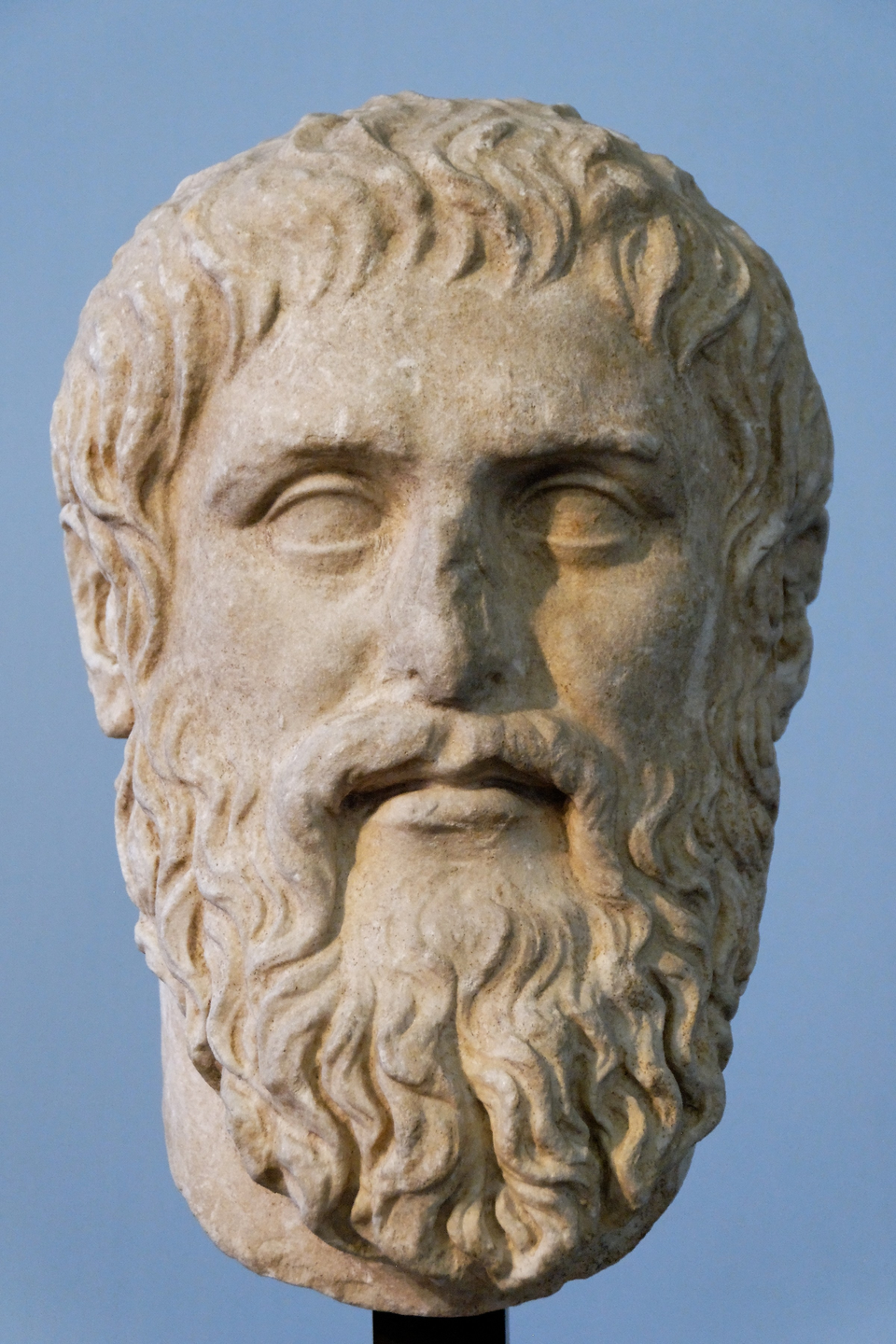

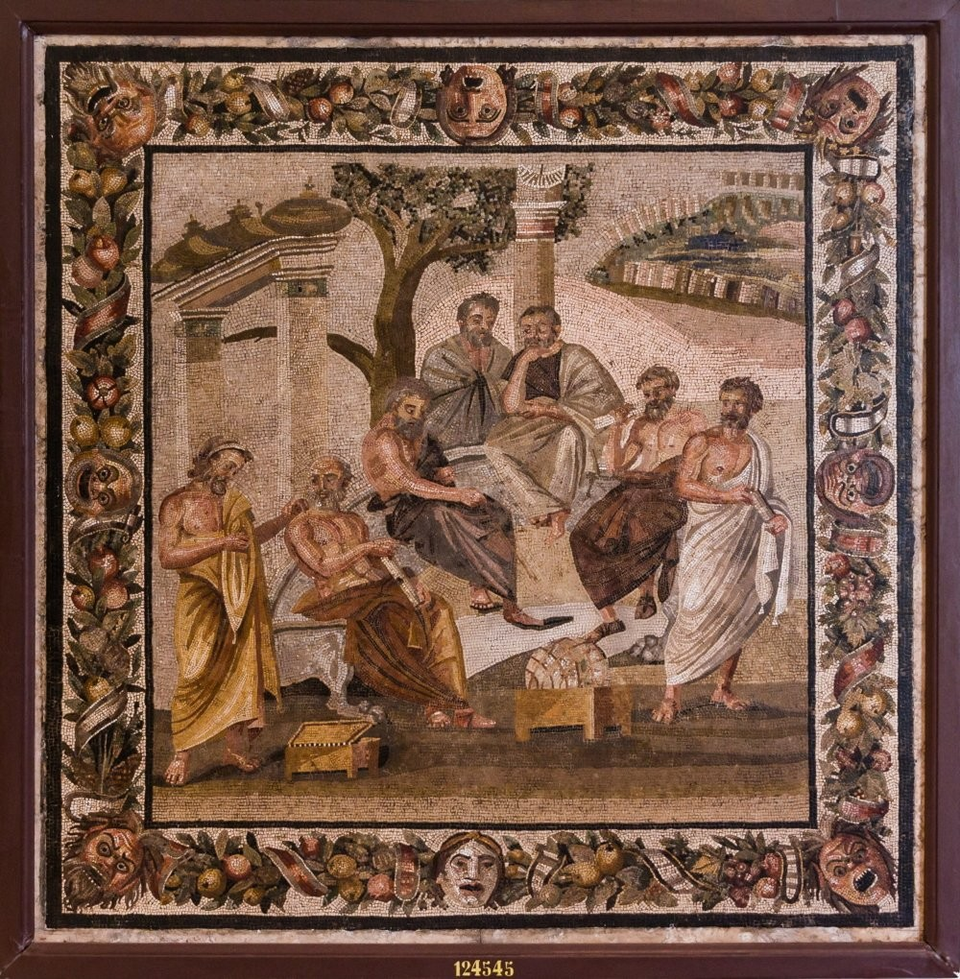

The great artist Raphael, Raffaello Santi (1483–1520), connected the Golden Age of Athens with the Renaissance. His fresco, called The School of Athens only many years after it was painted, depicts Plato’s Academy.
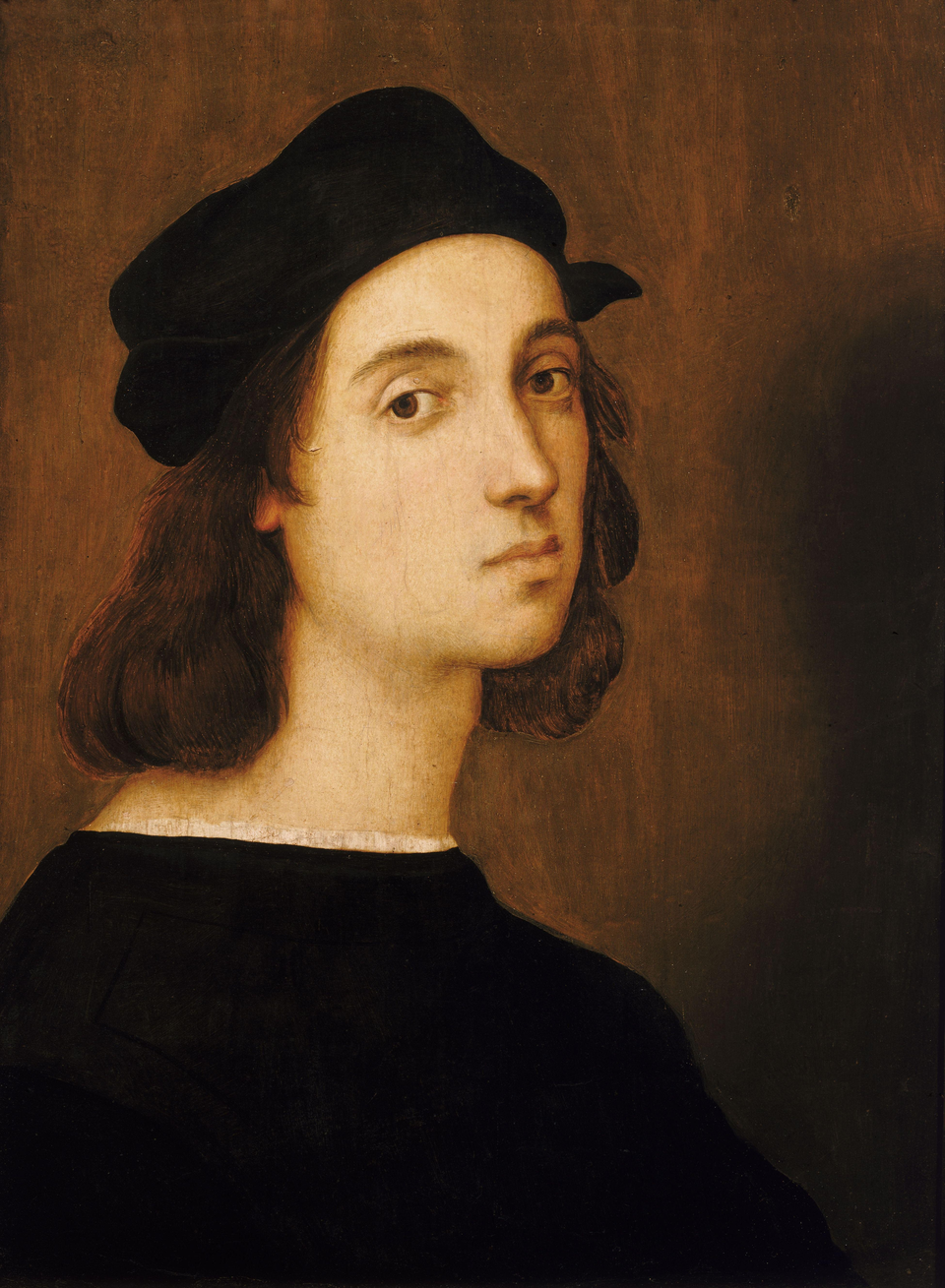

In 1508, Pope Julius II commissioned the 25-year-old Raphael to decorate his private apartments in the Vatican. Between 1508 and 1517, Raphael and his pupils painted four stanze, or rooms, in the Vatican Palace. The best-known fresco cycle is in the pope’s study, the Stanza della Segnatura, or “Room of Signs”.
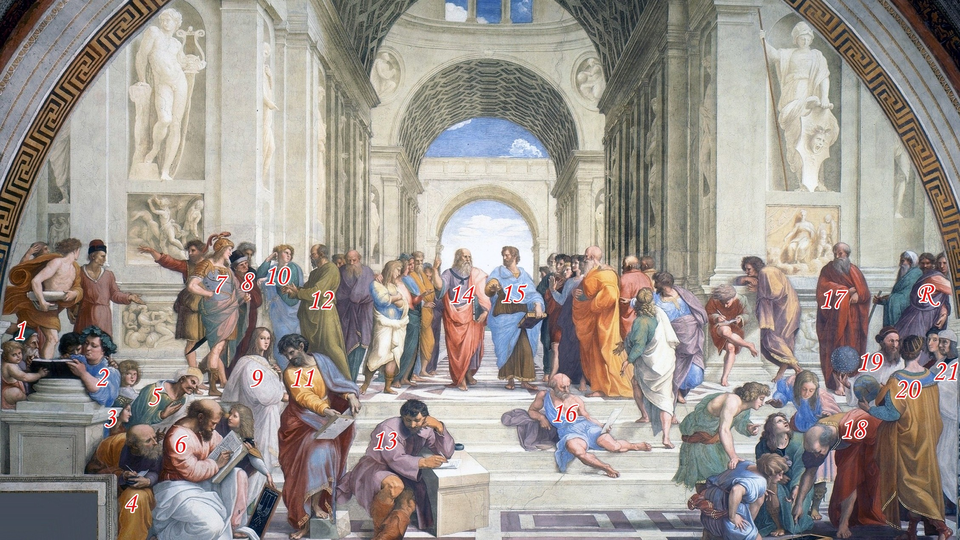
Thus arose the famous School of Athens, a masterpiece that became a manifesto of Renaissance humanism. The painting, measuring 7.7 × 5 metres, depicts 58 ancient philosophers, scholars, writers, poets and statesmen gathered beneath the vaults of an imagined temple of knowledge. They converse with their pupils. Such conversations fostered philosophical and scientific thought.
The composition is a triumph of perspective. The vanishing point coincides with Plato’s and Aristotle’s hands, emphasising their central role. The architecture is inspired by the outstanding architect Donato Bramante’s designs for Saint Peter’s Basilica: arches, domes and niches containing Apollo, god of the arts and patron of the Muses, and Minerva, goddess of wisdom and justice, evoke a synthesis of Christianity and antiquity. To emphasise the figures’ monumentality and importance, Raphael brought them out of the system of direct linear perspective into the foreground. This creates a powerful sense of presence, as though the great ancient philosophers were right beside us.
The figures were given portrait features, allowing people readily to recognise the faces of their contemporaries.
Who is depicted in the fresco?

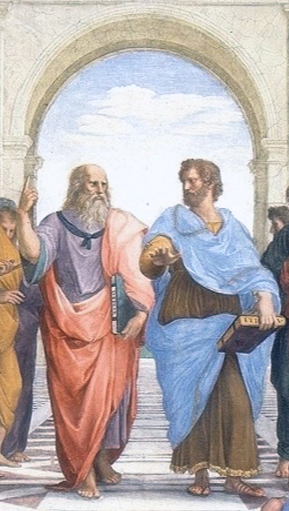
At the centre are Plato (14), pointing a finger towards the heavens, and Aristotle (15), gesturing towards the earth. Their debates about metaphysics and ethics establish the composition’s overall rhythm, reflecting the encounter between two world views. The grey-haired Plato, holding his Timaeus in his left hand, resembles Leonardo da Vinci. His young pupil Aristotle holds his Nicomachean Ethics. Neither can win their debate, for humanity equally needs the boundless cosmos and its native Earth, whose exploration will continue for ever.

The fresco does not portray an actual group of Athenians. Its figures include people who were not Athenian citizens, such as Parmenides and his pupil Zeno, and people who were not contemporaries, but lived in other times and countries: for example, the Persian mystical philosopher Zoroaster, who lived several centuries before Plato, and the Muslim commentator on Aristotle, Averroes, who lived many centuries later. The School of Athens thus represents an ideal community of classical thinkers, a community of teachers and pupils. Some figures cannot be identified, and there is no agreement about others.
Around the central pair are other famous philosophers, each engaged in a dialogue: Zeno of Elea (1), Epicurus (2), Antisthenes (8), Parmenides (11), Socrates (12), Heraclitus (13), who also resembles Michelangelo, Diogenes (16) and Plotinus (17). There is also Anaximander of Miletus (611–546 BCE), perhaps figure (4): an ancient Greek philosopher of the Milesian school of natural philosophy and a pupil of Thales of Miletus.
Who else appears besides philosophers?
Great warriors: Alexander the Great (356–323 BCE), figure (7), who was Aristotle’s pupil. This may instead be Alcibiades (450–404 BCE), a general and politician who studied with Socrates.
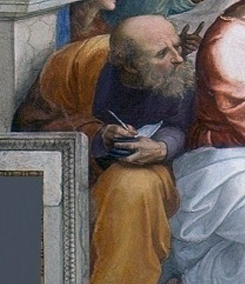
Well-known political and religious figures: Federico II Gonzaga, Duke of Mantua (3); Severinus Boethius (4); Empedocles, possibly also figure (4); and Aeschines (10).
Writers and historians: Xenophon (c. 430–356 BCE), possibly figure (8), an ancient Greek writer and historian of Athenian origin, general and political figure. He profoundly influenced Greek and Roman prose. Strabo (c. 64 BCE – 24 CE), probably figure (19), was an ancient Greco-Roman historian, geographer and philosopher.
Artists: Protogenes (c. 373–299 BCE), figure (21), an ancient Greek artist, master painter and sculptor.
We are chiefly interested in the mathematician-philosophers.
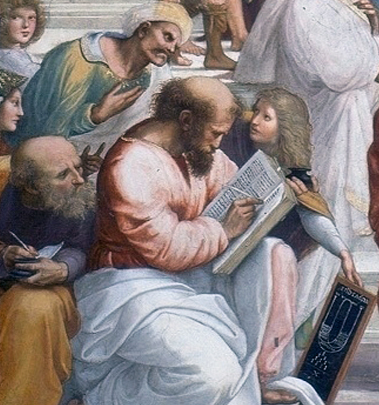
In the foreground, figure (6) is Pythagoras (c. 570–473 BCE), seated with a book and surrounded by pupils. Although well known for his mathematical discoveries, he was also a great philosopher and founder of the Pythagorean religious and philosophical school. He is therefore placed on the idealist Plato’s side.

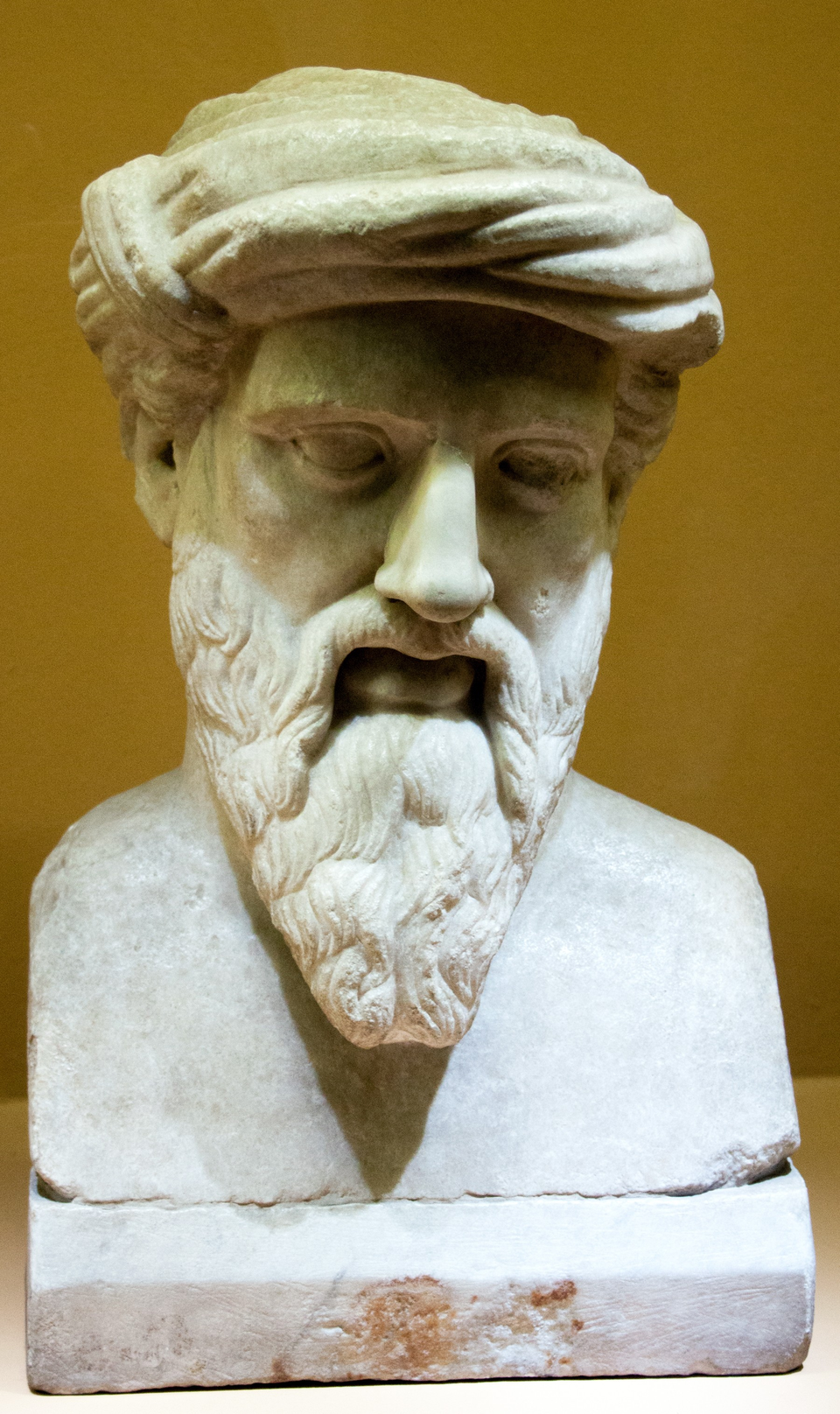

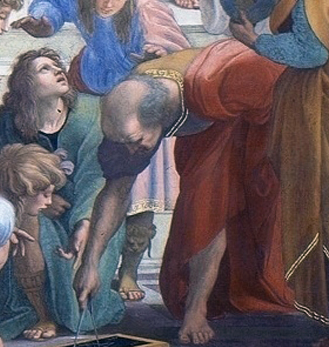
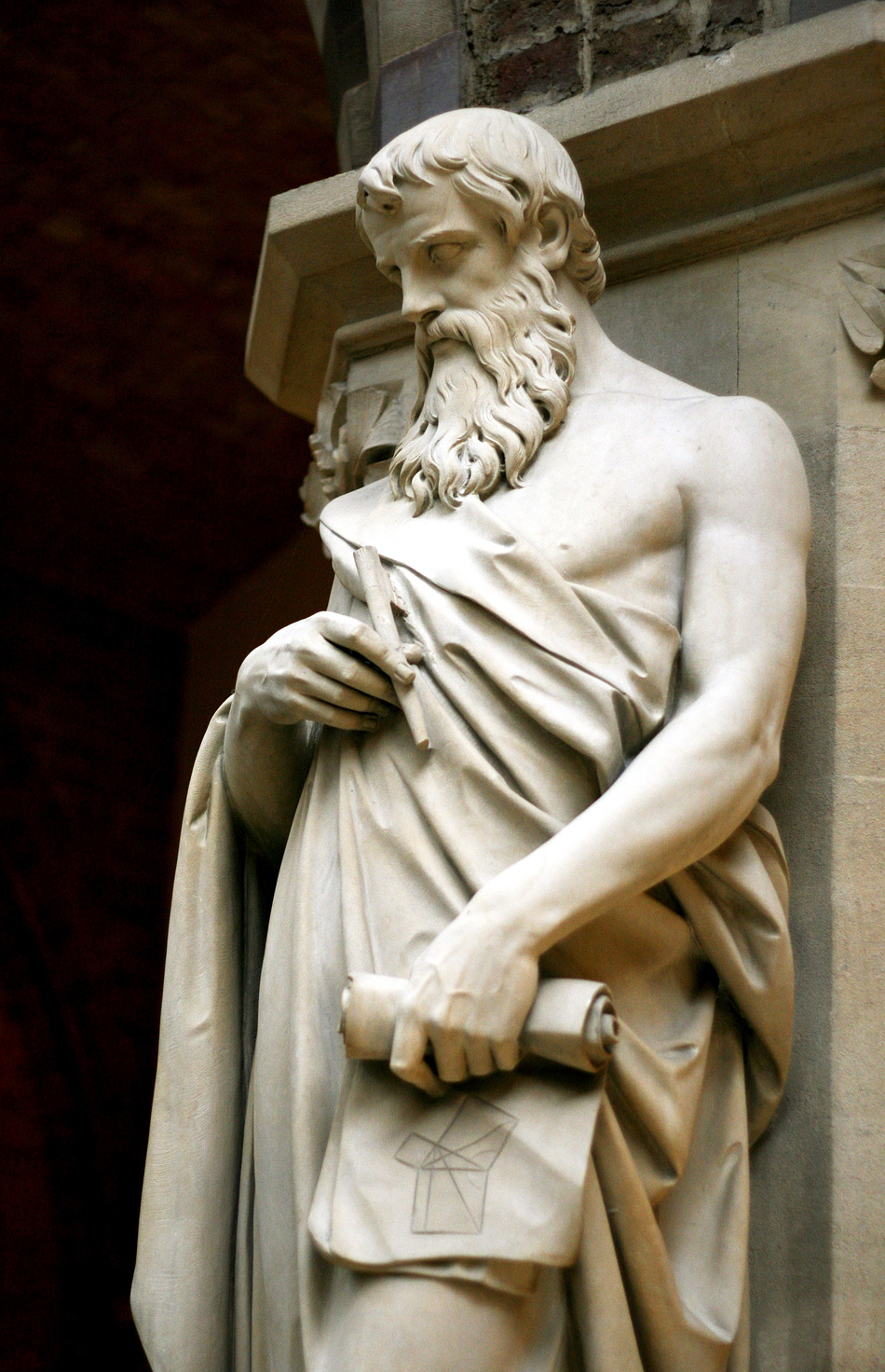
Mirroring Pythagoras on the other side, Euclid (c. 340–287 BCE), figure (18), bends over to draw with a compass. Euclid is known as the “father” of geometry, and his love of theorems with precise answers shows why he represents the Aristotelian side of the School of Athens. Specialists believe Euclid is a portrait of Raphael’s friend, the architect Bramante.


Zeno of Elea (c. 490–430 BCE), figure (1), was an ancient Greek philosopher and pupil of Parmenides, famous for his paradoxes.
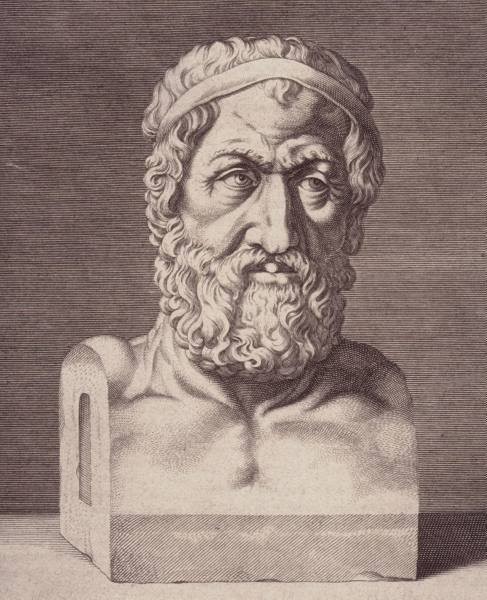

The great mathematician and astronomer Claudius Ptolemy (c. 100–178), figure (20), wears a yellow robe beside Euclid. He stands with his back to the viewer, holding a terrestrial globe.
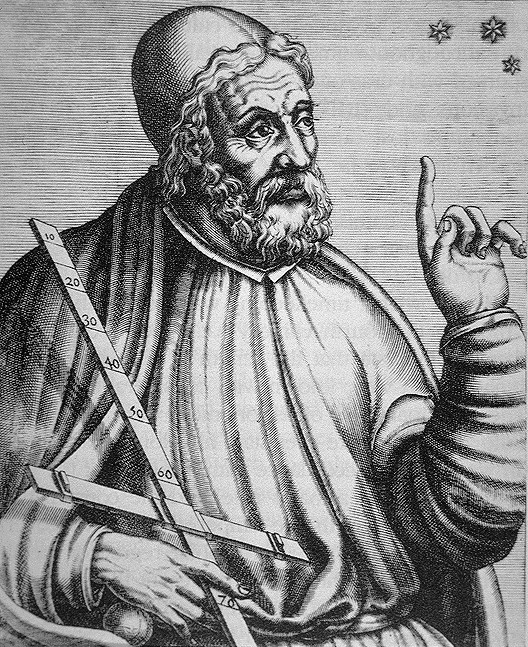

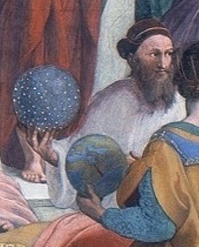
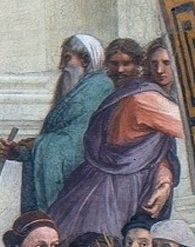
The man facing him with a celestial globe, figure (19), is thought to be the astronomer Zarathustra, or Zoroaster. He may instead be Hipparchus, or, in other interpretations, Strabo.

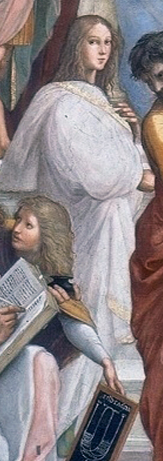
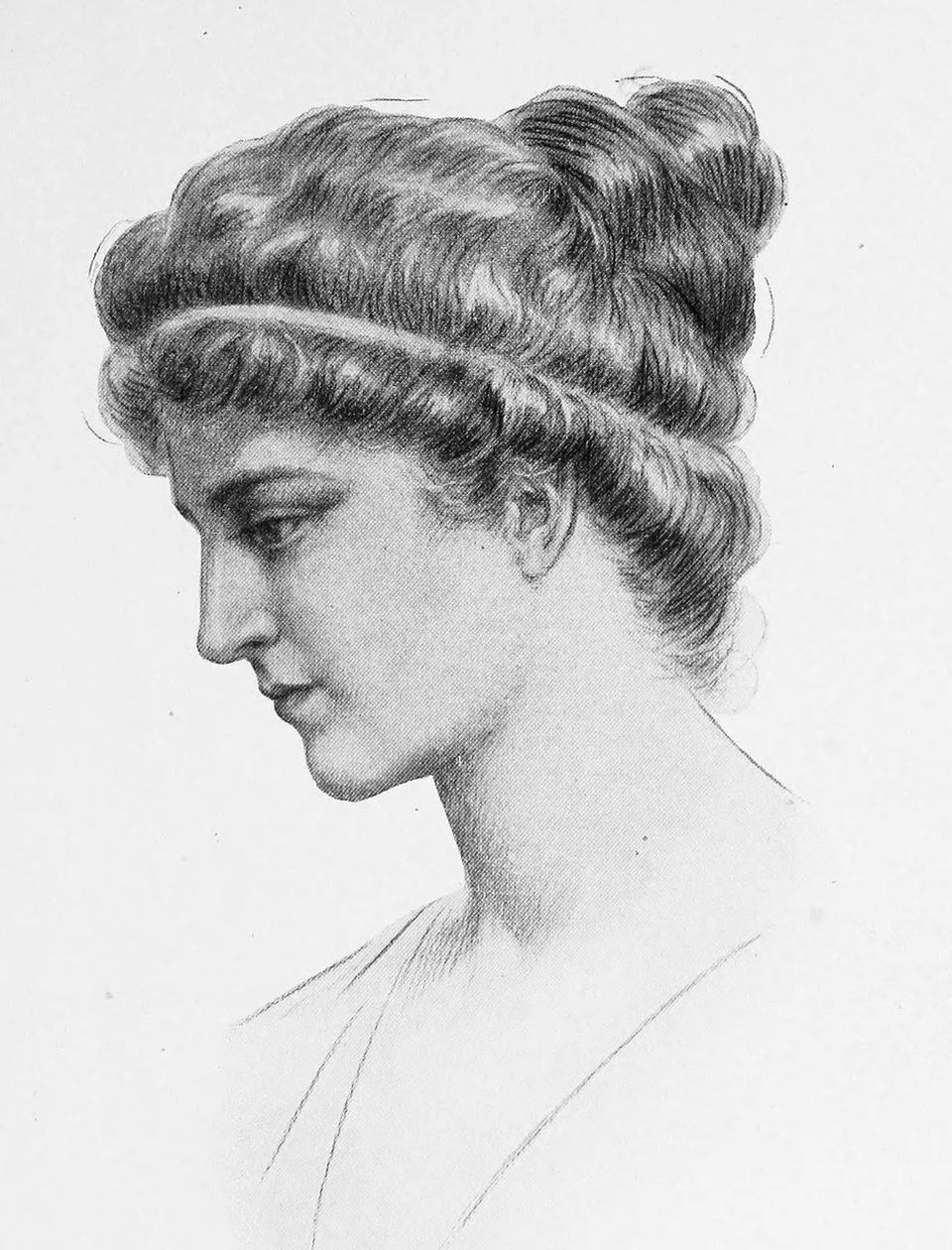
Hypatia of Alexandria (370–415), figure (9), was a philosopher, mathematician and astronomer, and the acknowledged leader of the Neoplatonic school. She is regarded as the first woman mathematician.


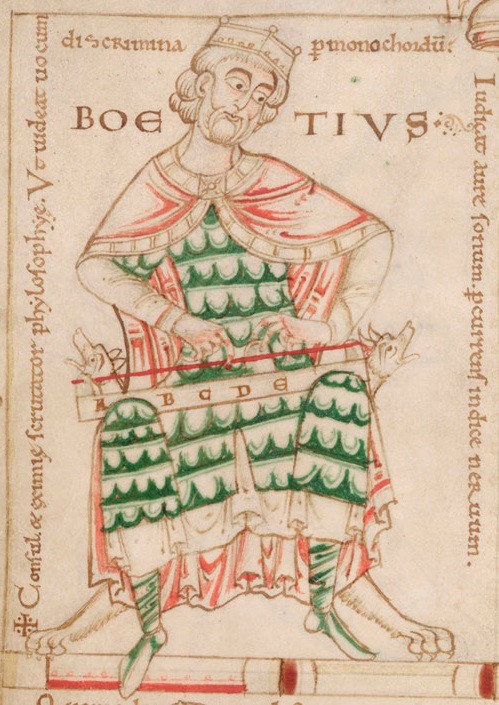
One of the most popular medieval authors on the quadrivium was Severinus Boethius (480–524), figure (4), a statesman and Neoplatonic philosopher. He studied in Athens. His Fundamentals of Arithmetic was a superficial translation of Nicomachus and Euclid, using numerical and geometric examples without proofs.


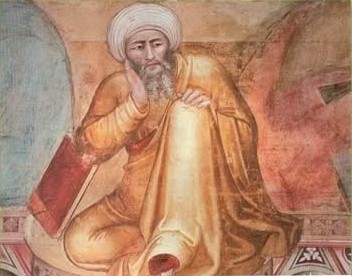
Ibn Rushd (1126–1198), figure (5), also known as Averroes, was an Andalusian mathematician and philosopher. He wrote on logic, Aristotelian and Islamic philosophy, theology, religious law, geography, mathematics, physics, astronomy, celestial mechanics, medicine, psychology and politics.

Who else deserves attention in the fresco?
The young man beside Zoroaster, looking towards the viewer, is Raphael himself (R). Does he take anyone’s side? For Raphael, painting is a philosophy of beauty. In painting, he is both a great idealist and a great realist.

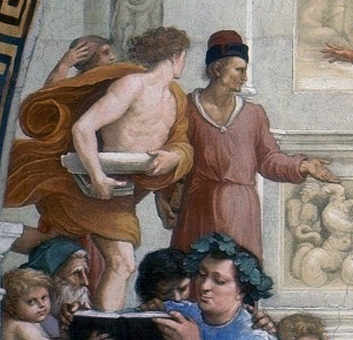
The young man in the far left corner is also remarkable. Holding a scroll and a book, he strides into this gathering of sages. A man beside him points the way, while someone in Socrates’s circle greets him. Perhaps he embodies a bold new idea that will provoke fresh debates and inspire scholars to further inquiry and discovery.

Raphael’s fresco rightly became one of the greatest masterpieces of his work and of all Renaissance painting. Beyond a gallery of portraits, it is a dialogue between past and future, with mathematics forming a bridge between idea and matter.
P. S. We also used a motif from The School of Athens on the cover of The Mathematician’s Bible: Fundamentals of Higher and Linear Algebra, as a symbol of a school and a dialogue between the cultures of teacher and pupil.