Today, let’s explore another art in which mathematics has a part to play: the art of magic. These tricks need no supernatural powers. Their secrets lie in numbers, shapes and their properties.
The American science writer Martin Gardner wrote many books that introduced young readers to recreational mathematics. One of them, published in Russian as Mathematical Puzzles and Diversions, describes a trick with a number matrix.
Look at the five-by-five grid below. Its numbers seem to have been placed at random, yet the grid has a remarkable property.
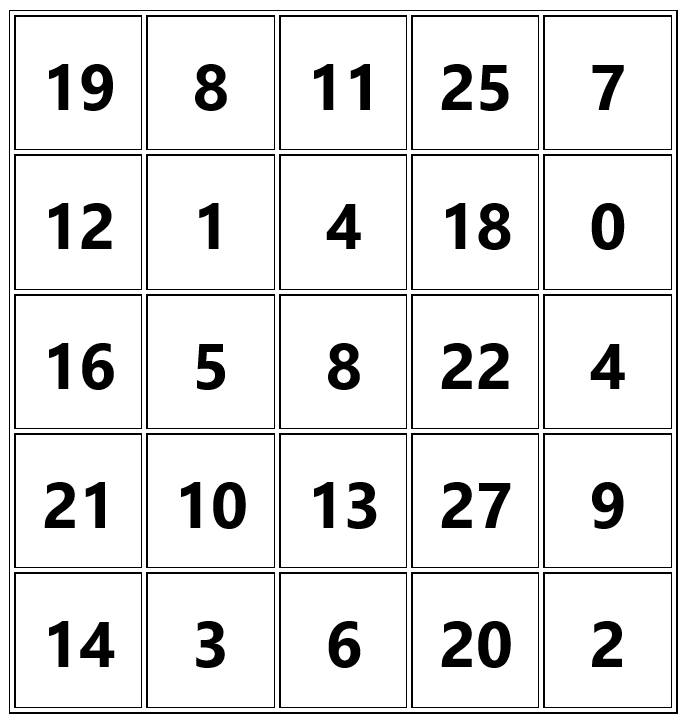
Here is the same matrix as a text table, making it easier to choose numbers and add them up. The header gives the column numbers:
| 1 | 2 | 3 | 4 | 5 |
|---|---|---|---|---|
| 19 | 8 | 11 | 25 | 7 |
| 12 | 1 | 4 | 18 | 0 |
| 16 | 5 | 8 | 22 | 4 |
| 21 | 10 | 13 | 27 | 9 |
| 14 | 3 | 6 | 20 | 2 |
Before you begin, write 57 on a card, seal it in an envelope and give the envelope to a spectator. Announce that you have predicted the sum of the numbers that will be chosen.
You will need five coins and twenty counters. Ask someone to choose any of the twenty-five cells and place a coin on it. Cover every other cell in that row and column with a counter. You can also draw the grid on a board and cross out the unwanted numbers instead.
Ask another person to choose an uncovered number. Mark it with a coin and cover the other uncovered cells in its row and column. Repeat this procedure twice more. Only one cell will remain uncovered: place the fifth coin there.
Now add up the numbers beneath the five coins. Whatever choices your spectators made, the total will be 57. Open the envelope and reveal your prediction!
How it works
The grid is an addition table built from two sets of numbers: 12, 1, 4, 18, 0 and 7, 0, 4, 9, 2. In our example, these form the second row and the fifth column. Together, they add up to 57.
Each cell is the sum of one number from each set. By choosing exactly one cell in every row and every column, you use each number from each set exactly once. That is why the total never changes.
You can build grids of different sizes and arrange for different totals. The zero marks the intersection of the row and column used to construct the grid.
P.S. A little mystery is part of any good magic trick. But if you would like to make a grid of your own, here is the method:
- Choose one row and one column as your starting points. Put 0 where they meet.
- Fill the other cells in that row and column with any numbers you like. In a five-by-five grid, the chosen row and column contain nine distinct cells, including their shared zero.
- Add those numbers together. Their sum is your prediction.
- Fill each remaining cell by adding the number in its column in the chosen row to the number in its row in the chosen column.
The same rule works for larger grids, so you can make your performance even more impressive.
Give it a try and surprise your audience!
Source
Gardner, Martin. Mathematical Puzzles and Diversions (Russian edition). Translated from English by Yu. A. Danilov; edited by Ya. A. Smorodinsky. 2nd edition, revised and expanded. Moscow: Mir, 1999. Chapter 2, “Matrix Tricks”, pp. 21–23, figures 8–9.
Previously published as “Martin Gardner’s Matrix” (Russian original).