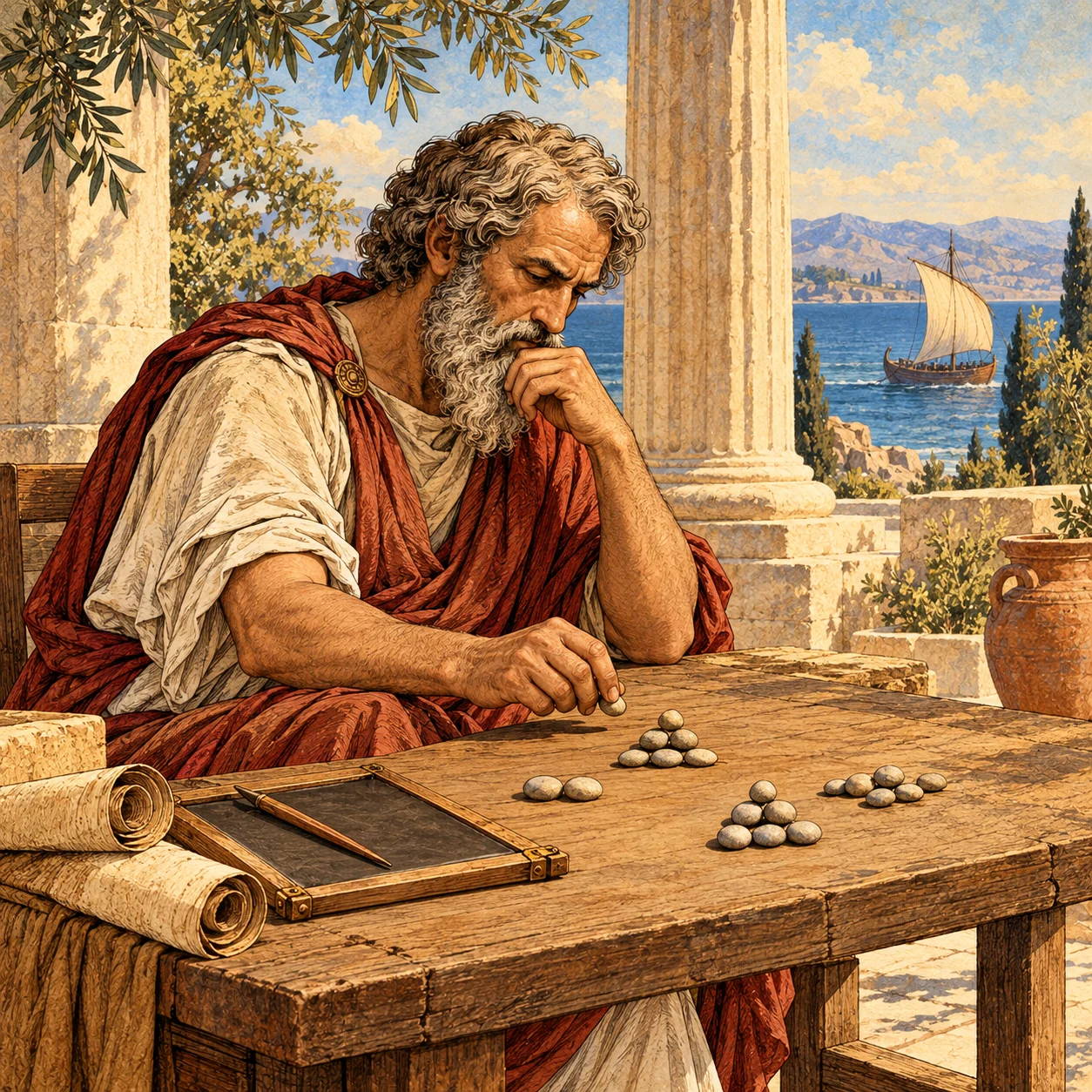
The idea of a perfect number is traditionally traced to the Pythagoreans of the sixth century BCE.
Take all the positive divisors of a number except the number itself: these are its proper divisors. If their sum is smaller than the number, the number is deficient; if larger, it is abundant; if equal, it is perfect. For example, 10 is deficient, 12 is abundant and 6 is perfect:
The Pythagoreans attached special significance to perfect numbers. The question of whether there are infinitely many of them remains open in number theory.
As of 2019, 51 even perfect numbers were known, beginning 6, 28, 496, 8128, … The largest known at that time, 2^{82589932}(2^{82589933}-1), has 49,724,095 digits. Perfect numbers are listed as sequence A000396 in the On-Line Encyclopedia of Integer Sequences (OEIS).
Greek mathematicians, notably Euclid, showed how to construct perfect numbers in the form 2^{n-1}(2^n-1). Whenever (2^n-1) is prime, the resulting number is perfect. A prime of this form is called a Mersenne prime, after Marin Mersenne; its exponent n must also be prime.
Leonhard Euler proved the converse for even perfect numbers: every one of them has Euclid’s form. There is therefore a one-to-one correspondence between even perfect numbers and Mersenne primes. Each Mersenne prime yields one even perfect number, and every even perfect number arises this way. This result is often called the Euclid–Euler theorem. Modern discoveries of Mersenne primes have been made through the Great Internet Mersenne Prime Search (GIMPS), a distributed computing project.
No odd perfect number smaller than 10^{1500} exists. Whether any odd perfect numbers exist at all is unknown.
From the mid-twentieth century onwards, computers made calculations possible on a scale far beyond what could reasonably be done by hand, opening new possibilities in the search for large perfect numbers.
It is striking that the Pythagoreans, so many centuries ago, explored numbers that still pose unanswered questions. Their mystical fascination with numerical perfection also found echoes in the writings of the Church Fathers. Some cultural and religious traditions associated the “perfection” of 6 and 28 with the six days of creation and a traditional 28-day lunar cycle.
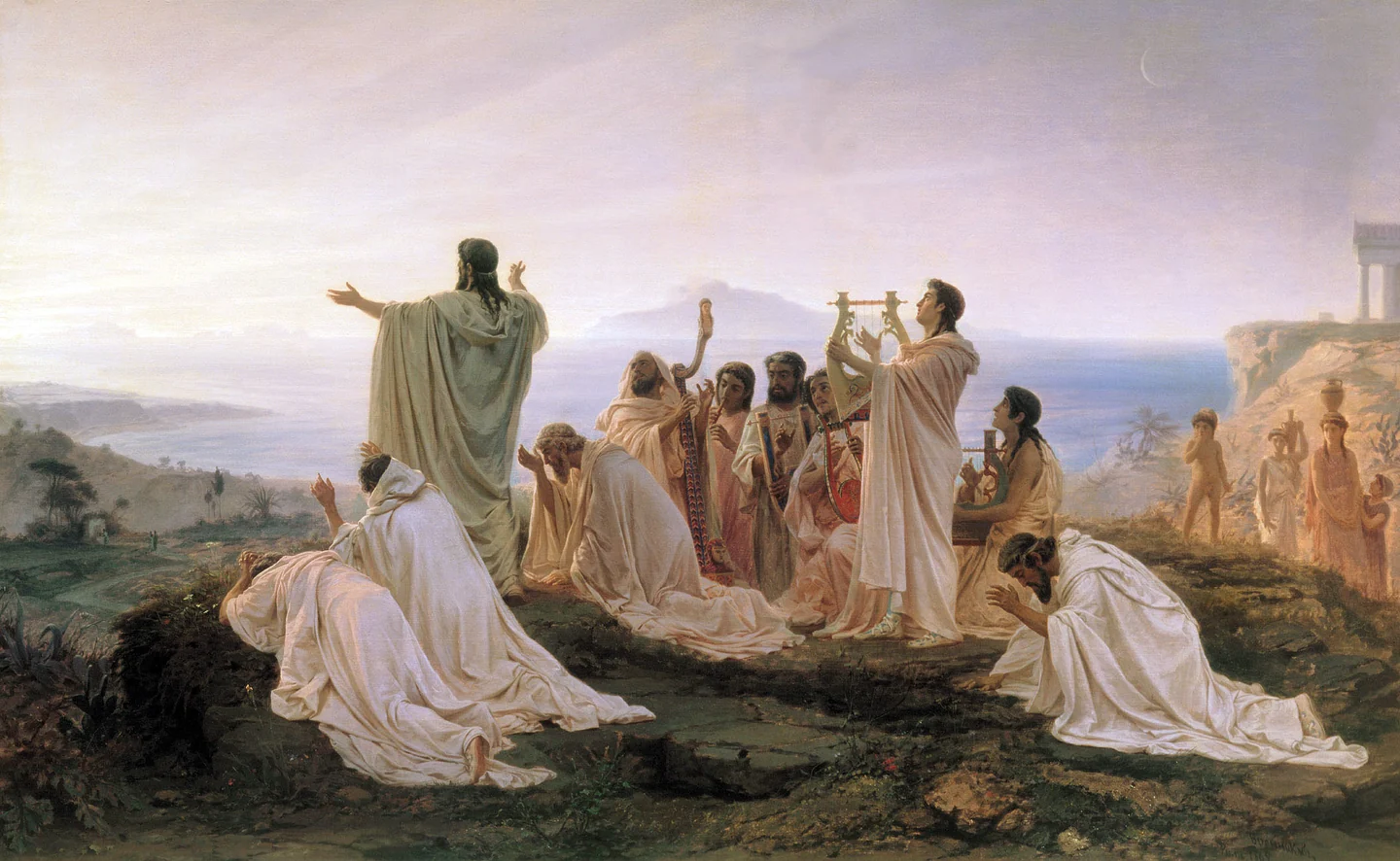

Perfect numbers remain a rich subject for research in number theory.
Read more about perfect numbers and Pythagorean arithmetic in Mansur Gilmullin’s History of Mathematics (in Russian).

Previously published as “Pythagorean Arithmetic: Perfect Numbers” (Russian original).