
Written in 2024 to mark the 290th anniversary of his birth
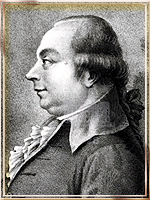
Stepan Yakovlevich Rumovsky was a Russian mathematician, astronomer and educator, a pupil of Euler and one of the first Russian full members of the Academy of Sciences (1767). He helped develop public education and wrote mathematics textbooks for schools.
He was born on 29 October (9 November in the Gregorian calendar) 1734 in the village of Stary Pogost, in Vladimir Province.
Rumovsky began his studies at the Alexander Nevsky Seminary. Mikhail Lomonosov selected him to study at the Academic Gymnasium attached to the Academic University, where his studies began in 1748.1
In 1753 he became an adjunct in astronomy at the Academy of Sciences. The following year he was sent to Berlin to study mathematics with Leonhard Euler. He lived in Euler’s home and returned to St Petersburg in 1756.
From 1760 Rumovsky taught mathematics and astronomy at the Academic University. He became an extraordinary member of the St Petersburg Academy of Sciences in 1763 and a full member in 1767.
Between 1766 and 1803 he headed the Academy’s Geography Department, directed its astronomical observatory, supervised cartographic work and prepared astronomical and meteorological calendars. In 1783 he joined the Russian Academy, a separate institution founded to study the Russian language.2 He served as vice-president of the St Petersburg Academy of Sciences from 1800 to 1803.
Rumovsky played an important part in establishing Kazan University. He was the first trustee of the Kazan Educational District, overseeing its educational institutions from 1803 until his death in 1812. Under his direction, a system of education took shape across Siberia and the eastern part of European Russia, bringing together Kazan University, secondary schools (gymnasiums), and parish and district schools in the district’s major towns. He chose the university’s teaching staff with great care. Within a short time, it became one of Russia’s leading universities and went on to train outstanding mathematicians. In organising its Faculty of Physics and Mathematics, he recruited distinguished professors, including Bartels and Littrow.
His research ranged across astronomy, geodesy, geography, mathematics and physics.
His works in pure mathematics include the memoirs On the Integration of Various Formulas and On Greatest and Least Quantities.
Rumovsky is also known for his textbook Abridged Mathematics (1760).
He was one of the compilers of the first edition of the Dictionary of the Russian Academy, published in six volumes between 1789 and 1794.
Read more about Rumovsky and other notable scholars in Mansur Gilmullin’s History of Mathematics (in Russian).
-
P. G. Kulikovsky, “Rumovsky, Stepan Yakovlevich”, Complete Dictionary of Scientific Biography, dates his move from the seminary to the Academy’s university to 1748. ↩
-
S. Ya. Rumovsky in the Russian Academy of Sciences directory (in Russian); the founding membership of the Russian Academy (in Russian). ↩