
Here is an old French puzzle about three brothers:
Three brothers each have some money. The first gives each of the other two as much money as that brother already has. The second then does the same, giving each of the others as much as each recipient has at that moment. Finally, the third does likewise. All three now have eight écus each. How much money did each brother have to begin with?
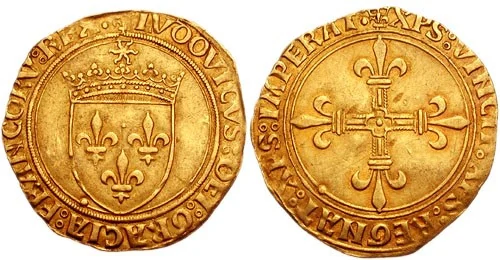
An écu was a French gold or silver coin used in medieval times.
This apparently simple problem has become a classic of recreational mathematics. To solve it using arithmetic, we need to travel backwards through the story, from the end to the beginning.
Solution 1: Working backwards
Start with the final amounts. Reversing each transfer gives the following table; read it from left to right:
| Brother | After the third transfer | After the second transfer | After the first transfer | Initially |
|---|---|---|---|---|
| I | 8 | \frac{8}{2}=4 | \frac{4}{2}=2 | 2+\frac{14}{2}+\frac{8}{2}=13 |
| II | 8 | \frac{8}{2}=4 | 4+\frac{4}{2}+\frac{16}{2}=14 | \frac{14}{2}=7 |
| III | 8 | 8+\frac{8}{2}+\frac{8}{2}=16 | \frac{16}{2}=8 | \frac{8}{2}=4 |
Answer: The brothers started with 13, 7 and 4 écus respectively.
Solution 2: A system of linear equations
Try solving the puzzle yourself before comparing your solution with the algebra below.
Let the brothers’ initial amounts be x, y, z écus.
After the first transfer, their amounts are x-y-z, 2y, 2z.
After the second transfer, they have 2x-2y-2z, -x+3y-z, 4z écus respectively.
The middle expression comes from simplifying 2y-(x-y-z)-2z.
After the third transfer, each brother has eight écus. The first two brothers’ amounts have doubled, while the third has paid them out of his 4z écus:
In the third equation, we subtract the amounts paid to the first two brothers from 4z: these payments are 2x-2y-2z and -x+3y-z.
Solving the three equations gives x=13, y=7, z=4.
Notes
Versions of this puzzle appear in collections of historical and recreational mathematics, including the following Russian editions:
- Bavrin, I. I. A Collection of Mathematical Problems and Entertaining Exercises for Grades 5–9. Moscow: VLADOS, 2013. 236 pp.
- Lucas, Édouard. Mathematical Recreations. St Petersburg: F. Pavlenkov, 1883. 204 pp.
Working backwards remains a useful way of thinking in many settings:
- Computer algorithms: some dynamic programming methods work backwards from a known final state.
- Education: problems of this kind feature in mathematics competitions, encouraging students to look beyond routine methods.
- Puzzle quests: a final result can provide the clue needed to reconstruct the steps that led to it.
Previously published as “An Old French Problem” (Russian original).