


“Farey sequences”, also called Farey series, Farey fractions or a Farey table, form a family of finite subsets of the rational numbers with distinctive and mathematically beautiful properties.
The Farey sequence of order n is the increasing sequence F_n of all nonnegative reduced fractions not exceeding 1 whose denominators are at most n. The fractions \frac{0}{1} and \frac{1}{1} are taken as the first and last elements of F_n.
The fractions are ordered increasingly:
The definition of the set F_n and Farey sequences up to n=5
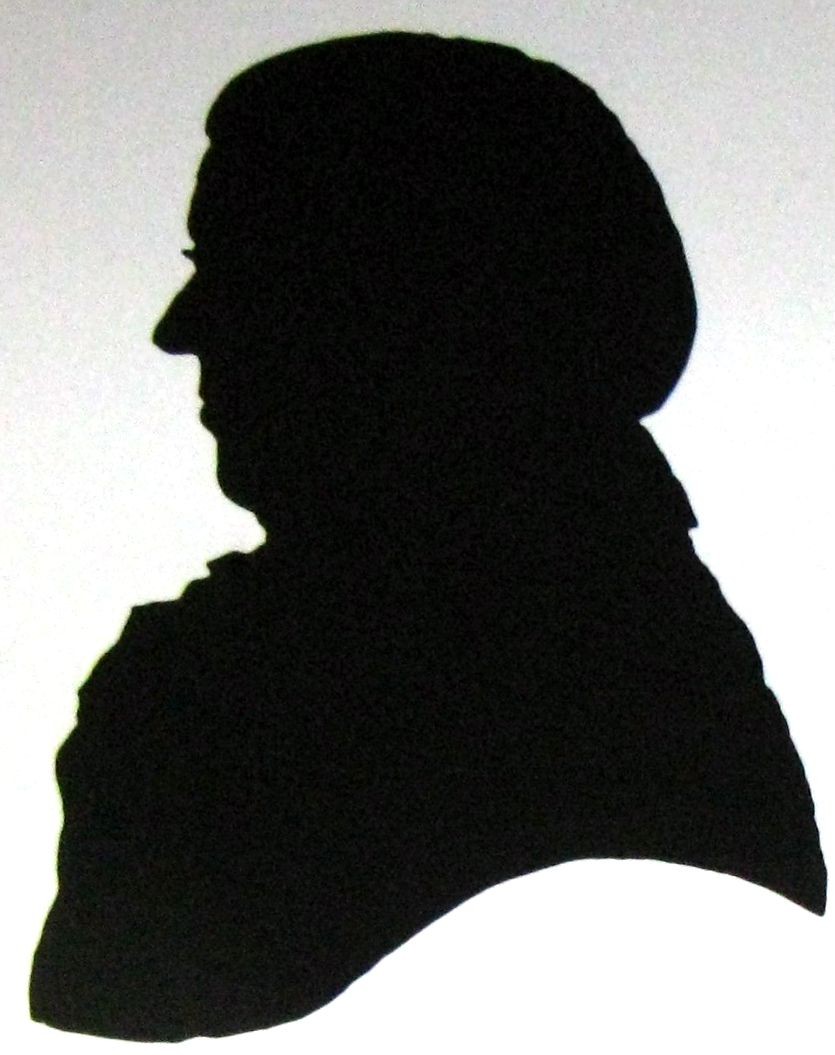
John Farey (1766–1826) was an English geologist and writer, and a pioneer of geophysics. He wrote numerous scientific works on geology, metrology, horticulture and music. His only contribution to mathematics was the fractions named after him, arising from his investigations into the mathematics of sound.
In 1816, Farey published a short article, “On a curious property of vulgar fractions”, in which he defined the sequence F_n.
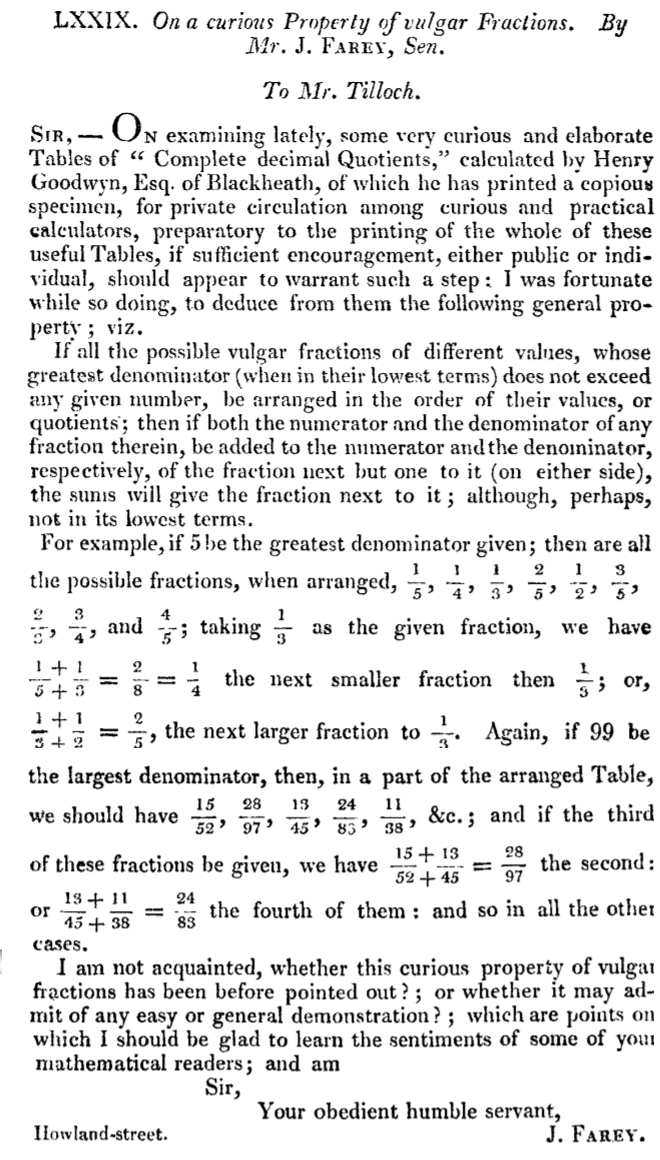

The article came to the attention of the French mathematician Augustin-Louis Cauchy, who published a proof that same year of Farey’s conjecture that each new term in a Farey sequence of order n is the mediant of its neighbours.
A. Ya. Khinchin introduced the concept of the mediant of two fractions in the theory of continued fractions. The mediant of the ordinary fractions \frac{a}{b} and \frac{c}{d} is the ratio of the sum of their numerators to the sum of their denominators: \frac{a+c}{b+d}.
The Farey sequence of order n+1 can be constructed recursively from the sequence of order n using this rule:
- Copy all the terms of the sequence of order n.
- If the sum of the denominators of two neighbouring fractions in the sequence of order n is at most n+1, insert their mediant between them.
Let us do a small experiment to gain some experience with Farey sequences. Here are some exercises:
- Try constructing F_6 yourself.
- Prove that if \frac{a}{b}<\frac{c}{d} are neighbouring fractions in the Farey sequence F_n, then bc-ad=1. The converse also holds: if \frac{a}{b}<\frac{c}{d} satisfy bc-ad=1, then they are neighbouring terms in the Farey sequence F_n with n=\max(b,d).
- The mediant of two fractions has the remarkable property of lying between them. Try proving this.
If \frac{a}{b}<\frac{c}{d}, then \frac{a}{b}<\frac{a+c}{b+d}<\frac{c}{d}. - There are exactly \varphi(n) reduced fractions with denominator n, where \varphi is the well-known Euler totient function from number theory. If L_n denotes the length of F_n, we obtain the recurrence:
L_n=L_{n-1}+\varphi(n).
Farey sequences have many interesting applications, including in mathematics olympiads. Computer science investigates various algorithms for generating all the fractions in F_n. Farey sequences also offer interesting topics for research projects.
__________
Answers
- Answer:
- Proof of the forward implication by induction on n.
For n=1, F_1 consists of the pair \frac{0}{1} and \frac{1}{1}.
Consider the induction step from n to n+1.
Suppose \frac{a}{b}<\frac{c}{d} and bc-ad=1. On passing to the next Farey sequence, the mediant \frac{a+c}{b+d} is inserted between them. We will prove that the required relation also holds for the new pairs.
• The pair \frac{a}{b} and \frac{a+c}{b+d}:
• The pair \frac{a+c}{b+d} and \frac{c}{d}: