
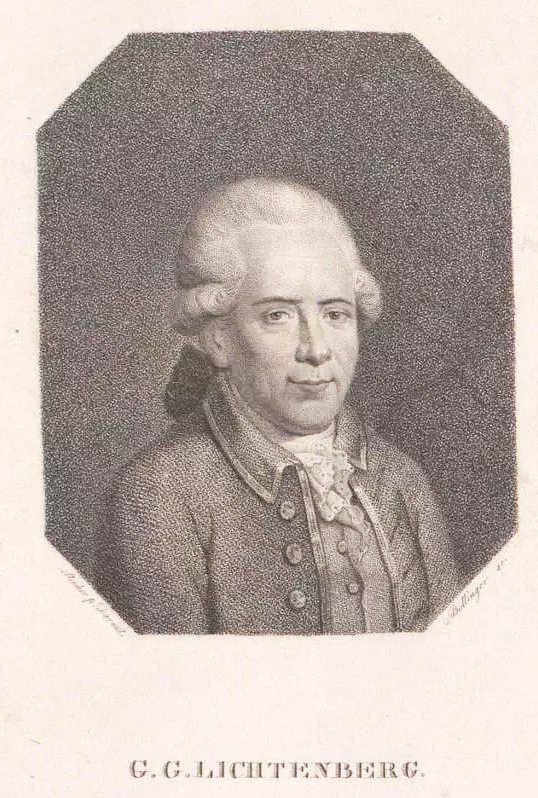

Georg Christoph Lichtenberg (1742–1799) was a German scholar: physicist, astronomer, mathematician, philosopher, publicist and writer. He was professor of physics and astronomy in Göttingen and a foreign honorary member of the St Petersburg Academy of Sciences.
A prominent scholar of the Enlightenment, he introduced the signs “+” and “−” to denote different kinds of electricity. His research greatly facilitated the experiments of later generations of physicists.
How does he relate to this article? Lichtenberg proposed a universal relationship linking the length and width of smaller paper formats to larger ones through similarity. This idea underlies ISO 216, the international metric standard for paper sizes, adopted throughout the world except Canada and the USA.
Functional literacy
Analysis of PISA, PIRLS and TIMSS results — international assessments of pupils’ educational achievement, reading and text comprehension, and the quality of mathematics and science education — shows that lower- and upper-secondary teachers’ professional readiness to develop pupils’ functional literacy does not fully meet the requirements placed on it.
The main areas assessed in international studies of functional literacy are mathematical, reading, scientific and financial literacy, global competencies, and creative and critical thinking.
Today, most leading expert communities have identified a need to develop functional literacy in all learners. This term denotes a person’s ability to engage with their environment and adapt and function within it as quickly as possible.
Researchers usually refer to A. A. Leontyev’s words: “A functionally literate person is someone able to use all the knowledge, abilities and skills continually acquired throughout life to solve the widest possible range of life problems in different spheres of human activity, communication and social relations.”
The principal teaching activities for developing functional, or mathematical, literacy are considered to involve an optimal combination of the curricular content of basic problems with practice-oriented, exploratory, situational and applied problems. When independently designing and implementing tasks to develop mathematical literacy, teachers should bear in mind that these tasks establish relationships between mathematical reasoning and the four processes of the problem-solving cycle: formulating, applying, interpreting and evaluating.
Mathematical literacy
We believe mathematical literacy is the dominant component of functional literacy. This plays an important role in defining the next educational direction: assessing pupils’ readiness to use mathematics in everyday life.
As soon as a problem describes a real or nearly real situation, supplies additional data some of which are not needed, or presents information in different forms such as text, tables or graphs, pupils find solving it substantially more difficult. These are precisely the situations presented in tasks Nos. 1–5 of Russia’s OGE, the Basic State Examination, under the new Federal State Educational Standards for Basic General Education.
For example, the following extract from an OGE assessment paper offers practical problems concerning modern paper formats.
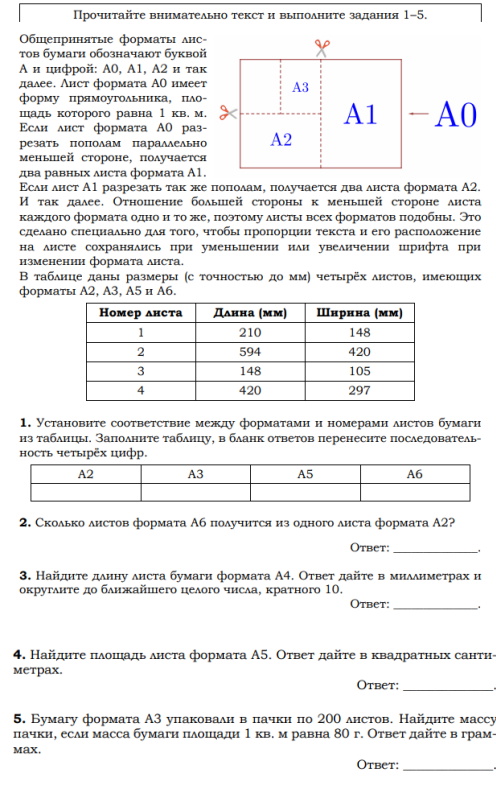

How can these tasks become mathematical-literacy problems?
For example, this situation can be supplemented with tasks from other versions of the examination.
• The size, or height, of a typeface is measured in points. One point equals 1/72 of an inch, or 0,3528 mm. What font height in points is needed for text to be arranged on an АЗ sheet in the same way as the same text printed in a 10-point font on an А4 sheet? Round the font size to an integer.
• Find the ratio of the shorter side of an А2 sheet to its longer side. Give the answer to the nearest tenth.
Meaningful reading in mathematics lessons
Mathematics lessons can also include tasks developing other components of functional literacy, above all meaningful reading skills.
For example, the following information is useful in the context of the paper-format situation being studied. In international classification, the A designation (ISO 216) is most commonly used for paper formats. It has the following features, which can form the basis of a whole investigation or learning project.
1. All the formats have a side ratio of 1:√2, known as the Lichtenberg ratio, approximately 1:1,4142. All these sheets have a remarkable property: they are similar rectangles, with the same length-to-width ratio.
Task. Can you prove that this ratio equals √2? What proportion is used in the calculation?
Answer. The proportion is a/b = b/(a/2). It gives a² = 2b² => a:b = √2.
2. A0 is the basic format, and each successive format is obtained by cutting the previous sheet exactly in half. Cutting an А0 sheet in half gives А1, and so on.
Task. Why do you think this relationship between different paper formats is needed?
Answer. When a sheet with these proportions is halved along its long dimension, the two resulting halves retain the Lichtenberg ratio.
For example, this makes it possible to fit two А4 pages onto one sheet by reducing their length and width by the same factor and converting the original pages to А5. Modern printer settings offer a “print two pages on one” option. This can be very useful for saving paper and toner.
3. The standard is based on the metric system and on a sheet of paper with an area of 1 square metre. Thus, А0 measures 841×1189 mm.
Task. Show the calculations explaining these dimensions.
Answer. 1189/841 ≈ 1.4138, so the Lichtenberg ratio is maintained. 1189×841 = 999949 ≈ 1 million square millimetres = 1 square metre.
4. The area of an А1 sheet is 1/2 square metre, А2 is 1/4 square metre, and so on.
Task. Can you establish how many times smaller the area of an А6 sheet is than that of А0? Find the pattern in the area ratios of different paper formats.
Answer. А1 — 1/2 square metre, А2 — 1/4 square metre, А3 — 1/8 square metre, А4 — 1/16 square metre, А5 — 1/32 square metre, А6 — 1/64 square metre. The pattern is that halving a sheet reduces its area by a factor of 2: A0 = 2A1 = 4A2 = 8A3 = 16A4 = 32A5 = 64A6.
5. √2 = 1,414213562… This number is irrational. For technological purposes, however, paper side lengths must be expressed in whole millimetres. The ratio 297/210 is therefore adopted for А4, equal to 99/70 = 1,4142857… This fraction is very close to √2.
Task. Why is 210 specifically chosen as the width of А4?
Answer. This gives А0 dimensions of 1189 mm and 841 mm respectively, whose product is 999949, very close to a million square millimetres, or 1 square metre.
Completing such tasks requires knowledge and skills from different parts of the lower-secondary mathematics course. They correspond to the topics identified in PISA and to the planned outcomes under Russia’s Federal State Educational Standards for Basic General Education and Model Basic Educational Programme, developed in grades 5–9.
We thus see that all areas of knowledge are interconnected in practice. Every practical problem has a mathematical foundation. Taken together, all this knowledge constitutes functional literacy.