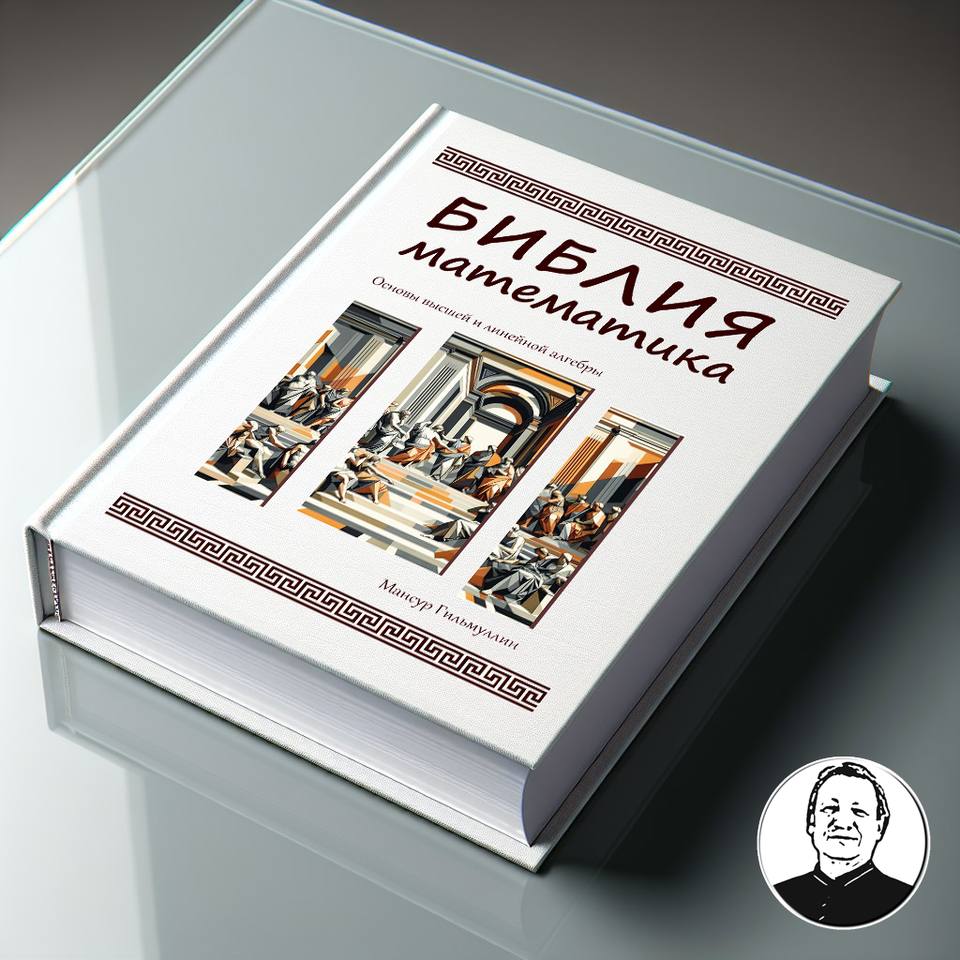

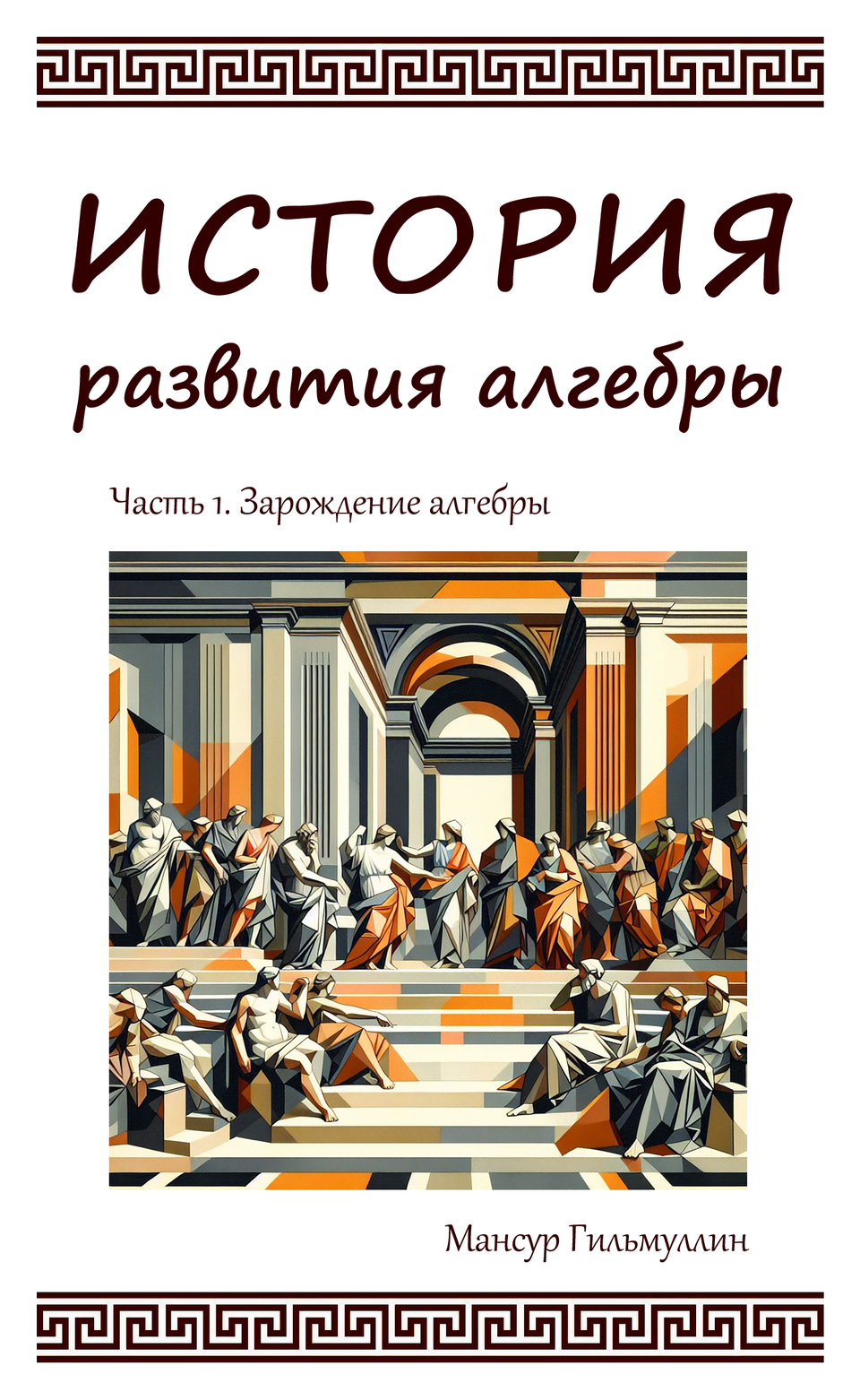

When studying any scientific subject, it is important to bring its history into the discussion. In The Mathematician’s Bible: Foundations of Higher and Linear Algebra, for example, we also supplied relevant historical information for certain algebraic topics. We must acknowledge, however, that nobody can claim to give a complete account of either all of algebra or its richly detailed history.
Should we take an interest in what happened in algebra thousands of years ago and spend time studying its history? We believe it offers examples of extraordinary human achievements and discoveries by the creators of science, valuable to mathematics and to human culture as a whole. Forgetting them would be gross ingratitude.
Many excellent books have been written on the history of mathematics as a science. With this article, we begin a short series on the development of algebra.
Modern algebra curricula and textbooks rarely give its history much attention. Few people know its origins or how its subject is defined. Studying its history, however, helps address many questions of world view and teaching method.
Every schoolchild knows from geometry textbooks, for example, that “geometry” means “land measurement” and that the ancient Greeks first gave it a foundation. Almost nothing is said about algebra’s Arabic roots. Their different origins are nevertheless felt even in school mathematics. Let us state at once that the term “algebra” is associated with Muhammad ibn Musa al-Khwarizmi’s work (787–850, Baghdad), Hisab al-jabr wa-l-muqabala, or The Calculation of Restoration and Balancing. The book became known in Europe through a Latin translation, and al-jabr, “algebra”, came to stand for the whole science, which until the nineteenth century was the science of solving equations. Al-jabr means “restoration”: transferring subtracted terms to the other side of an equation.
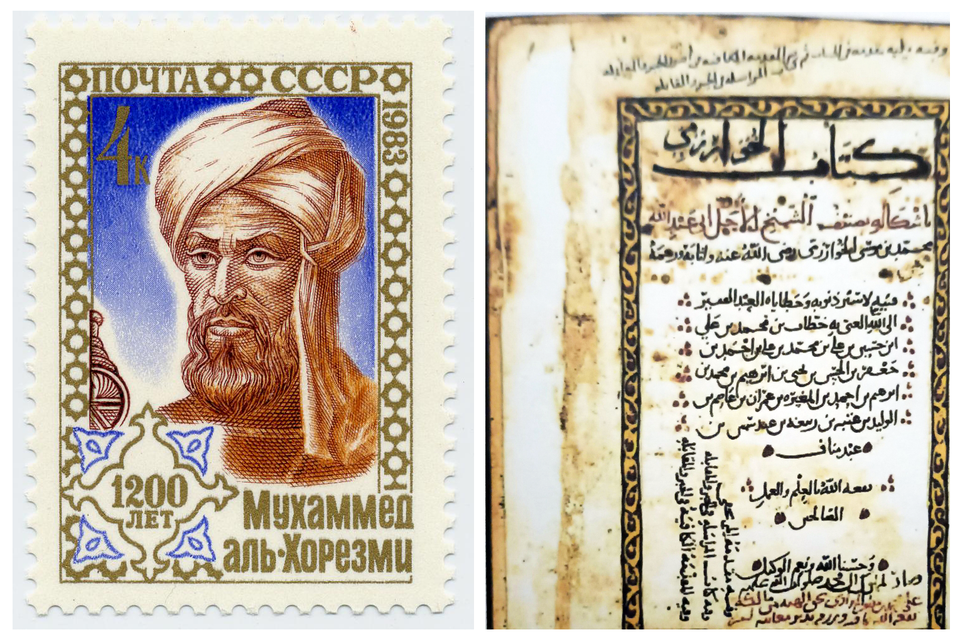

Russian school and university curricula require teachers to give students historical mathematical information and introduce them to the lives and work of outstanding mathematicians. Acquainting students with mathematical history means using historical facts thoughtfully and systematically in teaching, closely intertwining them with the systematic presentation of the entire syllabus.
We can distinguish periods in algebra’s history, each with characteristic features. Periodization makes it easier to understand the wealth of facts in mathematics’ historical development. Algebra’s character and the understanding of its subject changed from age to age. This is connected with the question of what algebra is.
We distinguish three periods:
I. The origins of algebra, up to the third century CE.
II. Elementary algebra, from the third century to the mid-nineteenth century.
III. Modern algebra, from the mid-nineteenth century onward.
Our series will sketch each period, recalling the directions of algebra’s development, its geography and chronology — the chronotope, or time and place of events — and naming its creators. This first article concerns the emergence of algebraic concepts.
I. The origins of algebra
This period extended from the first accumulation of mathematical knowledge to the third century CE, when Diophantus began analysing problems reducible to equations and first used algebraic symbols. Its beginning is lost in the history of mathematics’ emergence in the ancient civilizations of the East. Egyptian, Babylonian and Greek mathematics, in particular, developed algorithms for problems reducible to linear and quadratic equations.
This interval was characterized by the accumulation of factual material for solving such problems. Algebra did not yet exist as a science; only certain elements had appeared.
Ancient Egyptian algebra
Two surviving papyri allow us to judge the state of mathematics in ancient Egypt. Egyptian mathematics changed little after they were written.
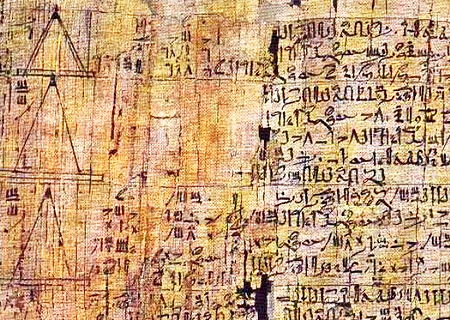
The first is known as the Rhind papyrus or Ahmes papyrus. It is held in the British Museum in London, was found in 1858 and purchased by the Englishman Rhind, and was deciphered in 1870. It is 544 cm long and 33 cm wide and contains 84 problems. Written in the seventeenth century BCE, it also preserves older material.
Its title reads: “Instruction on attaining knowledge of all obscure …, all secrets contained in things. This work was written in year 33, in the fourth month of the season of waters, in the reign of King Ra-a-us. From old manuscripts of the time of King … The scribe Ahmes wrote this.”

The second is called the Moscow papyrus and is held in Moscow’s Pushkin Museum of Fine Arts. It is 550 cm long and 8 cm wide and contains 25 problems. It was written two centuries earlier, purchased in the late nineteenth century by the Orientalist V. S. Golenishchev, and deciphered in 1927 by B. A. Turayev and V. V. Struve.
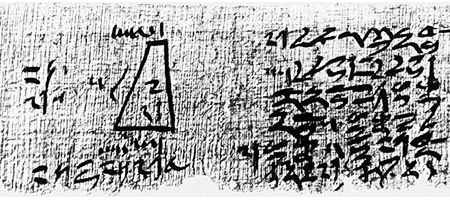

Mathematics in the Egyptian papyri is presented through solutions to practical problems.
Every problem has a strictly practical application: quantities of bread, storage capacity or field areas. The problems are grouped by subject rather than solution method. Each is solved afresh, without explanations, and entirely in numbers.
Numbers themselves and methods of solution were not yet considered separately. Neither justifications nor formulations of rules are given. The solutions are thus presented in an entirely dogmatic manner.
Numbers were written in a decimal system using special signs, hieroglyphs, for each decimal order. The positional principle of notation therefore did not yet exist.
Hieroglyphs originally looked like pictures and retained a resemblance to concrete objects.
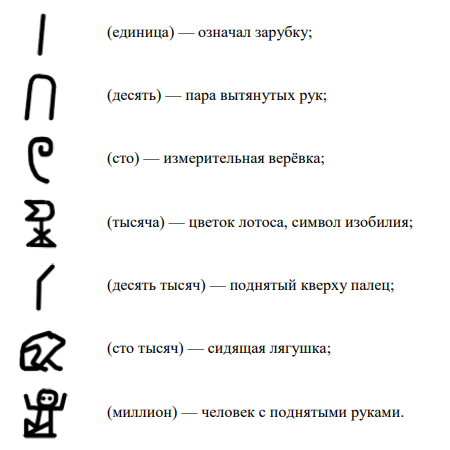

The legend in the illustration reads:
- One: a notch.
- Ten: a pair of outstretched arms.
- One hundred: a measuring rope.
- One thousand: a lotus flower, a symbol of abundance.
- Ten thousand: a finger pointing upward.
- One hundred thousand: a seated frog.
- One million: a person with raised arms.
Each sign was repeated as many times as there were units of its corresponding order in the number. Writing proceeded from right to left, although vertical columns and left-to-right writing were also used, matching the reading direction.
Egyptian arithmetic was chiefly additive: all calculations were reduced to addition.
Multiplication used doubling and addition. To multiply 13 and 11, for example, successive doublings were performed:
1 11
2 22
4 44
8 88
The resulting numbers were then added: 88 + 44 + 11 = 143.
Egyptian arithmetic also used fractions. All fractions were reduced to sums of basic or aliquot fractions, from Latin aliquot, “several”, with numerator one. The only exception was 2/3.
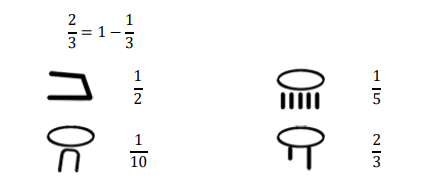

To denote such a fraction, Egyptians wrote the number we now put in the denominator and placed an oval-like hieroglyph above it. Mathematical historians conventionally write n̅ for 1/n.
There is reason to believe that the pyramid builders possessed much geometrical knowledge and skill: equal base angles of an isosceles triangle, an understanding of similar figures, the ability to measure and transfer angles, and the use of a rectangular coordinate grid. Their construction instruments, a triangular level and a simple diopter, support these conclusions.
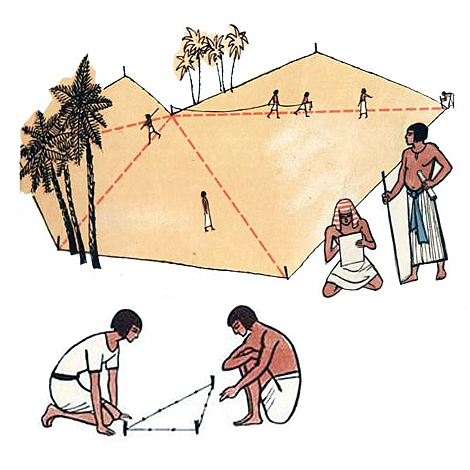
The familiar “Egyptian triangles”, right triangles with side ratios 3:4:5, were used in surveying. A cord with equally spaced knots could mark right angles in land plots. Harpedonapts, from the Greek for “rope-stretchers”, also applied their knowledge in construction. They used the following property: tying 12 knots in a cord — joining its 2 ends and making 11 equally spaced knots between them — produces 12 equal segments. A triangle can then be formed with taut sides of 3, 4 and 5 segments. The angle between the sides of 3 and 4 segments is right. This property rests on the celebrated Pythagorean theorem: the square of the hypotenuse equals the sum of the squares of the legs, 9 + 16 = 25.

The Egyptians also considered problems reducible to linear equations in one unknown. They used a method later named the “rule of false position”. An arbitrary value is chosen for the unknown, taking account of the problem’s numbers and trying to avoid fractions. If the result is not the number required by the problem, the trial “false” value and its component values are corrected proportionally. Here is an ancient Egyptian example.
Problem: “A quantity together with its fourth part gives 15. What is the quantity?”
A traditional solution in the Egyptian manner:
“Begin with 4. You obtain 5. Divide 15 by 5. Multiply the result by 4.”
Some problems also seek an abstract number unconnected with particular objects. It is denoted by a special hieroglyph meaning “heap”, read hau or aha. Egyptian algebra is therefore sometimes called “hau-calculus”.
Thus the practical mathematics of ancient Egypt contains some elements of classical elementary mathematics.
Scientific research and the training of scribes took place in “Houses of Life”, established at temples and containing libraries. The educational system included a fairly deep study of mathematics.
After Alexander the Great’s conquest of Egypt, Greek and Egyptian cultures began to merge.
Ancient Greek algebra
The central subject of Pythagorean mathematics was number, understood as a collection of units. Numbers underlie the world’s order: “All is number,” as the Pythagoreans said. Their arithmetic concerned properties of natural numbers: parity and classifications such as figurate, perfect and amicable numbers, and Pythagorean triples. They studied arithmetic, geometric and harmonic proportions and the means derived from them. Their fields were astronomy, geometry, harmonics or music theory, and arithmetic or number theory. Today, we cannot separate Pythagoras’ own work from that of his pupils. Ancient Greek algebra is therefore often discussed as Pythagorean mathematics.
Pythagoras (c. 570–473 BCE) is the most popular scholar in human history. Tradition attributes mathematics’ fundamental transformation to him. Just as Newton determined the development of science over the past four centuries, Pythagoras set humanity on the path of the triumph of Reason 2500 years ago. He was a great philosopher, comparable with his contemporaries Confucius, Buddha and Zoroaster.
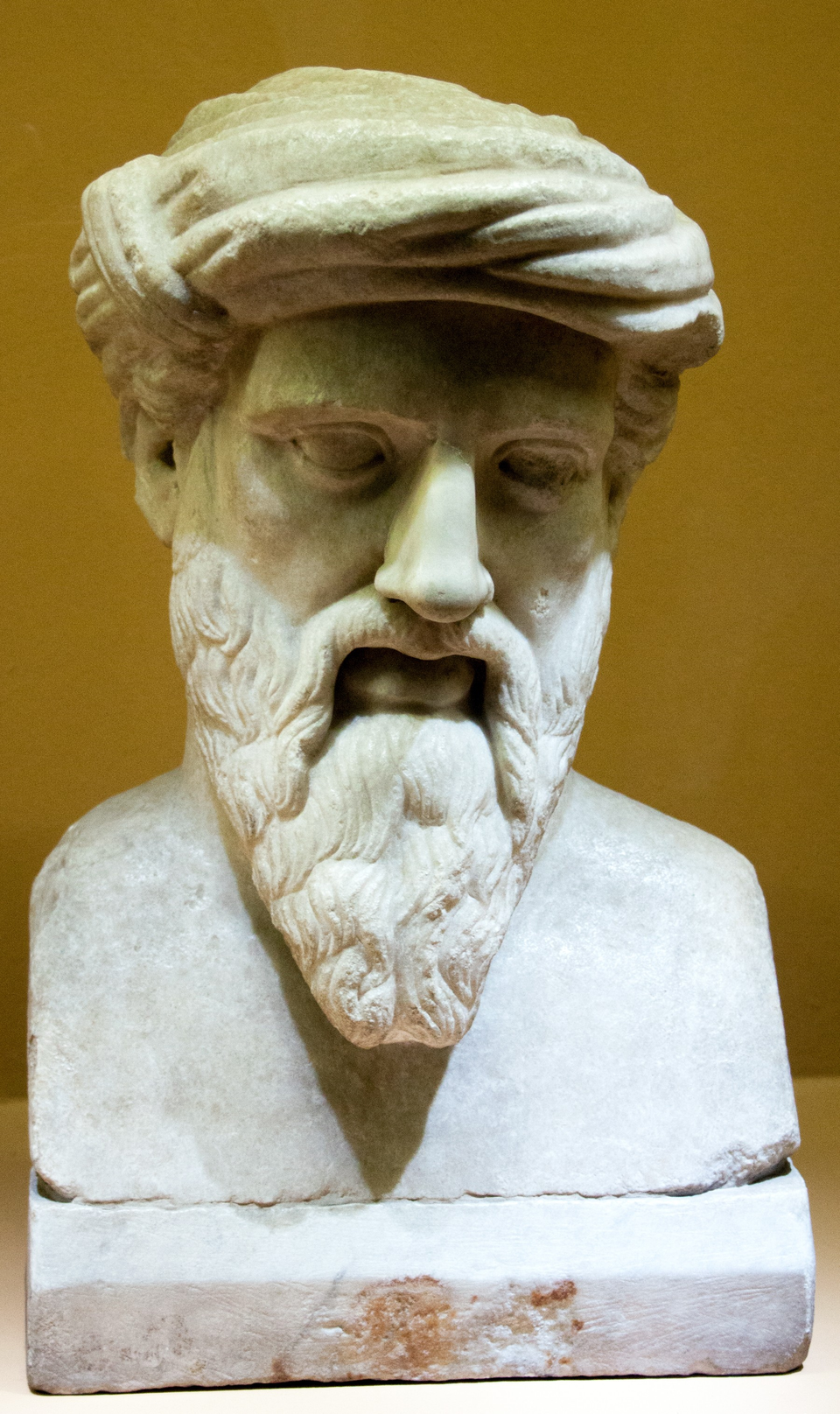

The Pythagorean brotherhood was a scientific school resembling a secret society. Members were bound by strict obligations, including keeping all achievements secret and attributing every result to the teacher. Newcomers vowed silence for three years and during that time could listen to the teacher only from behind a curtain. Women were among the pupils, notably Pythagoras’ wife Theano. Much of his life and work was mystical, including his mathematics: “Harmony is divine and consists in numerical relations. Whoever fully studies numerical harmony will become immortal. Number is the measure of things underlying existence, the cause of harmony and order.”
In the sixth–fifth centuries BCE, the axiomatic method of constructing science arose in Pythagoras’ school. Tradition credits him with the first proof of the theorem on the sum of a triangle’s interior angles. He is also commonly credited with the first proof of the best-known geometric theorem, which now bears his name.
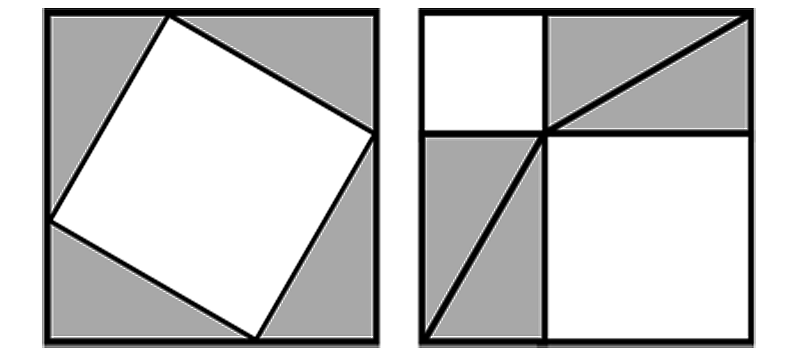
It states: “The square constructed on the hypotenuse of a right triangle is equal in area to the sum of the squares constructed on its legs.” It is the most significant theorem, simple and beautiful in its formulation.
Pythagoras’ proof is surrounded by legends. He is said, for instance, to have sacrificed a hundred oxen to the gods for discovering this truth. This is unlikely: Cicero already observed that any bloodshed was foreign to the Pythagorean order’s rules. In Euclid, the theorem is called the “nymph’s theorem”, because the diagram resembles a butterfly, or nymph. Since “nymph” also means a goddess or bride, the Arabs called it the “bride’s theorem”.
There are many other proofs: geometric, algebraic, mechanical and trigonometric. Pythagoras’ own proof has not survived. Of interest is a proof in the Indian spirit, due to Bhaskara II in the twelfth century.

The discovery of incommensurability — quantities whose ratio cannot be expressed through integers — and irrationality caused the first crisis in mathematics, prompting Greek mathematicians to seek a way out. They began building mathematics on geometry rather than the arithmetic of rational numbers. “Geometric algebra” emerged, based on plane geometry and suited to solving quadratic equations. Every rule and problem was formulated in terms of relationships between segment lengths and the areas of figures bounded by straight lines.
For example, the algebraic rules of distributivity and the square of a sum were derived geometrically. These problems connected the algebra of equations with compass-and-straightedge constructions. Along this path arose antiquity’s three famous classical problems: doubling the cube, trisecting an angle and squaring the circle. They raised new mathematical questions and were finally resolved by algebraic methods only in the nineteenth century. One of them is the construction of regular polygons. Some works of Euclid, Archimedes and Apollonius concern geometric algebra.
Diophantus’ work brought the transition to algebra based on arithmetic. Diophantus of Alexandria (c. 200–284), the last of antiquity’s great mathematicians, was a founder of algebra. He lived and worked in Alexandria. Almost nothing is known about his life, a mystery in scientific history. His mathematical work is unexpected both in its problems and in its methods. His principal work, Arithmetica, in 13 books, marks the beginning of symbolic algebra; only 6 books have reached us.
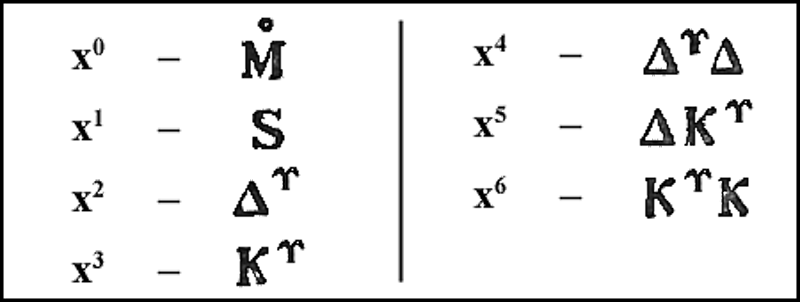
Ancient algebra reached its highest flowering in Diophantus. He first introduced letter symbols for an unknown and its powers up to the sixth. He called the unknown “number”, its second power “square” and its third “cube”. He introduced notation for reciprocals, a symbol for a negative number and for equality, and abbreviated words. He formulated and solved problems reducible to indeterminate equations and systems solved in positive integers. Such equations are now called Diophantine equations.

Diophantus’ writings were the starting point for number-theoretic investigations by Pierre de Fermat, Leonhard Euler, Carl Friedrich Gauss and other mathematicians.
We closely connect number theory and its history with algebra. Algebraic methods arose directly from numerical problems. Euclid’s Elements contains number-theoretic studies: divisibility, the greatest-common-divisor algorithm and the infinitude of primes. Greek mathematics gave us the sieve of Eratosthenes, Diophantus’ indeterminate equations and Pythagorean triples.
Here we conclude the origins of algebra. The next article will discuss the period of elementary algebra.