

A school pupil’s mathematical “prayer”: “The logarithm of a number b to base a is the exponent to which the base a must be raised to obtain b.”
Logarithms have distinctive properties that account for their wide use both in simplifying laborious practical calculations and in scientific research.
For example, their properties imply that instead of multiplying numbers with many digits, one need only look up and add their logarithms, then use an antilogarithm table to exponentiate: find the result from its logarithm. Division differs only in that the logarithms are subtracted.
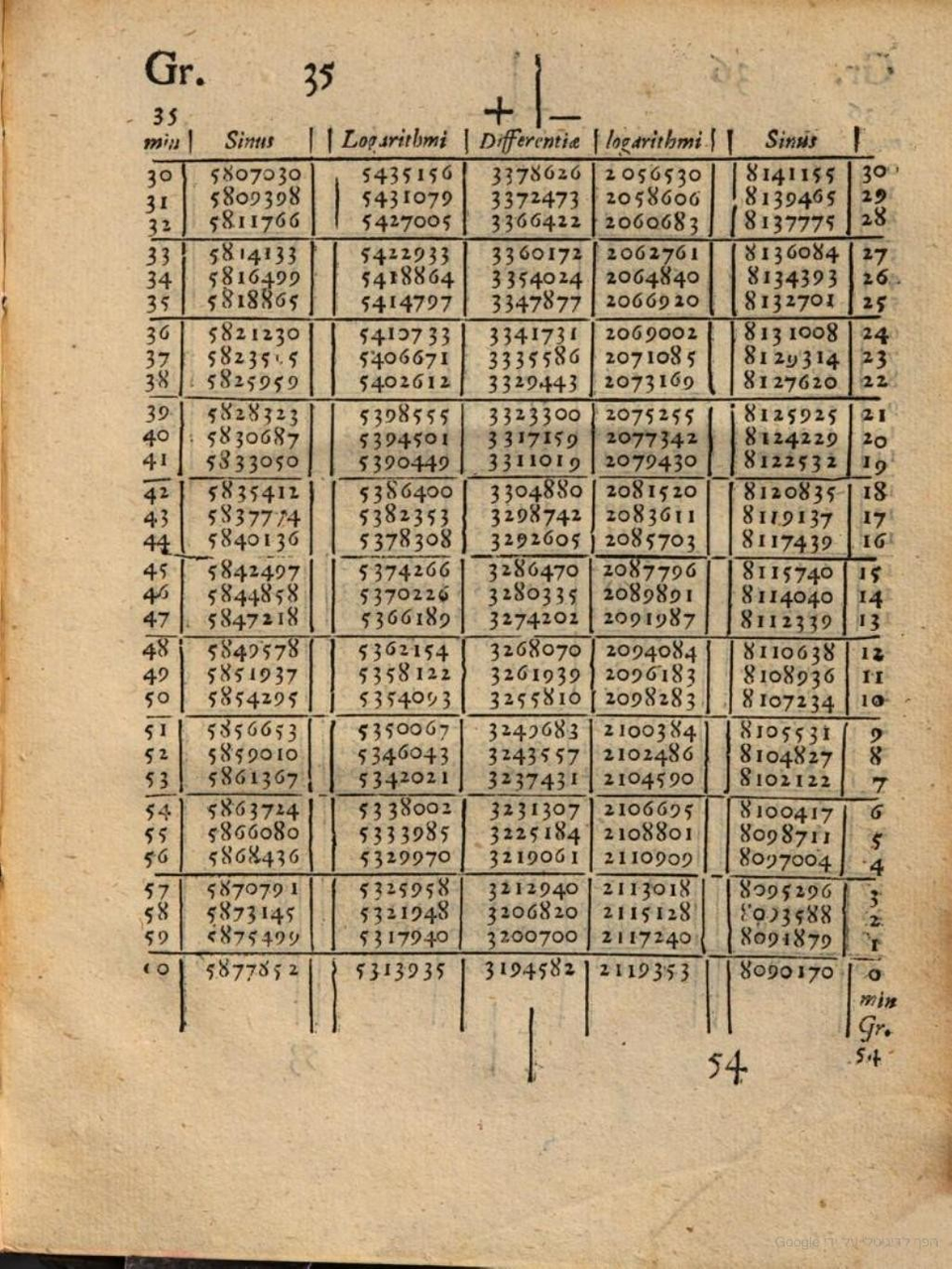
Logarithm tables
For more than three centuries, until the 19th century, logarithm tables were the principal means of scientific and engineering calculation. In the 20th century they were displaced by slide rules, arithmometers, and then calculators and computers.
The Scottish mathematician John Napier published the first logarithm tables in 1614 in A Description of the Admirable Table of Logarithms (Latin Mirifici Logarithmorum Canonis Descriptio). His central idea was to construct two sequences of numbers related so that, as one increased in arithmetic progression, the other decreased in geometric progression. The product of two numbers in the second sequence then depended simply on the sum of the corresponding numbers in the first, allowing multiplication to be reduced to addition.


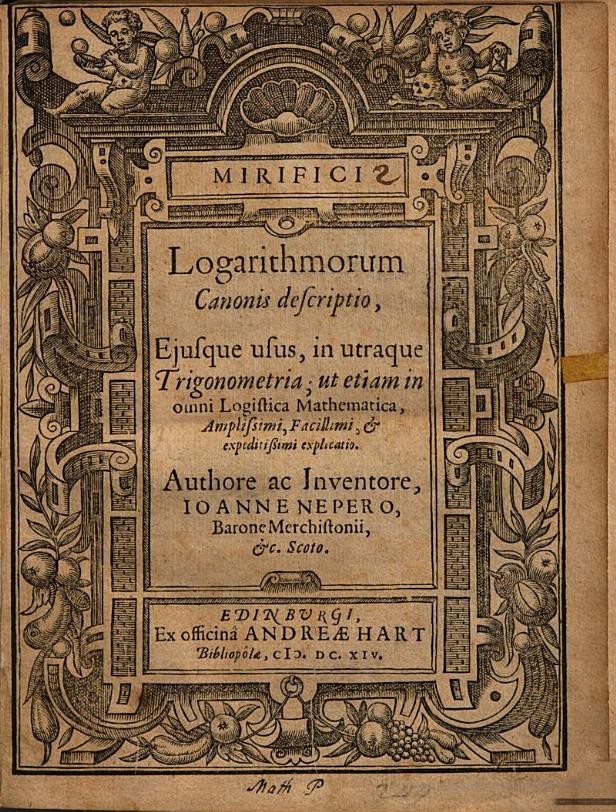

Because they served particular purposes, his tables contained logarithms of trigonometric quantities. Napier did not introduce the concept of a logarithm’s base. His proposed term “logarithm” became established in science, from Ancient Greek λόγος, “ratio”, and ἀριθμός, “number”.
Johannes Kepler included an enthusiastic dedication to Napier in an astronomical handbook he published in 1620. Logarithms enabled Kepler to complete relatively quickly his many years of work compiling the Rudolphine Tables, which consolidated the success of heliocentric astronomy.
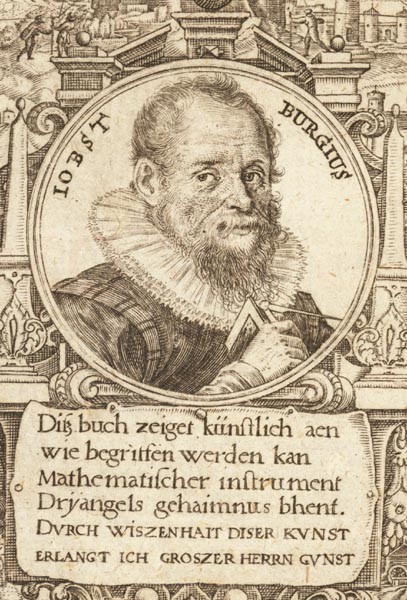
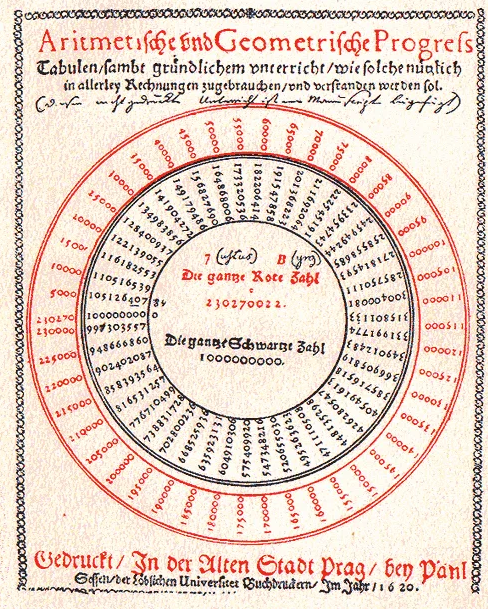
The Swiss mathematician Jost Bürgi published tables similar to Napier’s in 1620. They were the first antilogarithm table. Tables at that time were compiled using the property that numbers in a geometric progression have logarithms in an arithmetic progression. The cover of Bürgi’s collection accordingly reads “Arithmetic and Geometric Progressions”.


In 1617 the Oxford mathematics professor Henry Briggs published (1624) Arithmetica logarithmica, or Logarithmic Arithmetic, containing 8-digit common-logarithm tables for the first thousand numbers, followed by 14-digit tables for numbers from 1 to 20000 and from 90000 to 100000. Common logarithms are sometimes called Briggsian logarithms after him.
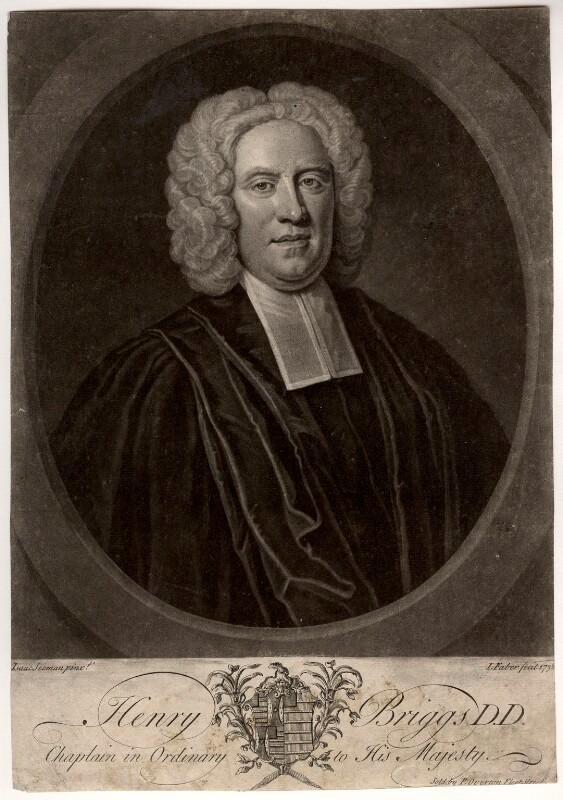

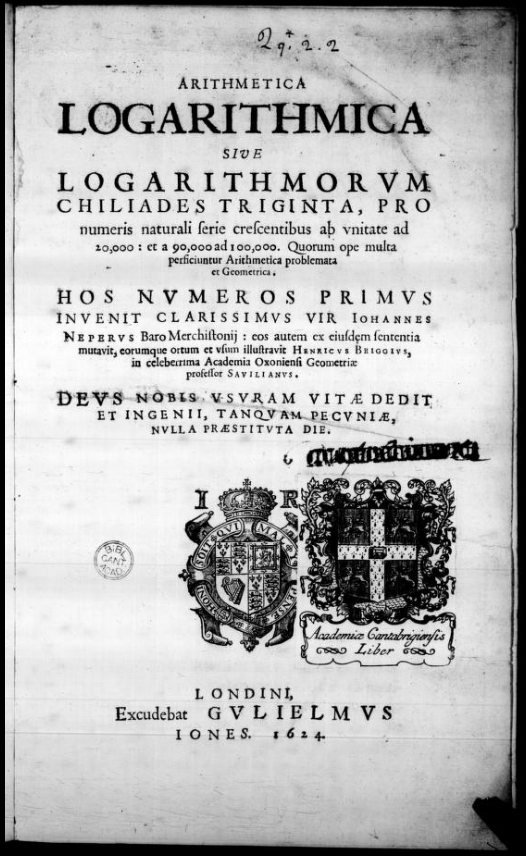

The Dutch mathematician Adriaan Vlacq published a second edition of Briggs’ 10-digit tables in 1628, supplying the missing numbers from 20000 to 90000.
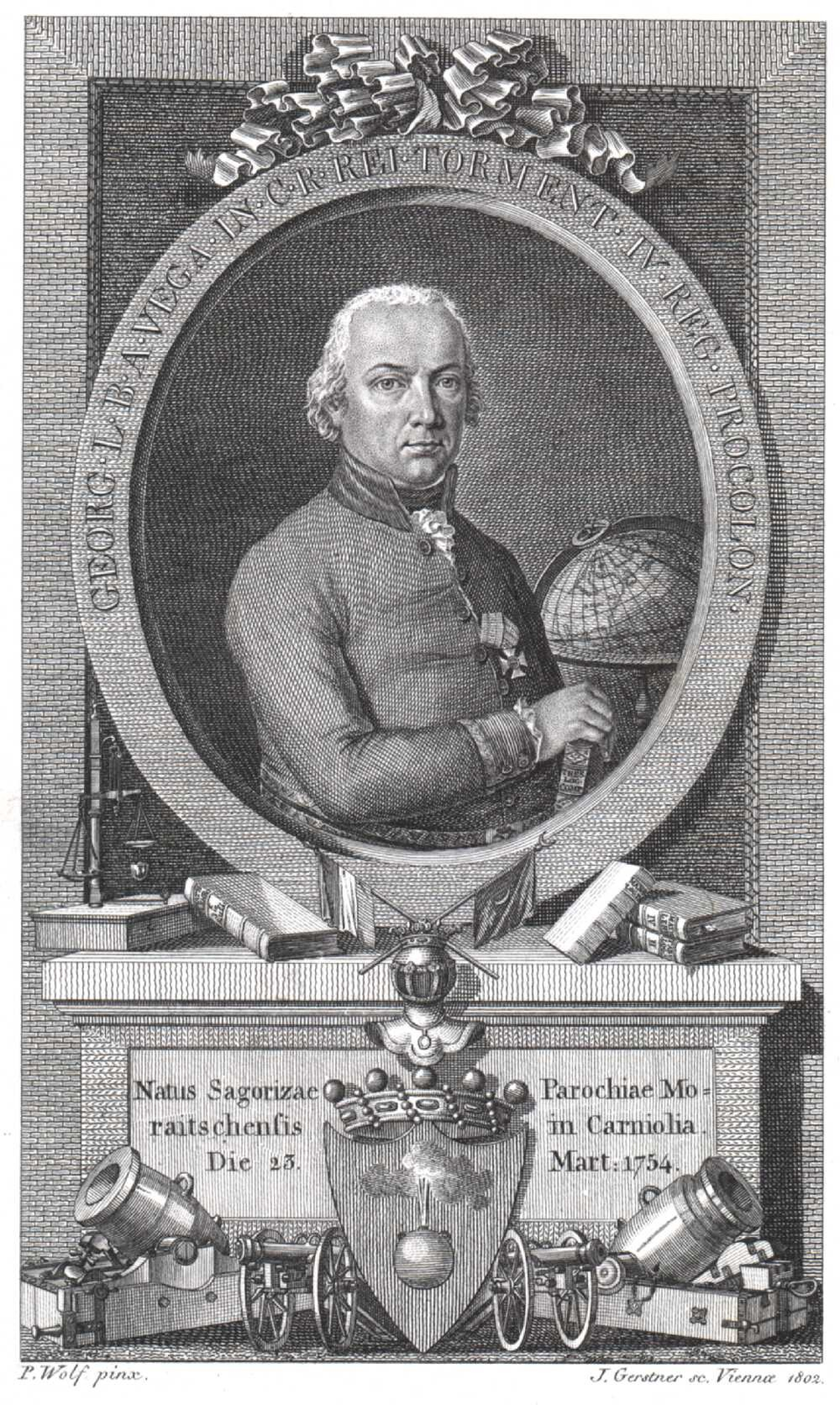
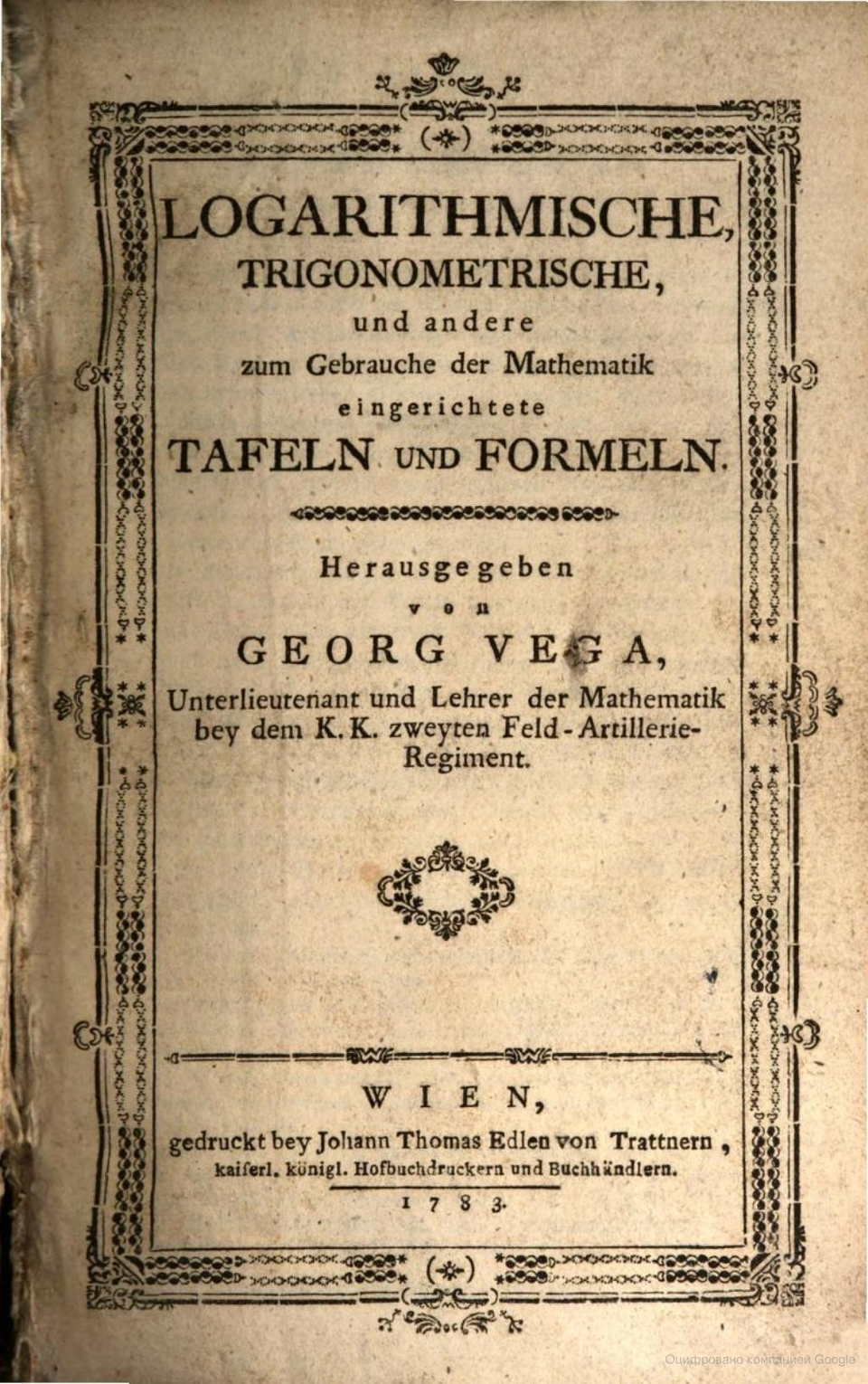
Of the many logarithm tables published by different authors in various countries, the most widespread were the Austrian mathematician Georg Vega’s 7-digit tables of 1783: Logarithmic, Trigonometric and Other Tables and Formulas, with Instructions for Use (German Logarithmische, trigonometrische, und andere zum Gebrauche der Mathematik eingerichtete Tafeln und Formeln). They went through more than 100 editions in 100 years.


Common-logarithm tables exist with differing numbers of mantissa digits. The most widespread are 4-digit and 5-digit tables. Sometimes 7-digit tables are used; rarely, tables allowing logarithms to be calculated to more digits are needed.
The first Russian-language logarithm tables appeared in 1703 with the involvement of L. F. Magnitsky and A. D. Farquharson.
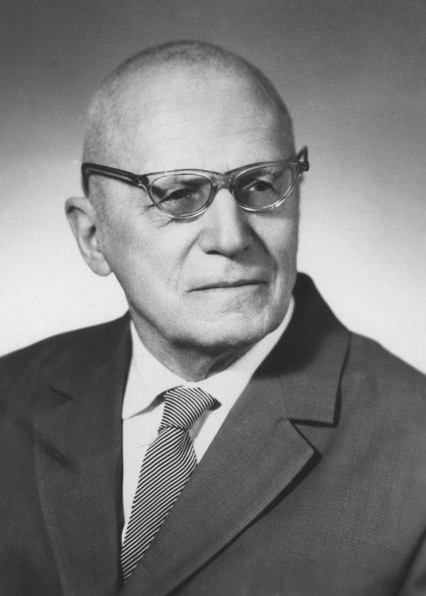
Vladimir Modestovich Bradis’ Four-Figure Mathematical Tables, repeatedly published from 1921 onwards, were used in educational institutions and engineering calculations that did not require high precision. They contained 4-digit mantissas of common logarithms of numbers and trigonometric functions, natural logarithms, and several other useful computational tools.

Common logarithms
Tables of common logarithms were thus the most widespread. The common logarithm of an integer power of 10 is an integer. The common logarithm of any number not equal to an integer power of 10 is fractional, and generally irrational.
The integer part of a logarithm is called its characteristic, and the fractional part its mantissa. For example, lg 253 = 2.4031: the characteristic is 2 and the mantissa 0.4031.
Since the common logarithms of N and 10ᵏN, for integer k, differ only in their characteristics and have identical mantissas, lg 10ᵏN = k + lg N, tables of common logarithms give only the mantissas of logarithms of integers.
The characteristic of any positive number’s logarithm can be found exactly without tables. The following rules are used.
- For a number greater than 1, the characteristic is one less than the number of digits in its integer part. For example, lg 20 000 = 4.3010.
- For a decimal fraction less than 1, the characteristic is the negative of the number of zeros before the first nonzero digit in the fraction. For example, lg 0.0002 = −4 + 0.3010. Thus common logarithms of fractions are written as the sum of a positive mantissa and a negative characteristic.
The mantissa is generally taken from tables, such as Bradis’ tables.
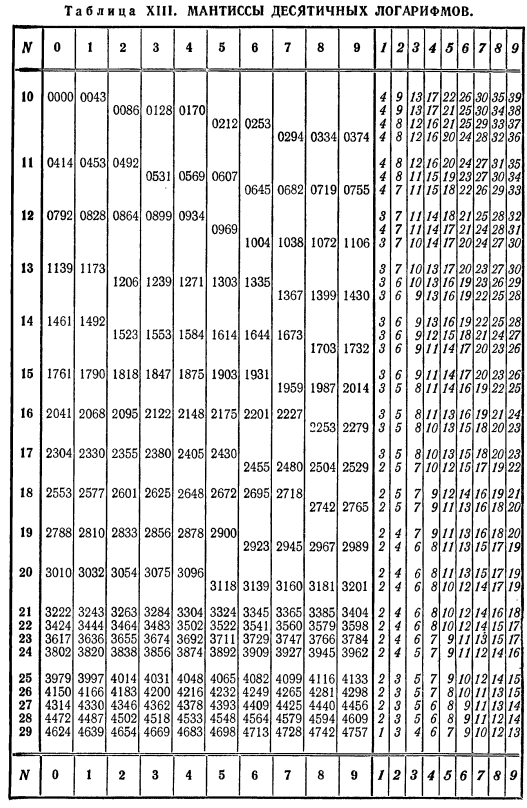

One remarkable property should be used: moving a number’s decimal point any number of places to the left or right leaves the mantissa of its common logarithm unchanged. Only the characteristic changes.
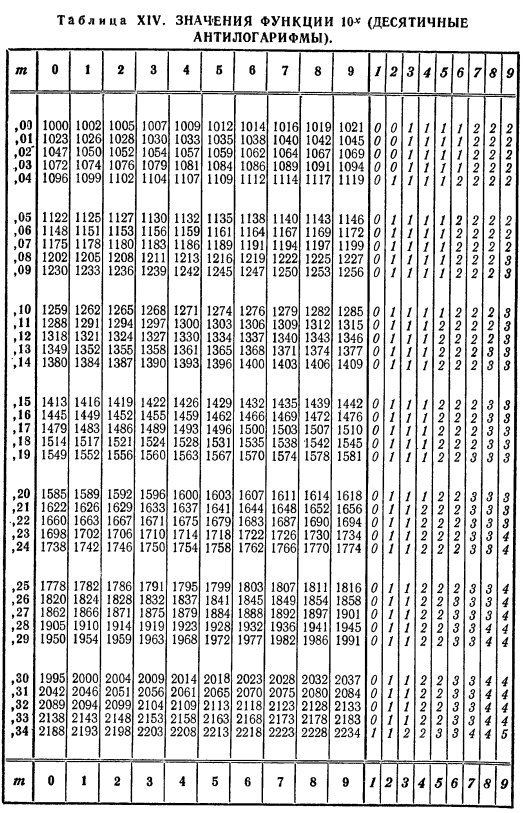
Logarithm tables often include antilogarithm tables: numbers whose logarithms are the given numbers.

Besides logarithms of numbers, logarithm tables usually contain logarithms of trigonometric quantities.
Further reading
- Bradis, V. M. Four-Figure Mathematical Tables for Secondary School. — Moscow: Prosveshcheniye, 1976. — 96 pp.
- Bradis, V. M. Means and Methods of Elementary Computation. — Moscow: Uchpedgiz, 1954. — 230 pp.
- Vega, G. Tables of Seven-Digit Logarithms. — Moscow: Nedra, 1971. — 559 pp.
- Manturov, O. V. Explanatory Dictionary of Mathematical Terms / O. V. Manturov, Yu. K. Solntsev, Yu. I. Sorkin, N. G. Fedin. — Moscow: Prosveshcheniye, 1965. — 540 pp.