

We conclude this short series on the history of algebra by considering the people and the chronotope — the times and places — of achievements in modern algebra. This period extends from the mid-19th century to the present.
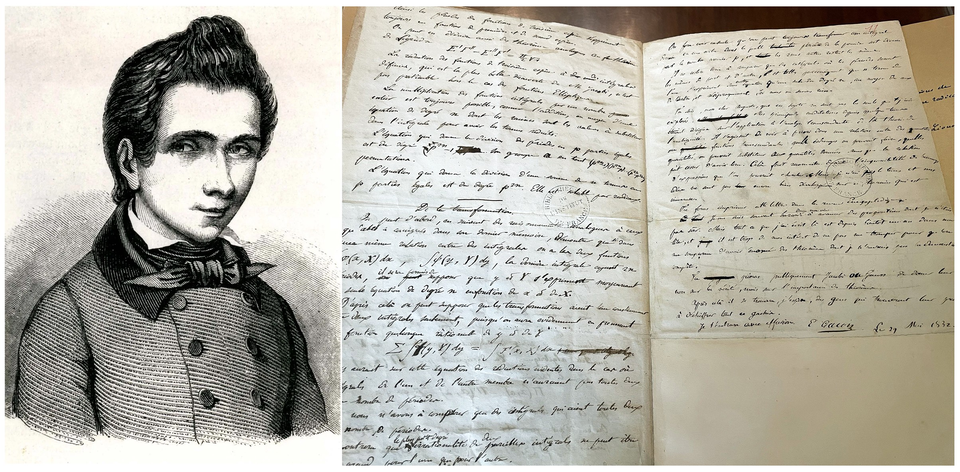
The brilliant French mathematician Évariste Galois (1811–1832) is named first among the founders of modern algebra. He obtained the principal results of the theory of algebraic equations later named after him, Galois theory. In 1828–1830 he wrote several works, the most important being “Analysis of a Memoir on the Algebraic Resolution of Equations” (1830), formulating important propositions of Galois theory, and “On Number Theory” (1830), in which he constructed the theory of finite fields.
Galois repeated N. Abel’s result that there is no general solution in radicals for algebraic equations of degree higher than four. He found a necessary and sufficient condition for an equation to be solvable by radicals. Yet the most valuable contribution was not even the result, but the methods used to obtain it. In solving these problems, Galois laid the foundations of a new algebra. He introduced fundamental concepts such as group, subgroup, normal divisor and field. Galois was the first to use the term “group”.

The brilliant Norwegian mathematician Niels Henrik Abel (1802–1829) worked at the intersection of analysis and algebra in 1826–1829. He definitively resolved the problem of the unsolvability by radicals of equations above the fourth degree. He showed that equations with a commutative group of permutations of their roots are solvable by radicals. Commutative groups are therefore now called “abelian”. His work led to the development of Galois’ group theory.
Group theory is regarded as one of the outstanding mathematical achievements of the 19th century, alongside the discovery of non-Euclidean geometries, which initiated the modern period of mathematics.
From the mid-19th century, the centre of gravity in algebraic research gradually shifted from the theory of equations towards studying arbitrary algebraic operations. Further progress became possible only through the gradual extension and deepening of the concept of number and the appearance of diverse examples of algebraic operations on objects other than numbers.
The abstract concept of an algebraic operation was explicitly identified in the mid-19th century through research into the nature of complex numbers. D. Boole’s algebra of logic, H. Grassmann’s exterior algebras and W. Hamilton’s quaternions emerged. A. Cayley created matrix calculus, and C. Jordan published a major treatise on permutation groups.
The modern view of algebra as a general theory of algebraic operations took shape in the early 20th century under the influence of D. Hilbert, E. Steinitz, E. Artin and E. Noether. It became firmly established with the publication of B. van der Waerden’s monograph Modern Algebra in 1930.
From algebra’s perspective, the nature of the underlying sets carrying the operations is immaterial. In this sense, the operations themselves are the objects of study. For a long time, actual research concerned relatively few principal types of universal algebra that had arisen naturally in mathematics and its applications, such as groups, rings and fields.
Algebra then decisively embarked on an axiomatic and more abstract path.
In the 19th–20th centuries, the range of problems solved by algebraic methods expanded enormously. Many new algebraic theories appeared, and applications grew on an unprecedented scale. Both the classical branches of higher and linear algebra — the theories of groups, rings, fields and vector spaces — and their specialized branches were developed.
Vector, or linear, spaces over a field can be viewed as algebras with one binary operation, addition, and a family of unary operations, multiplication by scalars from the underlying field. Taking a ring as the set of scalars gives the broader concept of a module. Linear algebra, an important branch of algebra, studies linear spaces, modules, their linear transformations and related questions. It includes the theories of linear equations and matrices, already developed in the 19th century. Multilinear algebra is closely connected with linear algebra.
The first works on the general theory of arbitrary universal algebras date to the 1930s and belong to G. Birkhoff. In the same years, A. Malcev and A. Tarski laid the foundations of model theory, studying sets with relations defined on them. Universal algebra and model theory subsequently became so closely intertwined that they produced a new discipline at the boundary of algebra and mathematical logic: the theory of algebraic systems, studying sets with algebraic operations and relations defined on them. The branch studying these systems is usually called general algebra, or higher or abstract algebra.
Several disciplines at the boundary between algebra and other branches of mathematics arise by introducing additional structures into universal algebras, compatible with their operations. They include topological algebra, with the theories of topological groups and Lie groups, the theory of normed rings and theories of various ordered algebraic systems. By the mid-1950s, homological algebra had become an independent discipline, with roots in both algebra and topology.
Algebraic methods began solving classification problems in many sciences. The latest major discoveries in topology were made with algebra’s help. Algebraic concepts and methods are widely used in number theory, functional analysis, differential equations, geometry and other mathematical disciplines.
Alongside its fundamental role within mathematics, algebra has considerable practical importance. Its applications include physics — representations of finite groups in quantum mechanics and discrete groups in crystallography — cybernetics through automata theory, mathematical economics through systems of linear inequalities and linear programming, computer algebra, data science and machine learning.
Times, places and people in modern algebra
In 1870 the well-known French mathematician Camille Jordan (1838–1922) wrote a book on permutation theory, Treatise on Permutations and Algebraic Equations, noting that his work interpreted Galois’ manuscripts. This was the first systematic course in group theory and Galois theory. The book made Galois theory available to all of mathematics.
The English mathematician Arthur Cayley (1821–1895) made substantial contributions to general and linear algebra, laying the foundations of matrix theory in 1858 and of modern algebraic geometry. He was the first to formulate the definition of a group in its present form: a set with an associative and invertible binary operation.
Gauss’ successor in Göttingen was the German mathematician Peter Gustav Lejeune Dirichlet (1805–1859). He made several major discoveries in number theory. His Lectures on Number Theory (1863) have been translated into many languages, reissued repeatedly and exerted considerable influence on outstanding mathematicians of later generations: B. Riemann, L. Kronecker and R. Dedekind. Dirichlet used analytic functions to solve problems in number theory.
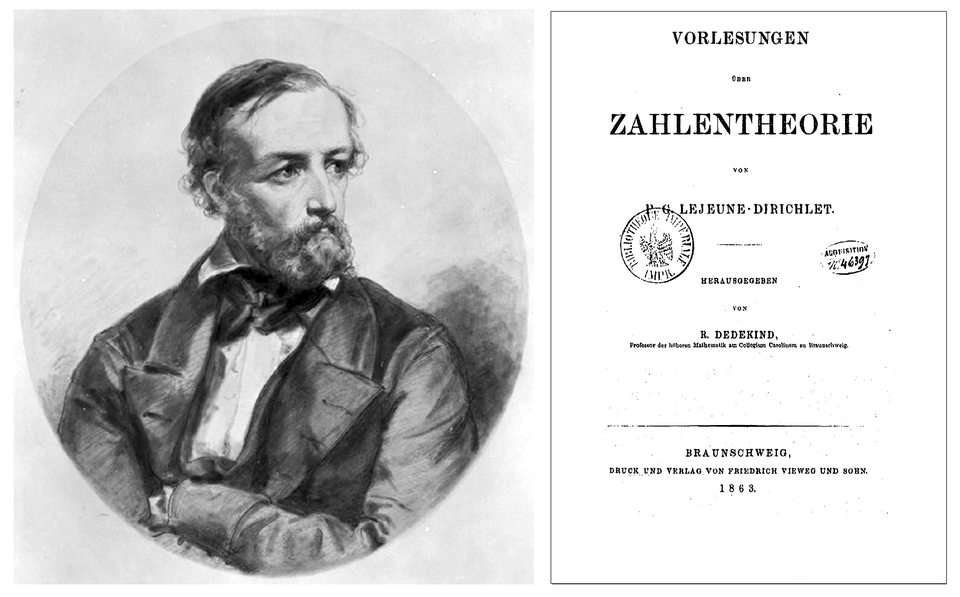

Leopold Kronecker (1823–1891), a German mathematician and professor at the University of Berlin, supported the “arithmetization” of mathematics. His principal work concerned algebra and number theory. In algebra, a criterion for the consistency of a system of linear equations bears his name. He also gave a method for factoring a polynomial over the rational numbers into irreducible factors.
Richard Dedekind (1831–1916) was a German mathematician and a pupil of Gauss and Dirichlet. His work laid the foundations of modern algebra, studying groups, rings, fields, structures and modules. He introduced the concepts of a ring and an ideal. He was among the first to give a set-theoretic foundation for the real numbers through Dedekind cuts, in Continuity and Irrational Numbers (1872).
Dedekind formulated a complete system of axioms for arithmetic in 1888, usually called the Peano axioms, as well as the principle of complete mathematical induction.
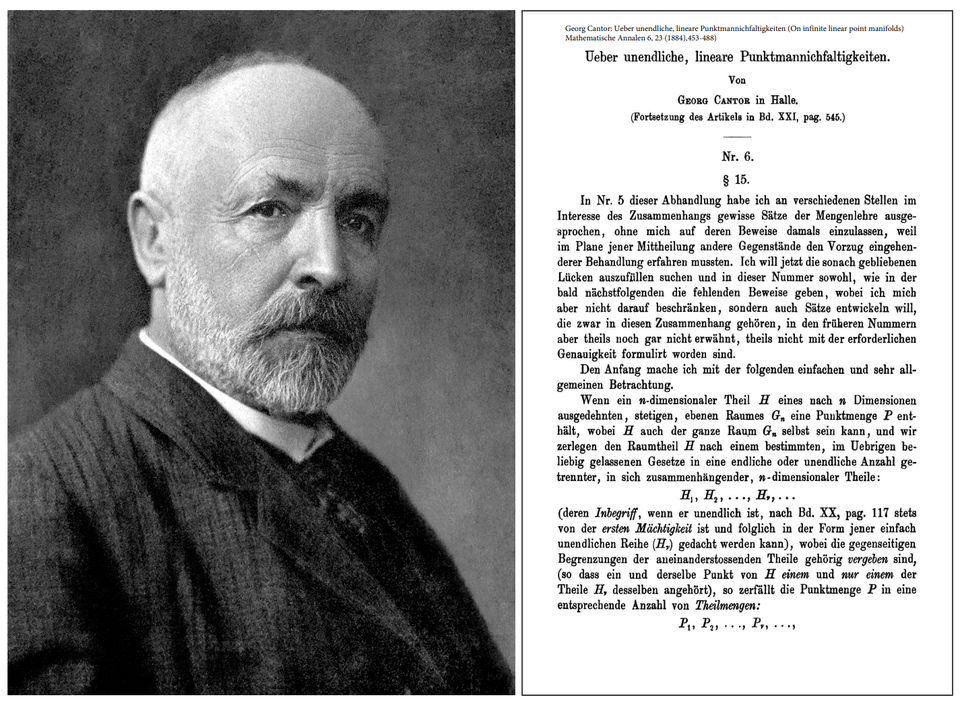
Georg Cantor (1845–1918) was a German mathematician and founder of set theory, in Foundations of a General Theory of Manifolds (1883), which now underlies mathematical analysis. He developed the theory of infinite sets, created one of the rigorous theories of real numbers and first formulated the continuity axiom bearing his name. His theory prompted a general reconsideration of mathematics’ logical foundations and influenced its entire modern structure.

In the 19th century, Russian mathematicians made substantial contributions to mathematics, including algebra.
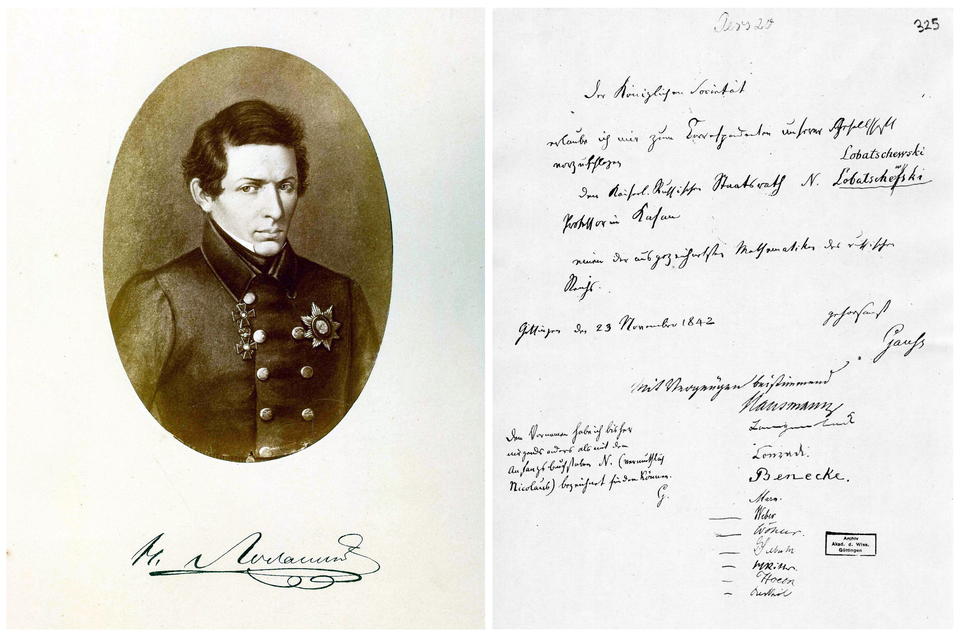
Nikolay Ivanovich Lobachevsky (1792–1856), the great Russian mathematician and geometer of genius, is known above all as the creator of non-Euclidean geometry. He also contributed greatly to other areas of mathematics. He gave a general definition of functional dependence, later introduced by Dirichlet. In Algebra, or the Calculus of Finites (1834), he proposed a method for approximately calculating roots of higher-degree algebraic equations, the Lobachevsky method. He also made significant contributions to determinant theory.
Lobachevsky’s entire life was connected with Kazan University. Much of his scientific work concerned the foundations of geometry. He initially tried to prove Euclid’s fifth postulate on parallel lines and became convinced that it was independent of the other axioms. He first announced his “imaginary geometry” in the lecture “A Concise Exposition of the Principles of Geometry with a Rigorous Proof of the Theorem of Parallels” (1826). Imaginary Geometry was published in the Scholarly Notes of Kazan University in 1835, followed in 1835–1838 by New Principles of Geometry with a Complete Theory of Parallels, giving a full and systematic exposition of the new geometry.
Europe learned of Lobachevsky’s work through Geometrical Investigations on the Theory of Parallel Lines (1840, Berlin). Gauss valued the discovery highly. On his nomination, Lobachevsky was elected a corresponding member of the Göttingen Scientific Society as one of the “most outstanding mathematicians of the Russian Empire”.

Pafnuty Lvovich Chebyshev (1821–1894), founder of the St Petersburg mathematical school, stood at the head of Russian mathematics in the middle and second half of the 19th century. Many of his papers concerned number theory. He established the asymptotic law of the distribution of prime numbers. The polynomials deviating least from zero are named Chebyshev polynomials after him.
In the first half of the 20th century, the concept of constructing all mathematics axiomatically emerged. According to it, “pure set theory underlies all mathematics” (A. Kolmogorov). The German mathematician Ernst Zermelo (1871–1953) gave the first system of set-theory axioms in 1908, comprising 7 axioms. Algebra and many other mathematical theories were later axiomatized.
In the 1920s, algebra developed rapidly. It was reorganized on the model of group theory, becoming the study of algebraic systems. Its subject changed: it now studied these systems. The earlier science of solving algebraic equations remained only one branch of modern algebra. The German mathematician Ernst Steinitz (1871–1928) gave a new formulation of algebraic problems in his memoir “Algebraic Theory of Fields” (1910).
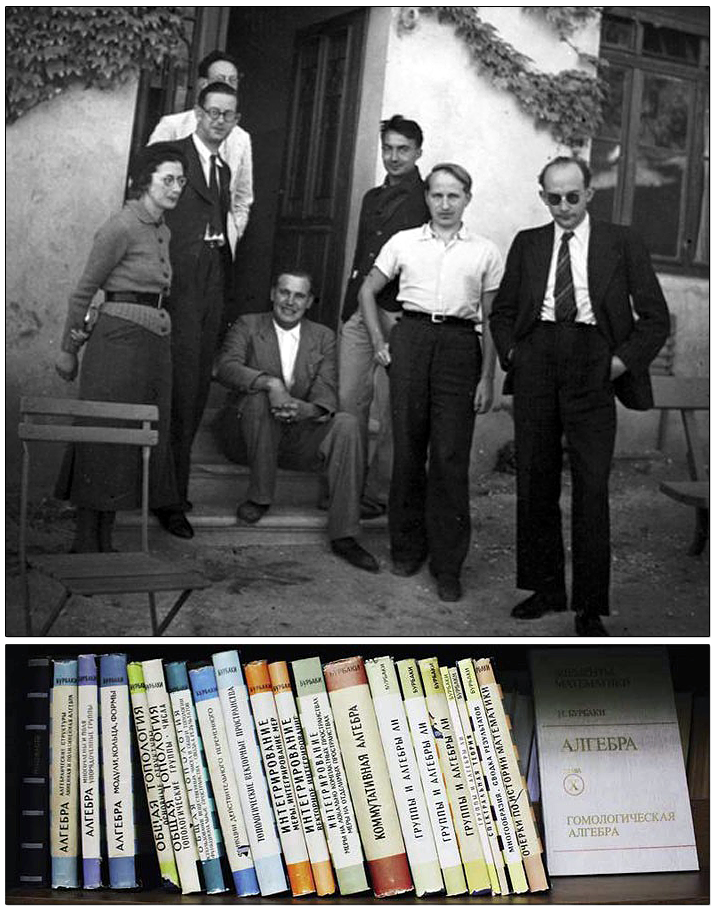
In the late 1930s, a group of French mathematicians joined together to construct all mathematics on an axiomatic basis. Their work produced the multivolume treatise Elements of Mathematics (1939), published under the pseudonym Nicolas Bourbaki, with set theory as its foundation.

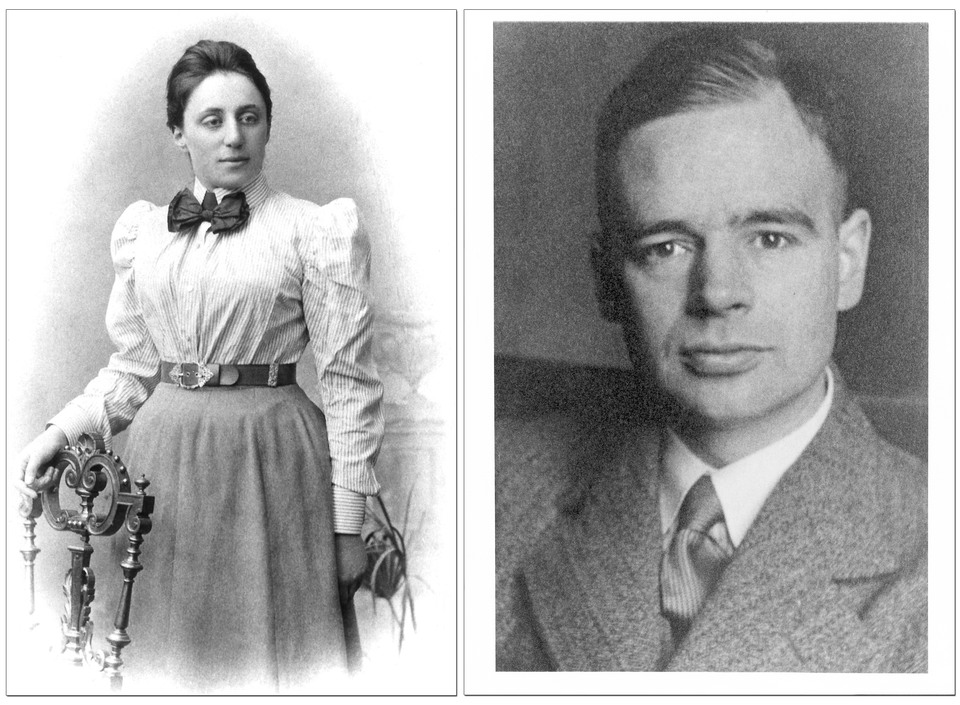
Over the century, all mathematics underwent algebraization. Among those who contributed greatly to this process were the German mathematician Emmy Noether (1882–1935), who created “abstract algebra” (the textbook Modern Algebra, 1931), and her pupil, the Dutch mathematician and historian of mathematics Bartel Leendert van der Waerden (1903–1996), whose exemplary general-algebra textbook Modern Algebra appeared in 1930. E. Noether, the most famous woman mathematician of the 20th century, was a professor at Göttingen University. She lectured on abstract algebra and algebraic geometry at Moscow University in 1928–1929.

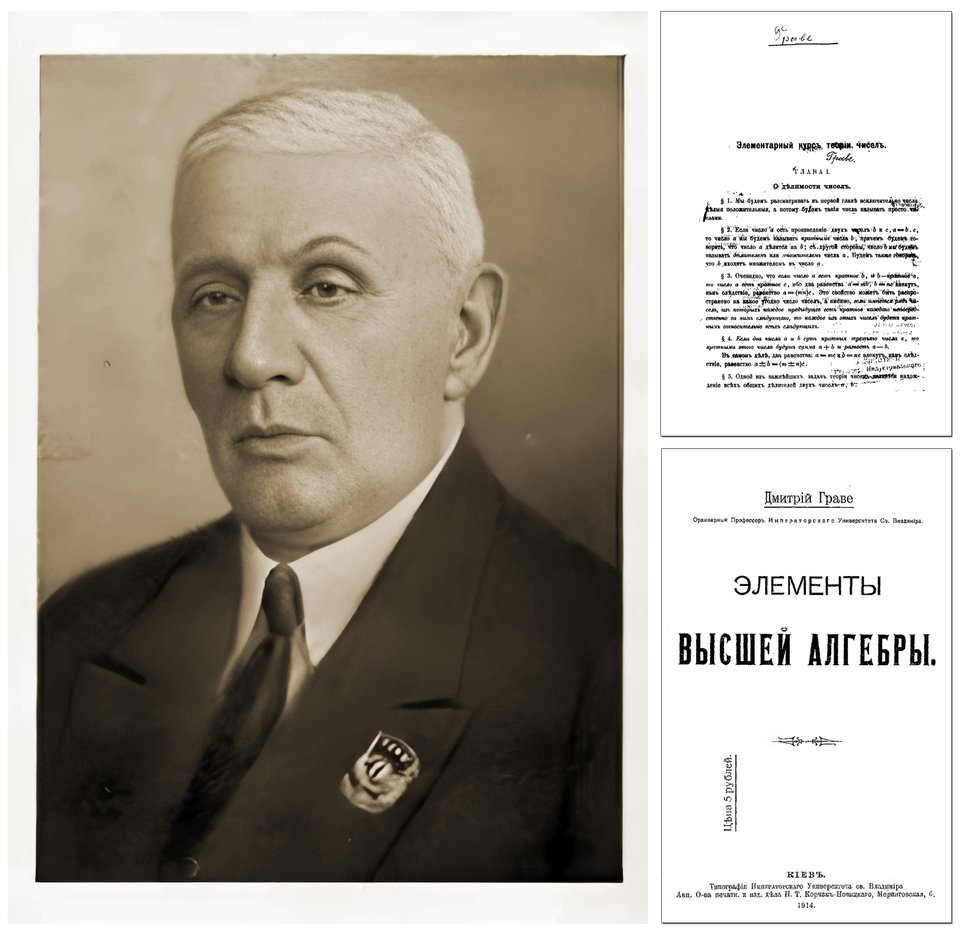
Special mention should be made of the first Russian algebraic school, established in the 1910s at Kyiv University by Dmitry Aleksandrovich Grave (1863–1939). Grave concentrated on the new algebra and number theory. His special seminar on group theory developed into a research school whose members included B. Delaunay, N. Chebotaryov and O. Schmidt. In 1909 Grave published the well-known Elementary Course in Number Theory, and in 1914 the fundamental Elements of Higher Algebra.

In the 1920s, Soviet algebraists intensively studying modern algebra gathered around academician Otto Yulyevich Schmidt (1891–1956), who had already published Abstract Group Theory in 1916. From 1923 he worked at Moscow University and headed its Department of Algebra.
Boris Nikolayevich Delaunay (1890–1980) studied problems of the new algebra and the theory of algebraic numbers.
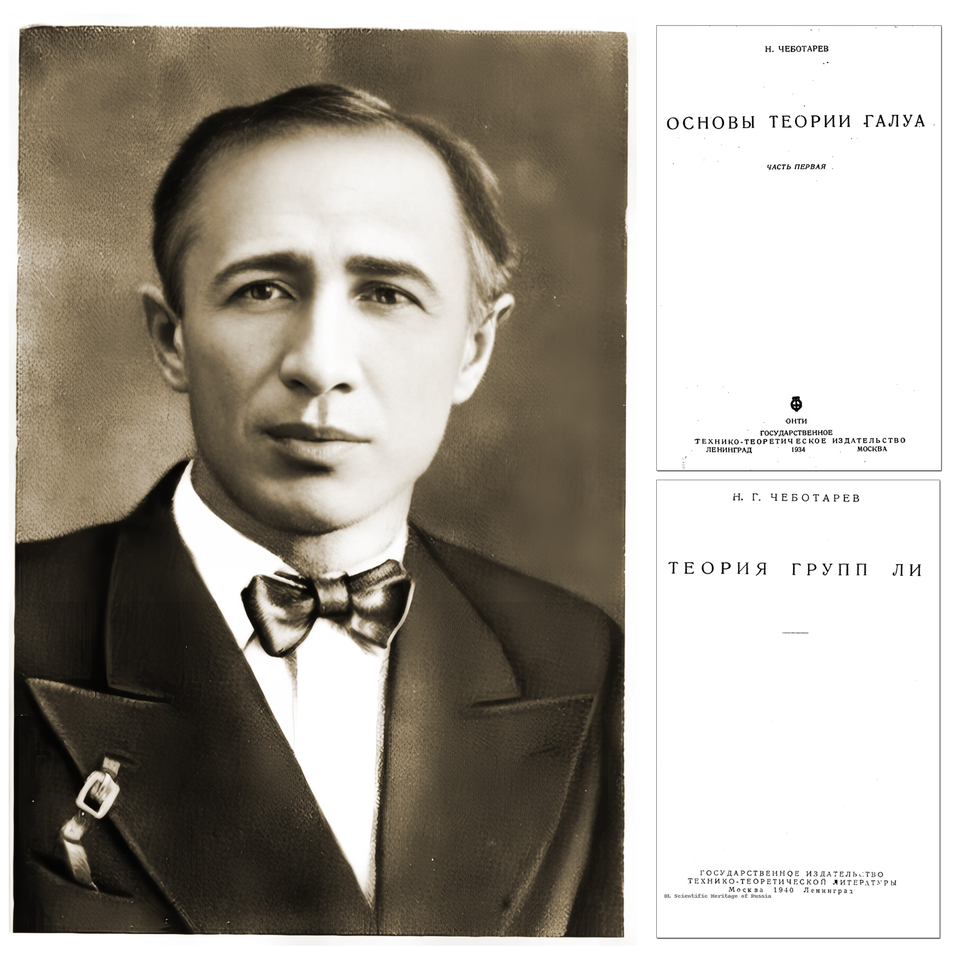
Nikolay Grigoryevich Chebotaryov (1894–1947) was a leading Soviet algebraist. He worked on algebraic number theory, Galois theory and Lie groups. He worked in Kyiv and Odesa, and from 1927 in Kazan, heading Kazan State University’s Department of Algebra. He founded the well-known Kazan algebraic school. His renowned monographs were Galois Theory (1934, 1937) and Theory of Lie Groups (1940). His pupils, working in different algebraic fields, extended the achievements of the Kazan school. For example, Vladimir Vladimirovich Morozov (1910–1975) successfully solved the problem of enumerating all primitive representations of simple Lie groups in 1938. Anatoly Vasilyevich Dorodnov (1908–1989) completely solved Hippocrates’ famous problem of quadrable lunes.

Important results were also obtained in number theory. The main achievements in analytic number theory are associated with the work of Ivan Matveyevich Vinogradov (1891–1983).
Throughout the 19th–20th centuries and into the present, number-theoretic research has expanded continually. Its renewed prominence is now driven by the needs of digital technologies.
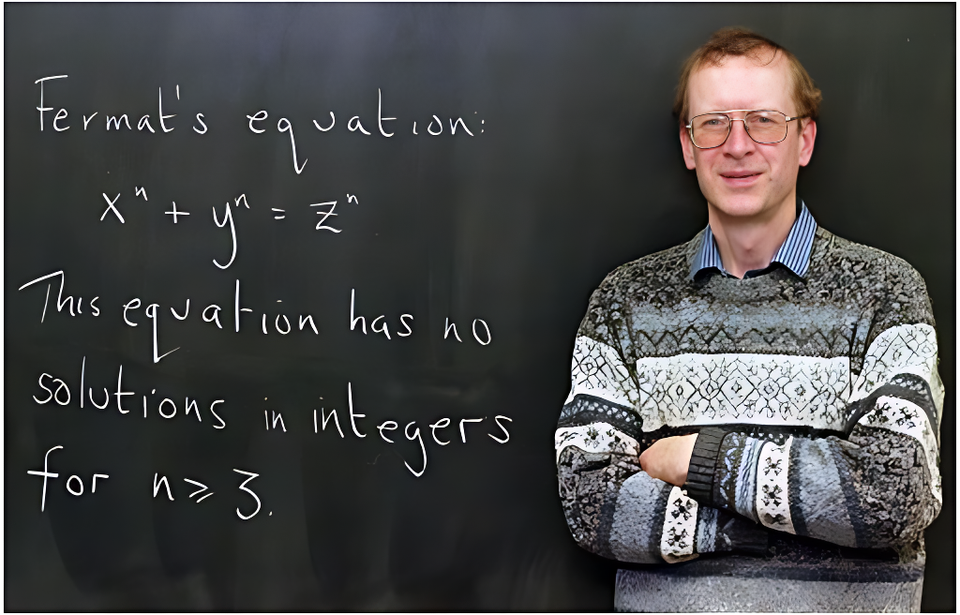
Some classical problems were also solved. For example, the English mathematician Andrew Wiles finally proved Fermat’s Last Theorem in 1995 — the Diophantine equation xⁿ + yⁿ = zⁿ has no solutions in positive integer values of x, y, z if n > 2 — closing this centuries-old problem.

Some algebraic Hilbert problems have also been solved: the 5th, “All continuous groups are Lie groups” (1953); the 7th, “The number 2^√2, the Gelfond–Schneider constant, is transcendental” (1930); the 10th, “There is no universal algorithm for solving Diophantine equations” (1970); and the 18th, “The number of crystallographic, or Fyodorov, groups is finite” (1911).
Algebra is developing dynamically, and mathematicians from our country have made major contributions. Andrey Nikolayevich Kolmogorov (1903–1987) was one of the outstanding Soviet mathematicians. He made foundational contributions to set theory, probability theory, statistics, information theory, algorithmic complexity and algebraic topology. He also studied the history and foundations of mathematics. His well-known works include Mathematics in Its Historical Development, On the Mathematician’s Profession, and Mathematics: A Science and a Profession. Historians of mathematics commonly refer to his definition of mathematics’ subject and his periodization. He believed that an adequate formal definition of the subject was impossible and defined it through its history.
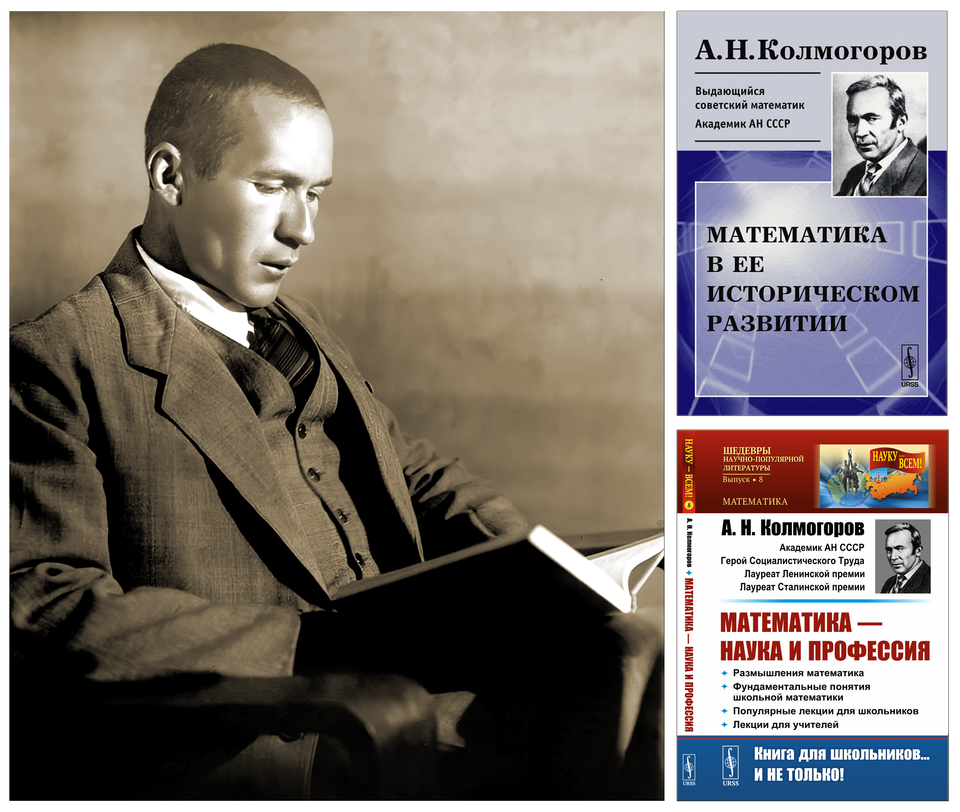

Let us also acknowledge the algebraic contributions of other well-known Soviet and Russian scholars: Mikhail Ivanovich Kargapolov (1928–1976), Aleksey Ivanovich Kostrikin (1929–2000), Anatoly Ivanovich Malcev (1909–1967), Yuri Ivanovich Manin (1937–2023), Pyotr Sergeyevich Novikov (1901–1975), Dmitry Konstantinovich Faddeyev (1907–1989), Igor Rostislavovich Shafarevich (1923–2017) and Lev Naumovich Shevrin (1935–2021).
Here we conclude this short account of the history of algebra. Predictions for science’s development over the coming decades are difficult to formulate. We cannot expect the classical branches of algebra to remain the principal sources of new ideas. Work on long-standing problems continues.
At the same time, a large unexplored territory lies between universal algebra and the classical branches of algebra and number theory. Computer algebra, studying algebraic algorithms and their complexity, forms part of that territory.
New algebraic theories are also needed to solve problems arising at the intersection of mathematical and non-mathematical sciences. Algebra plays the same role as language in a person’s communication with the world. To understand how important it is to learn algebra’s language, one need only try to do without it in independent mathematical study. We therefore wish everyone the opportunity to develop their algebraic taste. Let algebra mediate between spirit and matter.