


“Real mathematics should always be a little like a game: that is its beauty and strength.”
A. N. Kolmogorov
This elegant combinatorial problem was devised by Andrey Nikolaevich Kolmogorov (1903–1987), one of the greatest mathematicians of the twentieth century.
Andrey Nikolaevich was born on 12(25) April 1903 in Tambov. He spent his childhood in Yaroslavl and Moscow, where his mother’s sisters brought him up. One of them, Vera Yakovlevna Kolmogorova, formally adopted Andrey.


His future mathematical talents appeared early. In their home in the village of Tunoshna, in Yaroslavl Governorate, Andrey’s aunts organised a school for children of different ages and taught them themselves. They produced a handwritten magazine, Spring Swallows, featuring the pupils’ creative work: drawings, poems and stories. It also published young Andrey’s first “scientific experiments”, arithmetic problems he had devised himself.
Among them was the well-known button problem: “In how many ways can you sew on a button with four holes, using all of them? … There are actually quite a lot of ways … Naturally, all the holes had to be used: a little right triangle with one hole left empty certainly did not count.”
This is how the problem is presented in the recollections of A. N. Kolmogorov and his pupils, V. V. Vavilov and V. M. Tikhomirov.
Note. We regard two ways of sewing on a button as the same if one can be obtained from the other by rotating or turning over the button: rotations and reflections of the square are taken into account.
The children sewed on their own buttons, so the problem had a thoroughly practical purpose. Andrey’s favourite patterns were two parallel little lines and a cross.
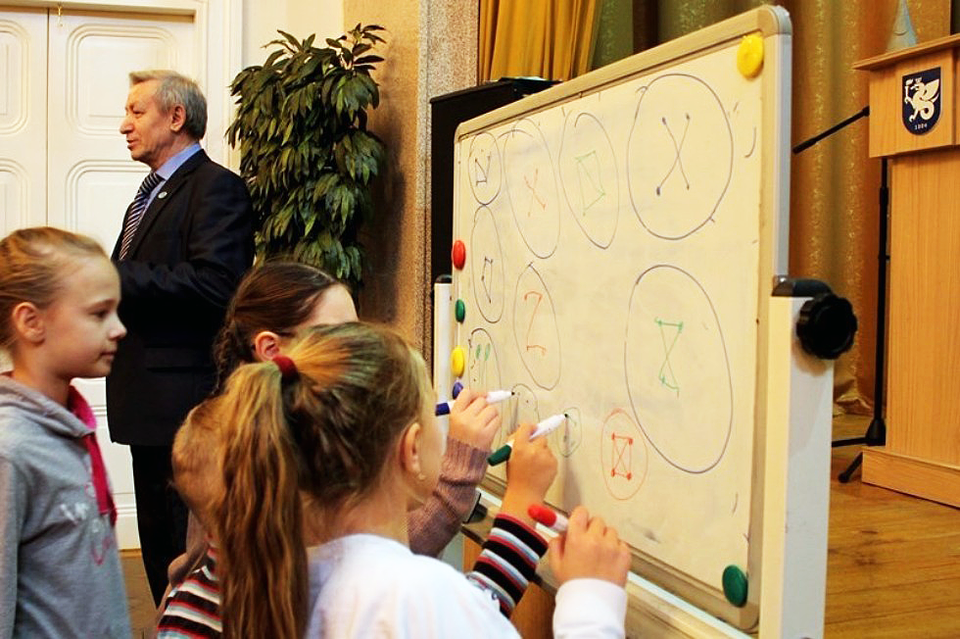
We invite you to sew on, or draw, some buttons yourself using these rules. How many ways can you find?
Other versions of the problem appeared later, which their authors, for some reason, also attribute to Kolmogorov. One version reads:
“A button has four holes for thread, arranged at the vertices of a square. Call the button attached to a shirt if the thread passes through at least two holes in it. In how many different ways can the button be attached to the shirt? The thread may pass over the button or beneath it.”
The button problem seems simple at first glance, yet it reveals deep connections between mathematics and everyday life, showing how abstract combinatorial principles appear in ordinary actions.
The problem is also connected with set theory, graph theory, topology and group theory, subjects on which A. N. Kolmogorov later worked extensively. His pupils recalled that he often used examples from everyday life to demonstrate the universality of mathematical thinking.
P. S. I also used this problem in my classes at Children’s University: