

Since ancient times, philosophers have used the categories of “motion” and “rest”, “continuity” and “discreteness”, and the “infinite” and “finite” to understand the world. The universe is infinite, the variety of forms in the world around us is infinite, and time is infinite, yet its continuous passage is measured in discrete quantities.
All these categories also exist in mathematics: the sequence of numbers is infinite, and a straight line is infinite. Greek scholars also encountered the problem of infinite procedures and quantities when attempting quadrature and rectification: calculating the areas of figures and the lengths of curves.
A deductive construction of mathematics inevitably invokes infinity. It became particularly significant with the discovery of incommensurability. Different scholars addressed the problems of infinity in different ways. The lack of clear rules for using it often led to contradictions. The possibility of presenting mathematics deductively was called into question.
Greek philosopher-mathematicians, including Anaxagoras in the fifth century BCE and Democritus (c. 460–380 BCE), also considered these categories.
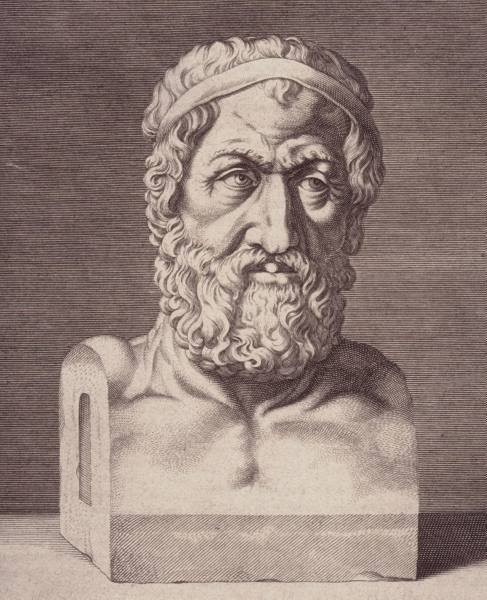
The difficulties are vividly illustrated by the paradoxes, or aporias and antinomies, of the ancient Greek philosopher Zeno of Elea (c. 490–430 BCE). Aristotle formulated and studied them in detail. Of the 45 aporias, from the Greek απορια, “difficulty”, only 9 have survived. They highlight contradictions in explanations of motion and time that use infinity, without attempting to resolve them.
1. “Achilles and the Tortoise”
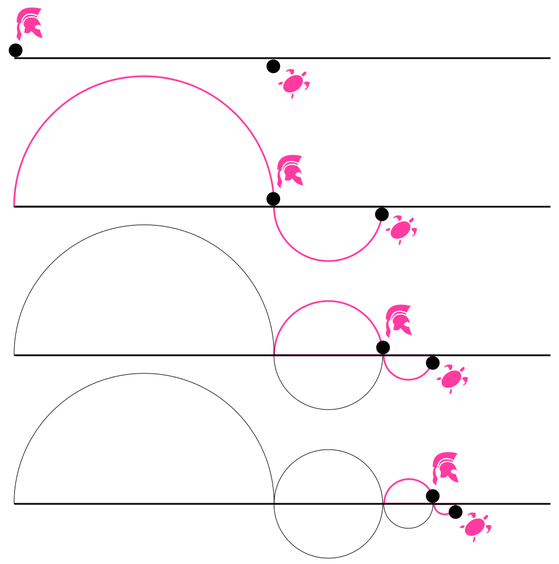

“Swift-footed Achilles will never catch the tortoise if it starts some distance ahead of him.”
Achilles is faster than the tortoise, but to catch it he must first reach point C, where the tortoise started. By the time Achilles reaches C, the tortoise has moved to C₁. Achilles cannot catch it until he reaches C₁, but by then it has moved on to C₂, and so on.
2. Dichotomy (division in half): “Motion Is Impossible”
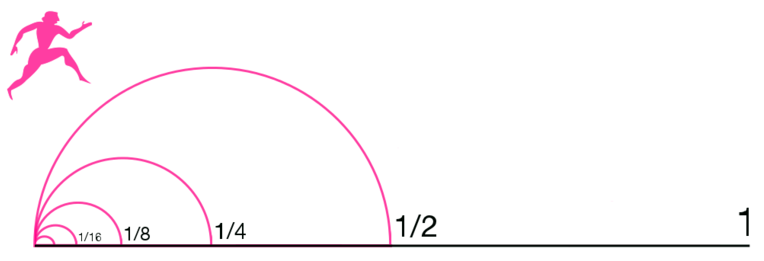

To travel from A to B, one must cover AB₁, half the distance AB. To reach B₁, one must reach B₂, halfway from A to B₁, and so on indefinitely. Since there are infinitely many segments, motion can never begin.
3. “The Flying Arrow Does Not Move”
At every indivisible instant, the arrow is at rest. Otherwise the instant would be divisible, since the arrow would have an initial and a final position. If the duration of its flight is the sum of such indivisible instants, the arrow is at rest throughout.
Zeno’s arguments showed that a finite segment can be divided into infinitely many smaller segments, each of finite length. If we regard a line as consisting of points, we encounter difficulties.
The scientific discussions prompted by these paradoxical arguments continue today.
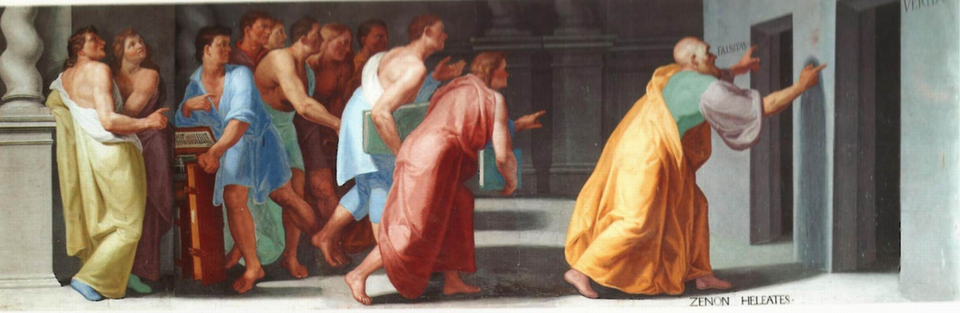

The incommensurable segments associated with Pythagoras and Zeno’s paradoxes constituted the first logical crisis in the construction of ancient Greek mathematics. It is a mistake to regard these arguments as sophisms or to suppose that the emergence of higher mathematics resolved every aporia. Those who studied the problems of the aporias include the philosophers Aristotle, Epicurus, Kant and Hegel, and the mathematicians and physicists D. Hilbert and P. Bernays, R. Courant and H. Robbins, Nicolas Bourbaki, S. A. Yanovskaya and R. Feynman.
Reflection on Zeno’s aporias led to a clear distinction between potential and actual infinity.