

Alexander the Great’s conquests opened a new age in the ancient world. His ten years of military campaigns created a new world empire, larger than any state that had existed before.
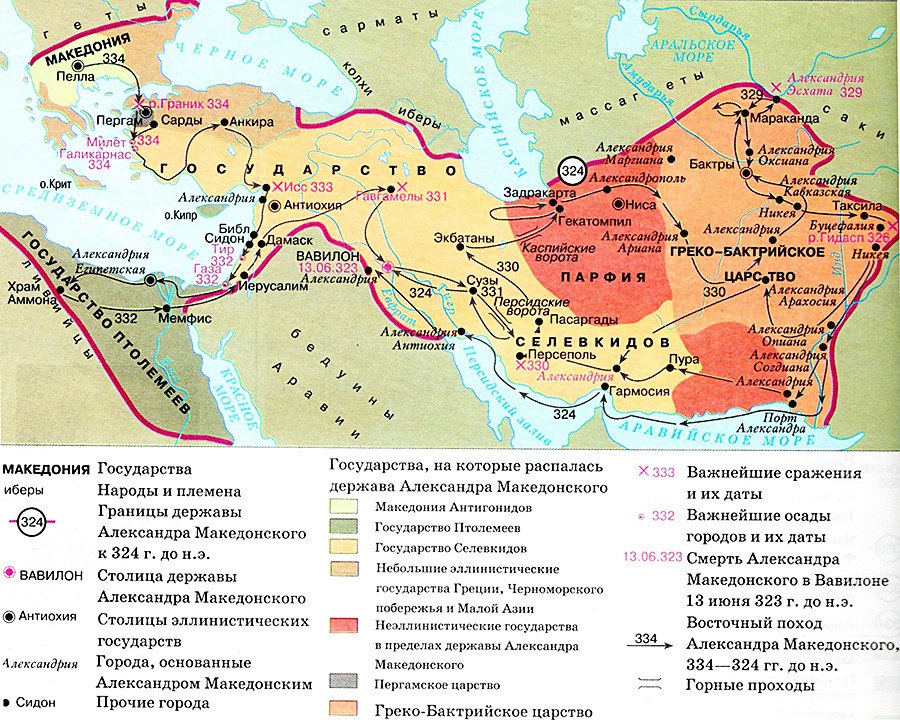

For the first time, it brought together and intermingled the peoples of Europe and Asia, their cultures and their ways of life. Alexander thus played a unique role in human history: he brought East and West together.
In 323 BCE, Alexander died in Babylon. His body was taken to Alexandria in a golden sarcophagus. His empire broke up into several large Hellenistic monarchies: Egypt under the Ptolemies, Mesopotamia under the Seleucids, and Macedonia under Antigonus.
The Hellenistic age began. It spanned three centuries, 336–30 BCE, from the creation of Alexander’s empire to the Roman conquest of Egypt. The old culture of the East mingled with Greek civilisation. Greek became the language of government, and culture and science developed in that language.
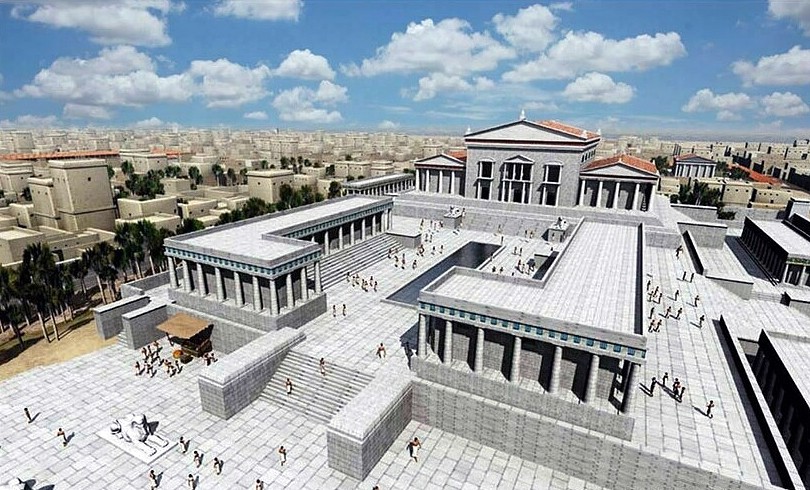
Alexandria, founded in 332 BCE, became the cultural, scientific and commercial centre of the entire ancient world. It was Egypt’s capital, its largest port, and the new capital of Hellenistic Egypt. The island of Pharos sheltered the harbour entrance. A magnificent lighthouse, 130 metres high and regarded as one of the Seven Wonders of the World, stood on the island. The Ptolemies patronised science and the arts.
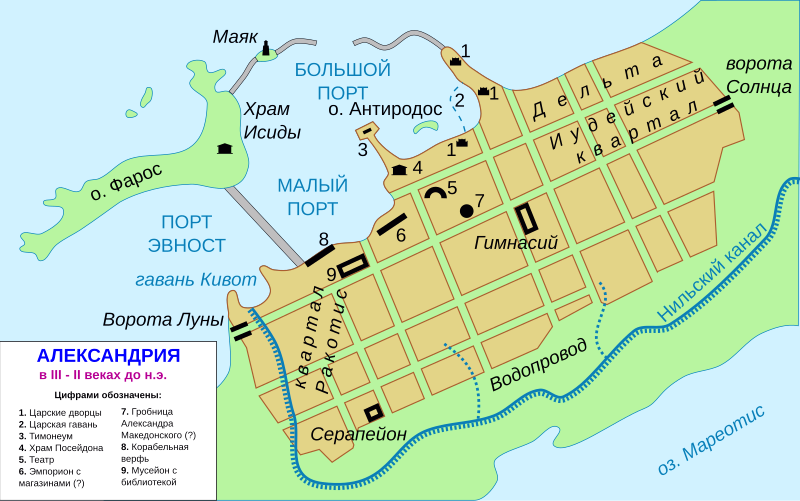

According to Plutarch’s accounts, Ptolemy I Soter founded the Mouseion, or House of the Muses, in Alexandria around 290 BCE. A temple of the Muses, it served as a religious, research, educational and cultural centre of Hellenism. The term “mouseion”, from the ancient Greek μουσεῖον, originally denoted a traditional type of Greek sanctuary. The institution was supported by the state. Leading scholars, philosophers and poets from around the world were invited there. It was a palace with rooms for scientific work, lecture halls, a temple, a theatre, a park, a botanical garden and a menagerie. Its scholars studied natural philosophy, history, mathematics, astronomy, geography, medicine, music, linguistics and other sciences. They lived within the complex and received a stipend, stipendium, from the Ptolemies.
The Mouseion was the only ancient temple of the Muses to operate continuously for at least 800 years. It flourished most under the early Ptolemies, approximately until the end of the third century BCE. At that time, its head was also tutor to the heir to the throne. The institution retained its role during the Roman conquest, when the Roman emperors took over its patronage. As the Roman Empire became Christian, the Mouseion lost its religious functions and remained a secular institution.
The Mouseion’s collections and buildings suffered severe damage during the civil war of 48–47 BCE, when Julius Caesar was in Alexandria. Its decline is also associated with the prohibition of “pagan science” under Theodosius I in 391 CE.
Its last scholar known by name was Theon of Alexandria (335–405), father of the celebrated woman mathematician Hypatia.
The Mouseion included the vast Library of Alexandria, the largest repository of books in the Hellenistic world. Its rich collection was founded on Aristotle’s library. Every ship arriving in Alexandria with literary works on board had to sell them to the library or make them available for copying. The library amassed some 700 thousand papyrus scrolls. The book became the basis of learning.
The library’s main collection ceased to exist during the fighting conducted by the Romans under Emperor Aurelian in 273. Another account holds that the library was destroyed during the Arab conquest in the first half of the seventh century.
Contact between ancient Greek mathematics and the mathematics of the East proved so fruitful that, within a century and a half, 350–200 BCE, everything we now call Greek mathematics was created.
At different times, the Mouseion hosted well-known scholars encountered in the history of mathematics: Eratosthenes (276–196 BCE), Euclid (c. 340–287 BCE), Archimedes (287–212 BCE), Apollonius (262–190 BCE), Hipparchus (180–125 BCE), Heron (first century), Menelaus (first century), Claudius Ptolemy (c. 100–178), Diophantus (third century), Pappus (third century), and Hypatia (370–415).
The Alexandrian Mouseion established traditions of:
- interdisciplinary work, bringing together mathematics, astronomy and engineering;
- open access to knowledge;
- state support for research.
Alexandria continued its cultural and artistic traditions until the seventh century, when the caliphs conquered Egypt.