
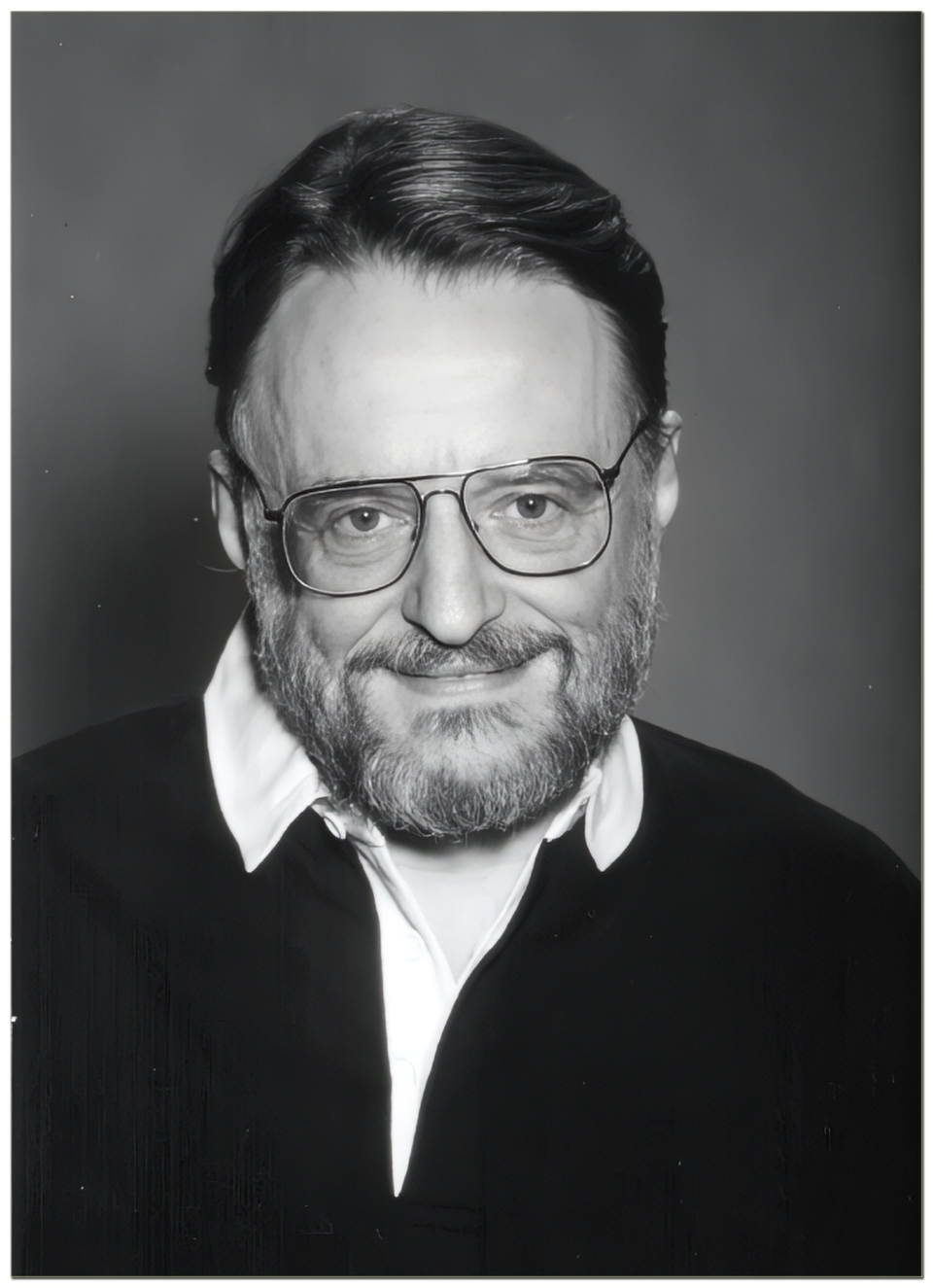

John Horton Conway (1937–2020) was a British mathematician and a fellow of the Royal Society of London (1981). He is known to the wider public chiefly as the creator of the Game of Life.
Mathematics was Conway’s sole interest, and he noticed mathematical aspects everywhere, in everyday objects as well as games.
Conway said he had never worked a day in his life, but had always simply played games. His mathematical contributions were nevertheless varied and substantial:
- he discovered the Conway groups;
- formulated the monstrous moonshine conjecture in group theory;
- was a founder of combinatorial game theory;
- discovered surreal numbers;
- produced work in number theory.
Conway was born on 26 December 1937 in Liverpool, United Kingdom. He studied at Gonville and Caius College, Cambridge (1956–1959), graduated from Cambridge University (1962), received his PhD there (1964) and stayed to teach.
He often played mathematical games with colleagues and students and regularly invented them. They devised the topological game Sprouts, which immediately became popular. Conway began corresponding with Martin Gardner about games, including Sprouts, and an algorithm for a form of the fair-division problem.
The late 1960s and the 1970s were exceptionally productive for Conway. He called this period annus mirabilis, Latin for “year of wonders”. He found three new sporadic groups: Co₁, Co₂, Co₃. The list of finite simple groups consists of 18 countably infinite families and 26 finite exceptions outside that classification, called sporadic groups. The Monster is the largest sporadic group.
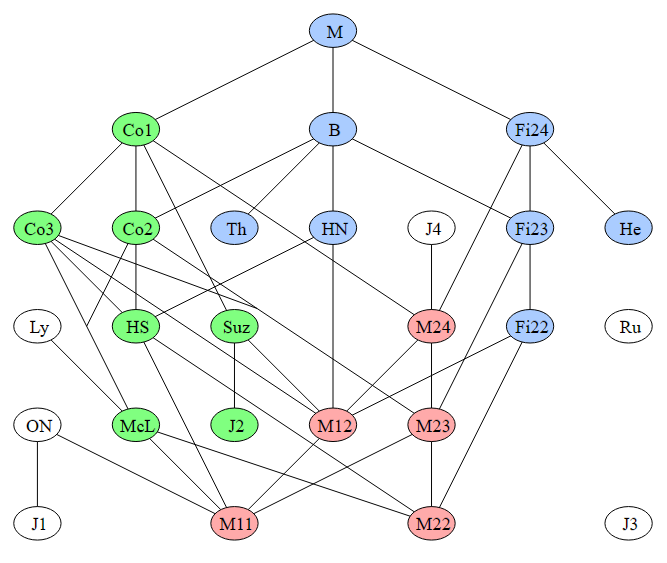

The deep and mysterious connection between sporadic groups and modular functions became known as the monstrous moonshine conjecture.
In the early 1970s, Conway conceived a reference work on finite groups. The project’s participants called the future book the Atlas of Finite Groups. The Atlas was completed in 1984. Its publication (1985) was a long-awaited event for group theorists around the world. The Atlas now exists as an online encyclopedia.
Besides finite groups, Conway studied lattices and sphere packings, and the related subject of error-correcting codes.
In 1983, he became a full professor at Cambridge. He later worked at Princeton University in the United States (1986–2020).
Conway’s recreational science
Much of Conway’s work belongs to recreational mathematics. Besides university teaching, he lectured and wrote about mathematics for schoolchildren and the general public.
Conway had been interested in cellular automata, particularly von Neumann’s automaton, since childhood. His and his friends’ efforts were rewarded when they devised what became the Game of Life. He explained its basic rules in a 1970 letter to Martin Gardner. Gardner wrote about Life in his Scientific American column, and the piece became the most popular ever to appear there. Life attracted thousands of enthusiasts across America and beyond, and made its inventor known to the wider public.


Continuing his work on game theory, Conway coauthored Winning Ways for Your Mathematical Plays (1981). He discovered that positions in “partisan games” could be expressed by numbers, and that the required class contained new numbers as well as integers and reals. Donald Knuth called these numbers surreal. Conway regarded surreal numbers as his greatest source of pride. He rapidly wrote and published his own book on partisan games and surreal numbers, On Numbers and Games (1976).
Conway invented the esoteric programming language FRACTRAN. A program in it consists of an ordered collection of ordinary fractions and an initial integer. He gave, for example, a program generating prime numbers.
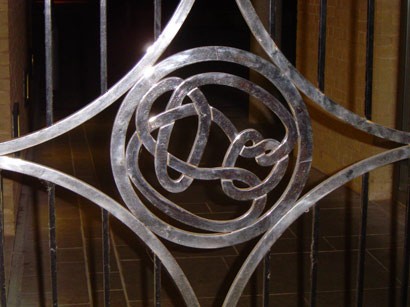
The Conway knot is also well known: a knot with a minimum crossing number of 11. He first described it in 1970.

It is often impossible to distinguish profound research from lighthearted entertainment in Conway’s work. A substantial part of the scientific community, for example, has always viewed cellular automata as recreational mathematics without deep theoretical or practical significance.
He was living proof that one could become a successful mathematician by following one’s curiosity without worrying about appearing “serious”.