
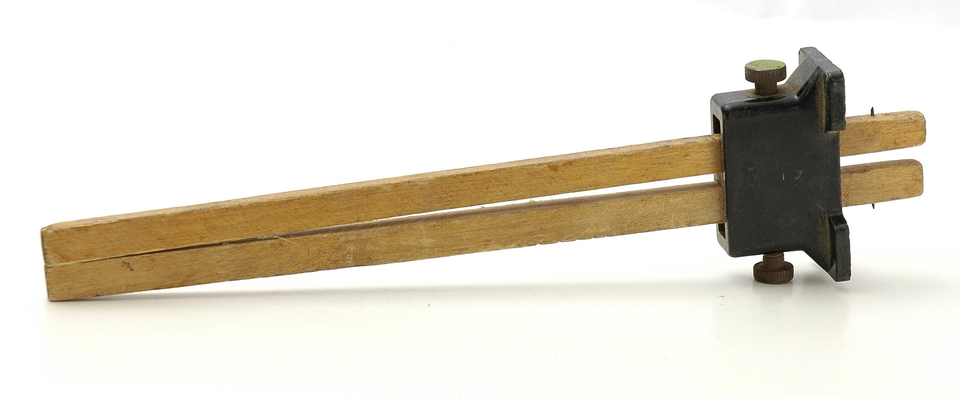

The marking gauge (Russian reysmas or reysmus, from German Reißmaß) is one of the oldest measuring and marking instruments in the history of technology. Its original task was to draw parallel lines on workpieces, from drawing boards to wooden components. Similar devices have been known since antiquity, and in the Middle Ages they became essential tools for carpenters, smiths and geometers.
Although the marking gauge is not considered a “purely mathematical” instrument, its operation rests entirely on the laws of geometry, above all the parallel axiom.
Construction and operation
A traditional wooden carpenter’s marking gauge consists of:
- a stock or base;
- one or two beams, sometimes sliding, secured to the stock by a wedge or screw;
- scribers at the ends of the beams: pointed metal pins.
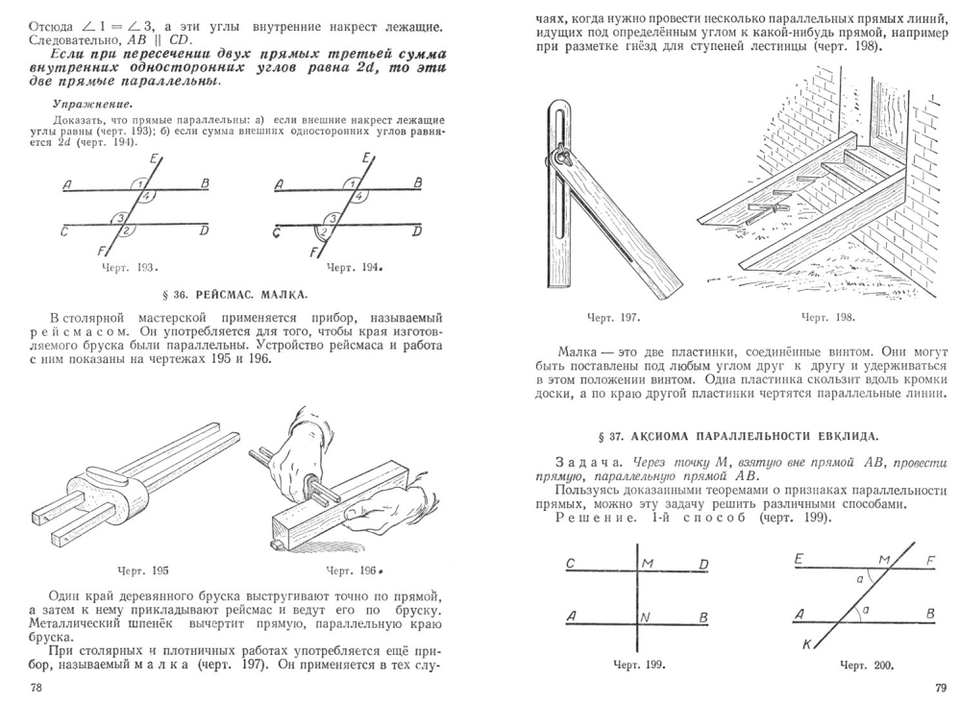
The beams were fixed by a wedge or screw, setting the distance between the line and the edge of the workpiece. Drawing the line was called marking out, and the pointed metal rod that drew it was called a scriber. As the scriber moved across the surface, it left an even line strictly parallel to the reference line.
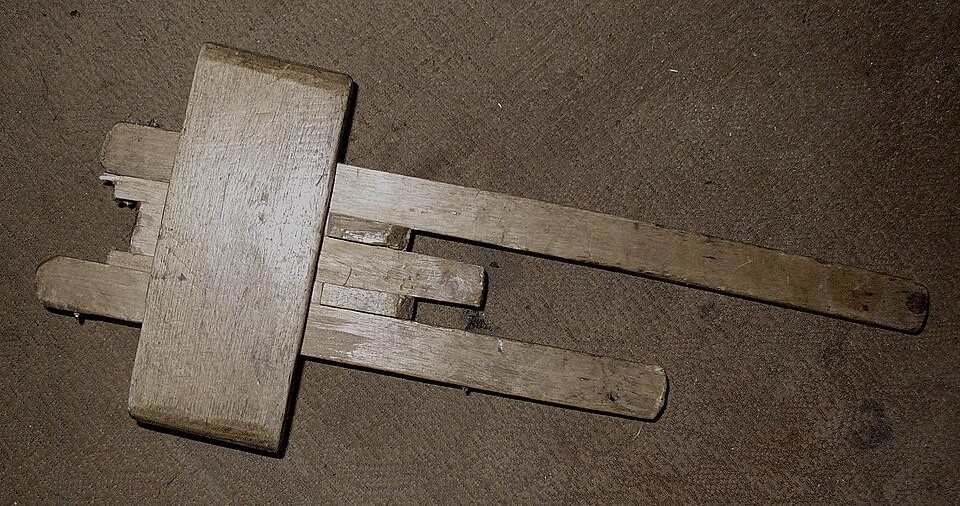
In joinery, the marking gauge was also used to transfer dimensions from drawings to a workpiece. The two-beam version was particularly popular, for example for marking mortises and tenons simultaneously.

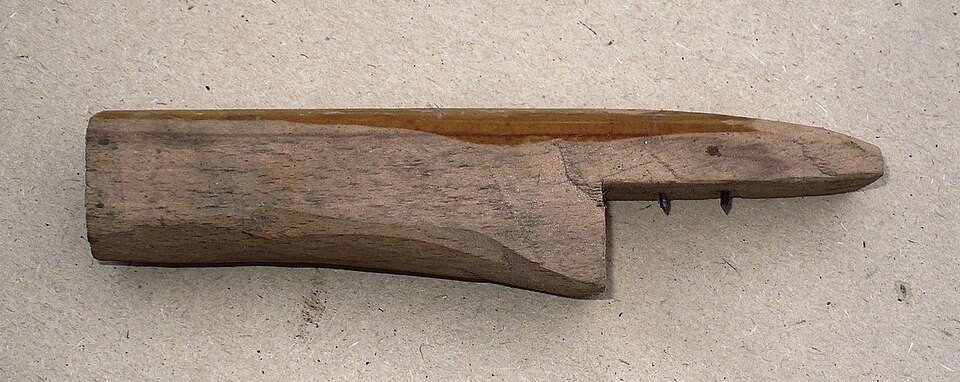
An alternative was a tool called a skoba: a wooden block with nails driven into it at the required spacing. It could draw several parallel lines in a single pass.

The height gauge: a modern development
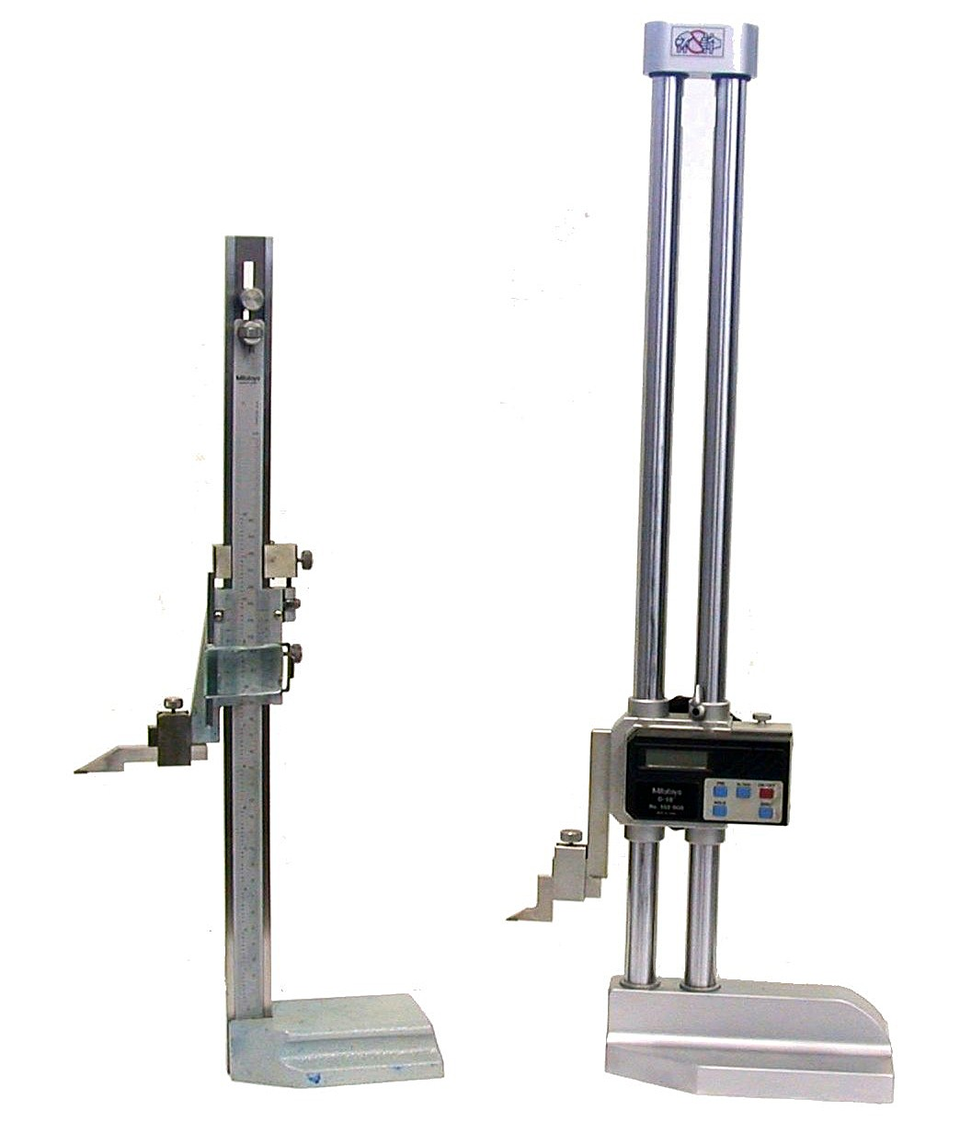
As technology advanced, the marking gauge evolved into the height gauge (Stangenreißmaß), an instrument for precise vertical marking and height measurement in mechanical engineering and metalworking.
Its construction resembles a vertical vernier caliper:
- a heavy base for stability;
- a vertical beam with a vernier or digital display;
- a movable measuring pointer.
Modern digital models offer accuracy down to 0.01 mm and are widely used in laboratories and factories.

Historical background
Simple scribers resembling marking gauges were known in antiquity. Ancient Egypt, Greece and Rome used guiding devices to cut grooves in stone and wood.
In the Middle Ages, similar instruments were used in architecture, icon painting and joinery, from Catholic cathedrals to wooden iconostases.
Industrial metal height gauges appeared in the late 19th century in Germany and Switzerland, countries where precision mechanical engineering was developing rapidly. They soon became familiar tools in factories and technical schools.
In Soviet schools, the marking gauge was a required tool in practical-work and technical-drawing lessons. It appears in geometry textbooks as late as the 1970s.

The marking gauge is more than a carpenter’s tool: it is a clear example of geometry in practice. It brought craft and science together, linking Euclid’s ideas with the tasks of technical drawing. Even in the digital age, it has remained a symbol of precision, symmetry and parallelism.
Further reading
- Atanasyan, L. S., and Butuzov, V. F. Geometry: A Textbook for Grades 7–9 of General-Education Schools. — Moscow: Prosveshcheniye, 1998. — 336 pp.
- Great Soviet Encyclopedia. Vol. 21 / Chief editor A. M. Prokhorov. — Moscow: Sovetskaya Entsiklopediya, 1970–1978.
- Nikitin, N. N. Geometry: A Textbook for Grades 6–8. — Moscow: Prosveshcheniye, 1969. — 216 pp.
- Nikitin, N. N., and Fetisov, A. I. Geometry: A Textbook for Grades 6–9 of Seven-Year and Secondary Schools. — Moscow: Uchpedgiz, 1956. — 234 pp.
- Prochukhaev, V. G. Measurement in the Secondary-School Mathematics Course. — Moscow: Prosveshcheniye, 1965. — 140 pp.
- Trutovsky, A. Ye. A Handbook for the Master of Joinery and Furniture Production. — Moscow: Goslesbumizdat, 1959. — 124 pp.