
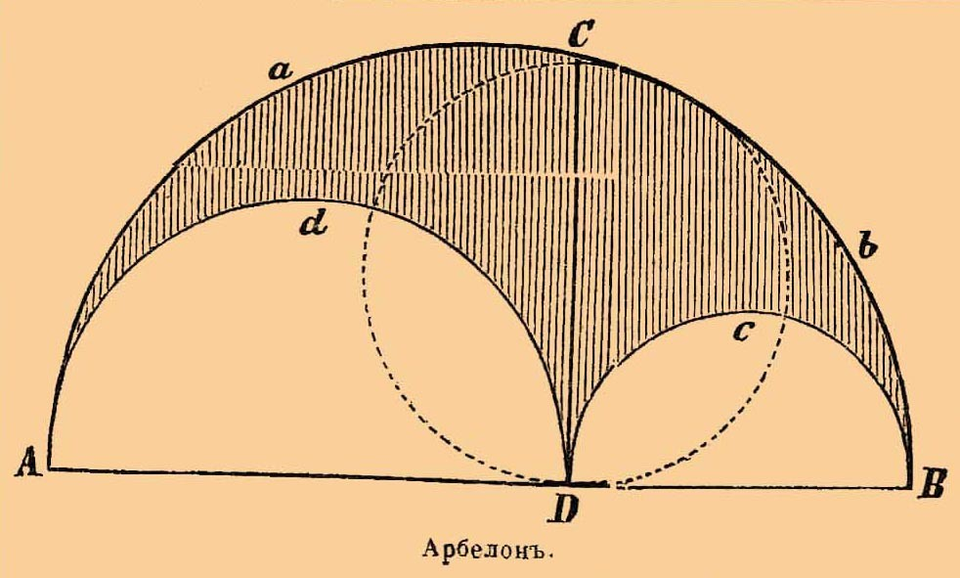

The arbelon, or arbelos, is one of the most elegant figures studied by Archimedes. It became the subject of subtle mathematical analysis as early as the third century BCE. Archimedes devoted several lemmas to it in the Book of Lemmas (Liber assumptorum), which has reached us through an Arabic adaptation and a Latin translation.
Archimedes himself probably did not call this figure an “arbelos”; the name appeared later, in the commentaries of subsequent mathematicians. Yet he uncovered remarkable connections between areas, arcs and lines in this simple but profound figure.
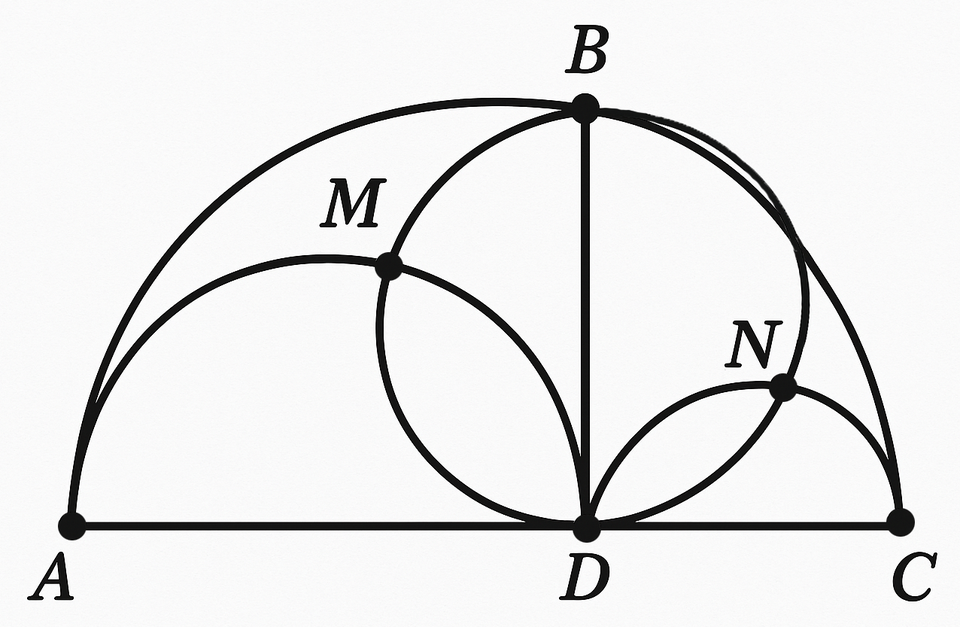

An arbelos is the region bounded by three semicircles constructed on diameter AC: one on the whole diameter and the other two on its parts AD and DC, where D lies between A and C.
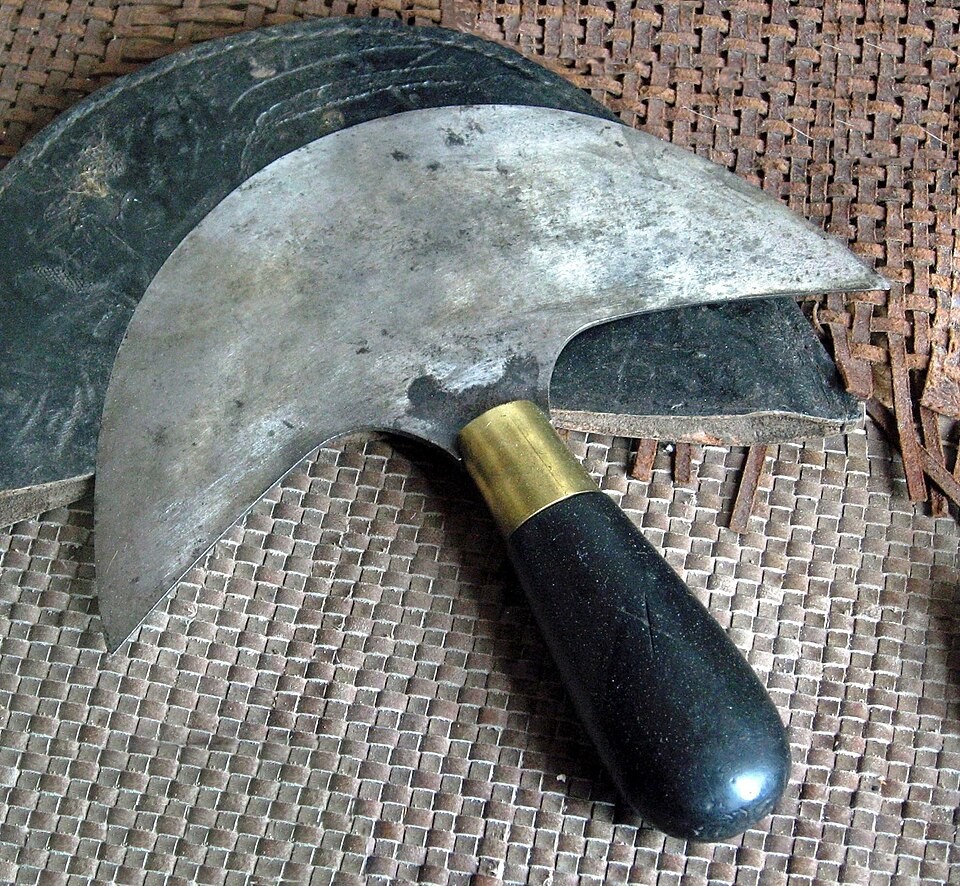
The name “arbelos” comes from the Greek word “ἄρβηλος”, meaning a “shoemaker’s knife” or “hatchet” used by shoemakers. The figure’s shape really does resemble this tool.

Archimedes’ problem
Archimedes discovered several surprising properties of the arbelos that are still studied in geometry courses:
- The area of the arbelos equals the area of the circle whose diameter is DB, the perpendicular to AC erected at D and extended to meet the large semicircle. This remarkable relationship reveals a deep connection between the figure’s straight and curved elements.
- The perimeter of the arbelos, the sum of the arcs of its three semicircles, equals the circumference of a circle with diameter AC. In other words, the two smaller arcs together have the same length as the larger arc, a fact Archimedes proved with his characteristic elegance.
Try proving these properties yourself. You will probably use algebraic formulas. Archimedes, however, used the method of exhaustion. Can you manage without formulas?
Historical background
The formula for the area of a circle in its modern form appeared later, but its justification belongs to Archimedes. In Measurement of a Circle, he proved that the area of a circle equals that of a right triangle whose base equals the circle’s circumference and whose height equals its radius. In studying the arbelos, Archimedes used his famous “method of exhaustion”. This was an early precursor of the integral approach, whose modern expression in formulas took shape much later.
Today, arbelos problems appear in popular mathematics books and mathematical olympiads.
Archimedes’ arbelos is an excellent tool for teaching geometry. It vividly demonstrates the connection between algebra and geometry and links the history of science with modern mathematical theories.