
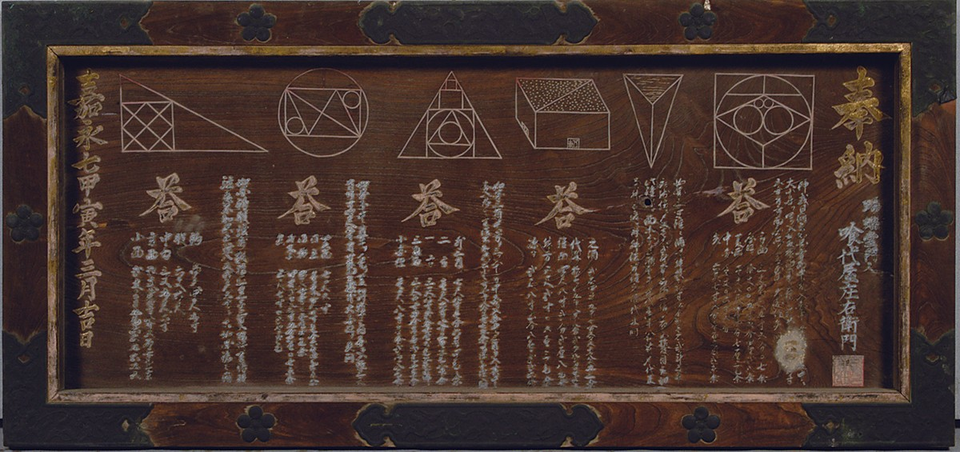

Some stories in the history of mathematics seem almost unbelievable. One originated in Edo-period Japan: geometric problems were solved not only in schools and books, but also written on wooden tablets, painted and displayed in Shinto shrines and Buddhist temples as offerings and challenges to other experts. These tablets were called sangaku.
At first glance, sangaku resemble ordinary ema — votive tablets, small wooden plaques used in Japanese religious tradition that can still be seen in shrines today. Instead of prayers or animal images, however, they bore circles, polygons, ellipses, arcs, tangencies and short inscriptions stating a problem. Often these were beautiful compositions: mathematics appeared here both as a science and as an object of contemplation.
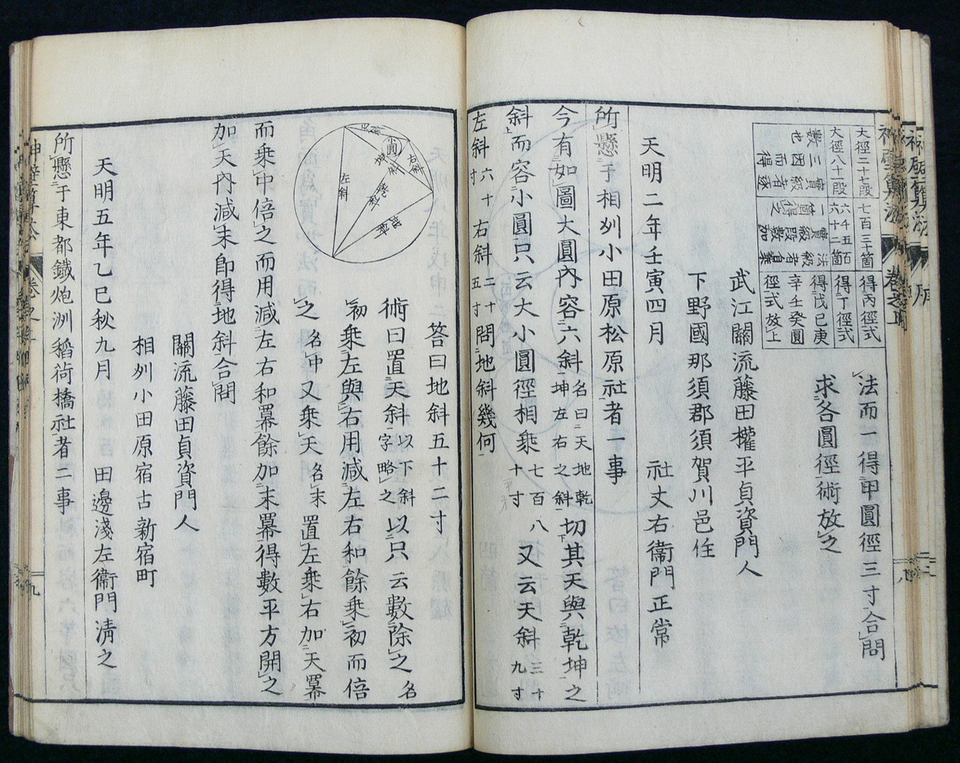
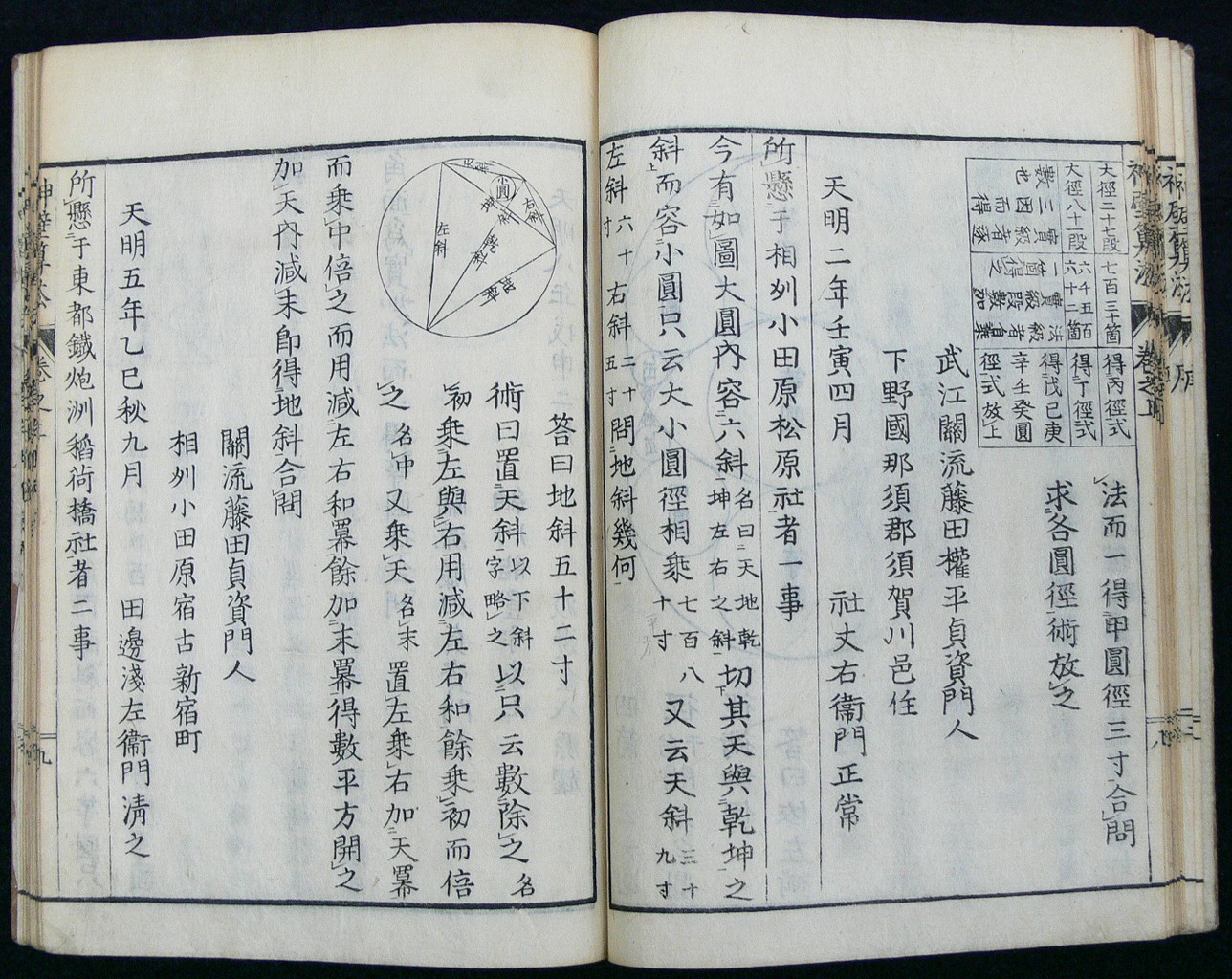
Sangaku cannot be understood apart from wasan, traditional Japanese mathematics. During the XVII–XIX centuries, Japan had relatively limited contact with the West, and its mathematical tradition therefore developed largely independently. This world had schools, teachers, lineages of pupils and even a distinctive rivalry between approaches. Mathematics was both useful knowledge and a prominent part of educated culture.
Why were tablets with geometric diagrams hung in temples at all? The cultural background matters. Japan already had a tradition of dedicating gifts and ema tablets to shrines. Against that background, a mathematical tablet was hardly alien. Rather, the solution to a beautiful problem could be viewed as a worthy product of learning, suitable for dedication to a deity.
The earliest sangaku are particularly valuable today. The oldest surviving example was dedicated to Hoshinomiya Shrine in what is now Sano in 1683, although the original was damaged by fire in 1975 and a copy is now displayed. The next oldest is thought to be a sangaku of 1691 from Yasaka-jinja in Kyoto. In 1993 it was designated an Important Cultural Property of Japan. Particularly interestingly, this monument is considered the oldest known example preserving a complete problem and answer.
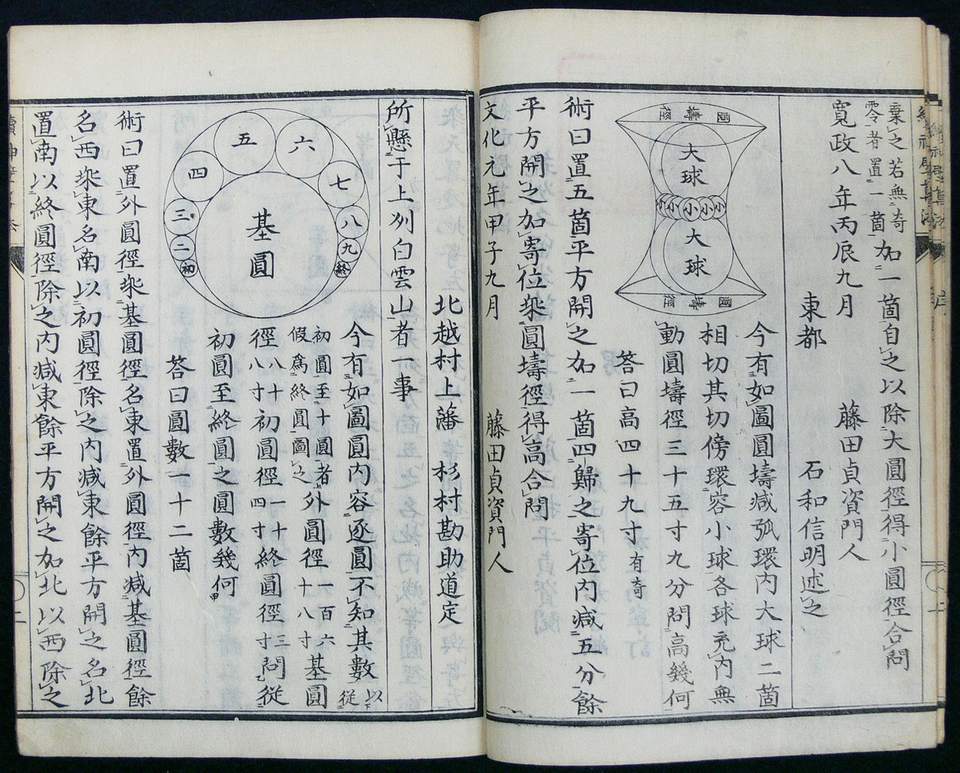
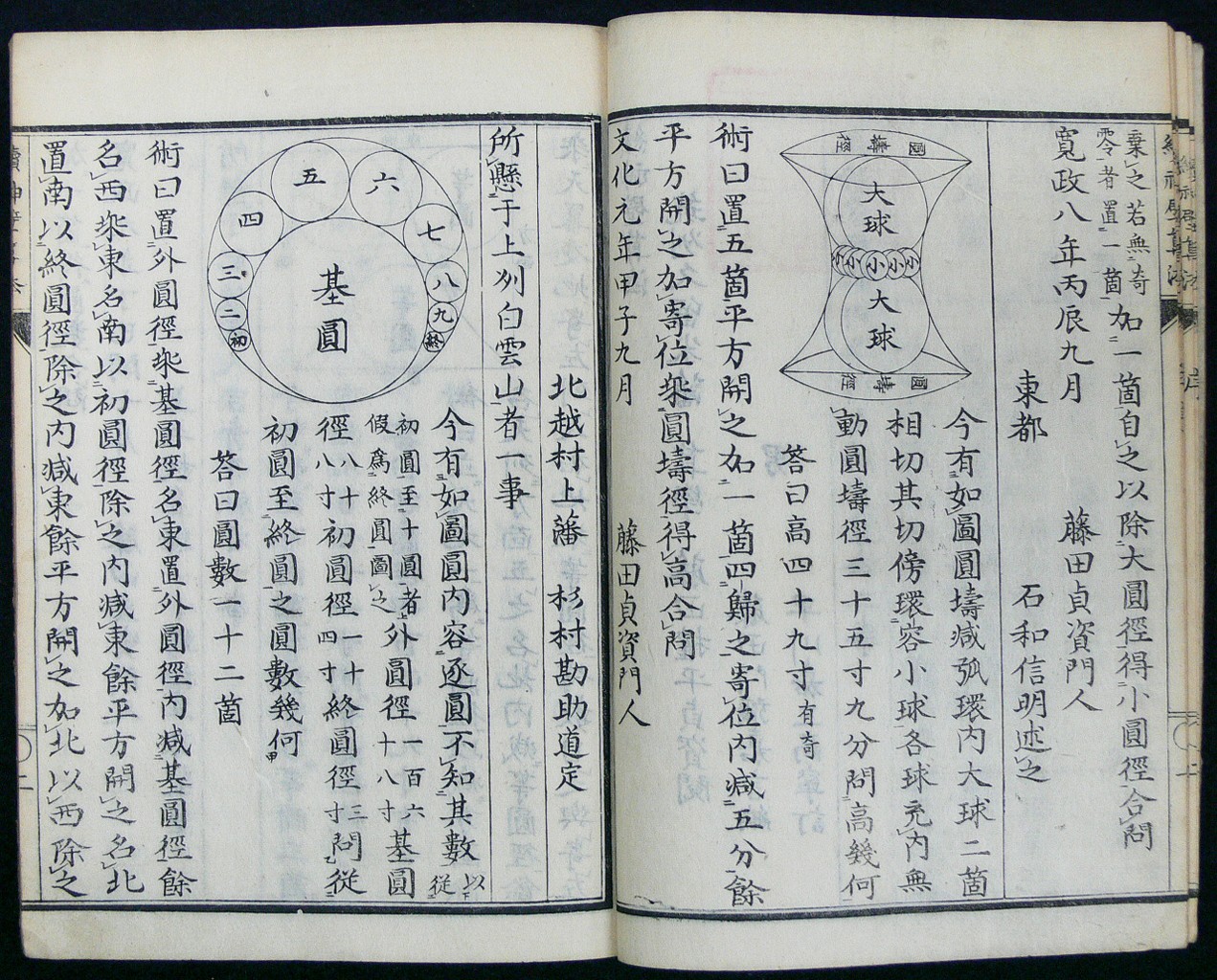
Sangaku were more than temple decorations. Dedicating one became a way of publicly presenting a problem or result: a tablet was both an offering and an advertisement for a school’s mathematical skill. The tablets therefore often featured spectacular problems with striking figures and complex configurations. Many were later copied into manuscripts and collections. Particularly important are the books associated with Fujita Sadasuke and his son: Shinpeki sanpo appeared in 1789, an expanded edition in 1796, and a continuation in 1807. Later, the manuscript Saishi shinsan recorded 204 tablets.
Who made these tablets? More than a narrow circle of professionals. The inscriptions show many educated members of the samurai class among their donors, alongside whole groups of pupils, children and sometimes women. This is what makes the sangaku tradition so vivid: it represents a broad culture of problems, drawing and competition, rather than the private mathematics of a handful of authors in the capital.
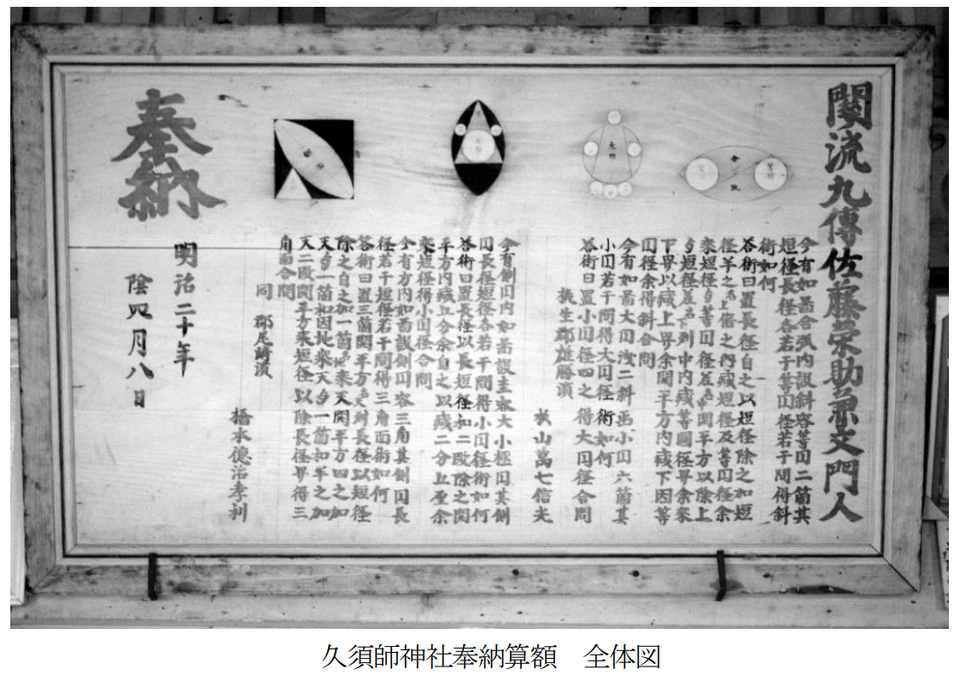
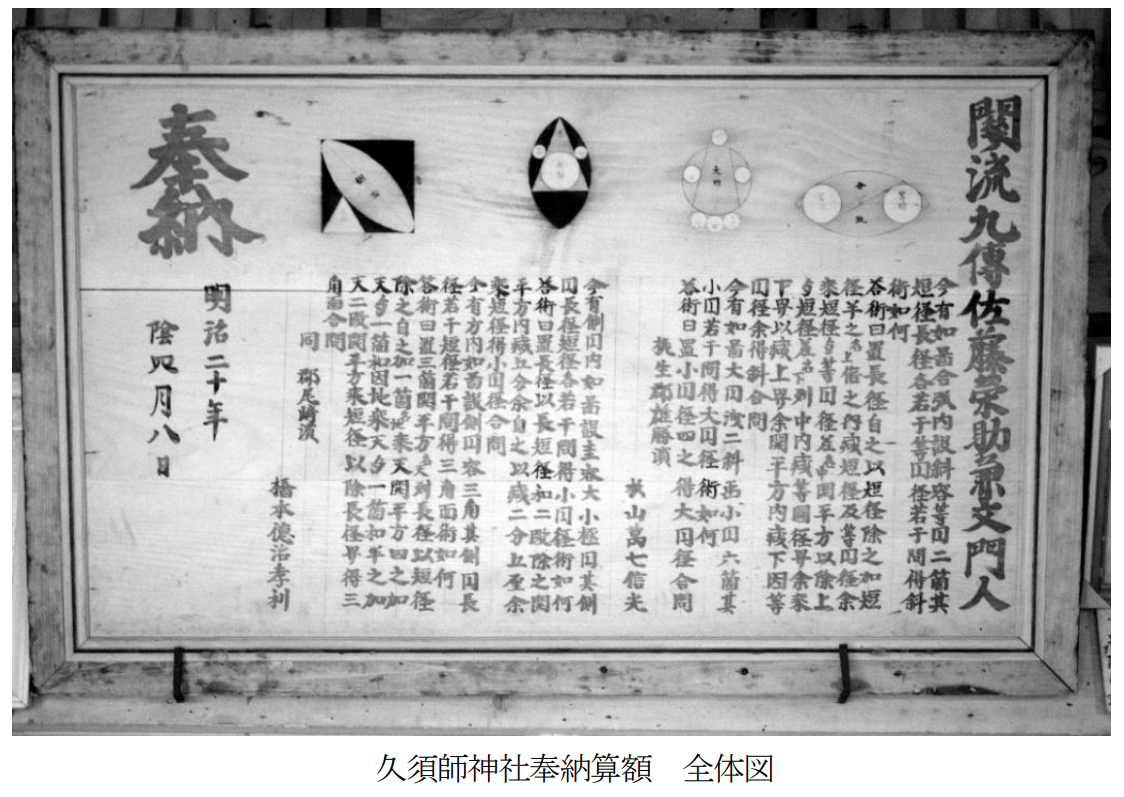
The history of sangaku is still being written. About a thousand surviving tablets are known today, roughly four hundred of them from the Edo period. Many others are known only from books, manuscript copies and later descriptions. Japanese researchers began compiling regional catalogues in the XX century, and investigations continue today. Sangaku are therefore a living field of historical mathematical research as well as unusual museum objects.
What problems appeared on sangaku?
To see sangaku as more than attractive tablets with circles, it helps to examine real problems. Most tablets supplied only the statement and answer; a detailed solution was often absent, leaving contemporaries to work it out for themselves. Here are three examples in modern notation.
Problem 1. Three tangent circles
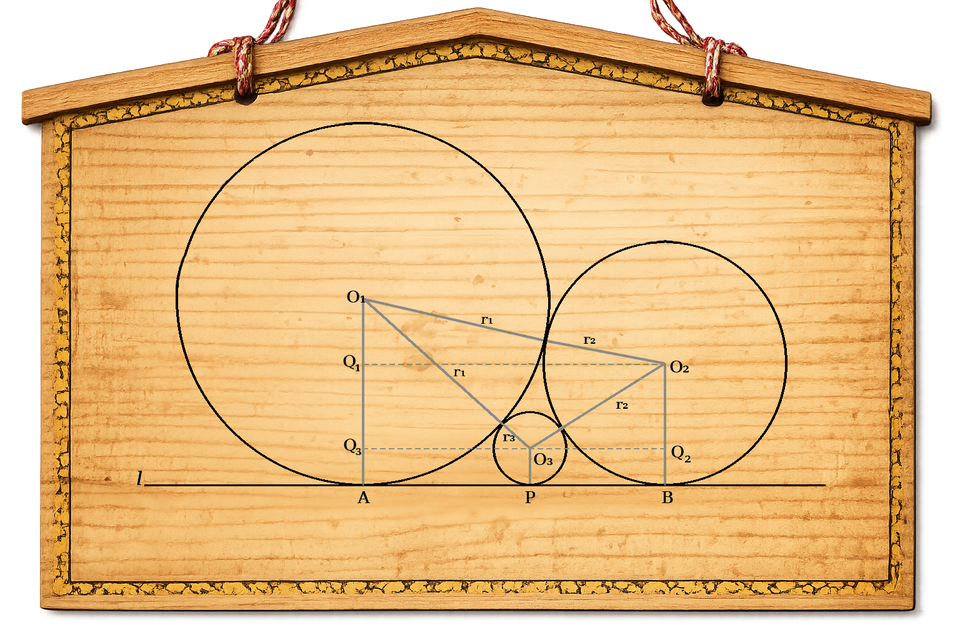

Two circles of radii r₁ and r₂ are tangent to the same straight line and to each other. A third circle of radius r₃ is also tangent to that line and to both circles. Find r₃ in terms of r₁ and r₂.
Solution. Consider the right triangle O₁O₂Q₁. Let A and B be the points where the two outer circles touch the line; then AB = Q₁O₂. After the appropriate rearrangements, the Pythagorean theorem gives
Similarly, considering the right triangles O₁O₃Q₃ and O₂Q₂O₃, we find that if P is the point where the middle circle touches the same line, then
so
Squaring gives:
After cancelling, we obtain:
hence
Thus,
This is a very characteristic sangaku problem: a beautiful decorative diagram yields a short, memorable formula for the answer.
Problem 2. A line divides a triangle into two equal-area parts
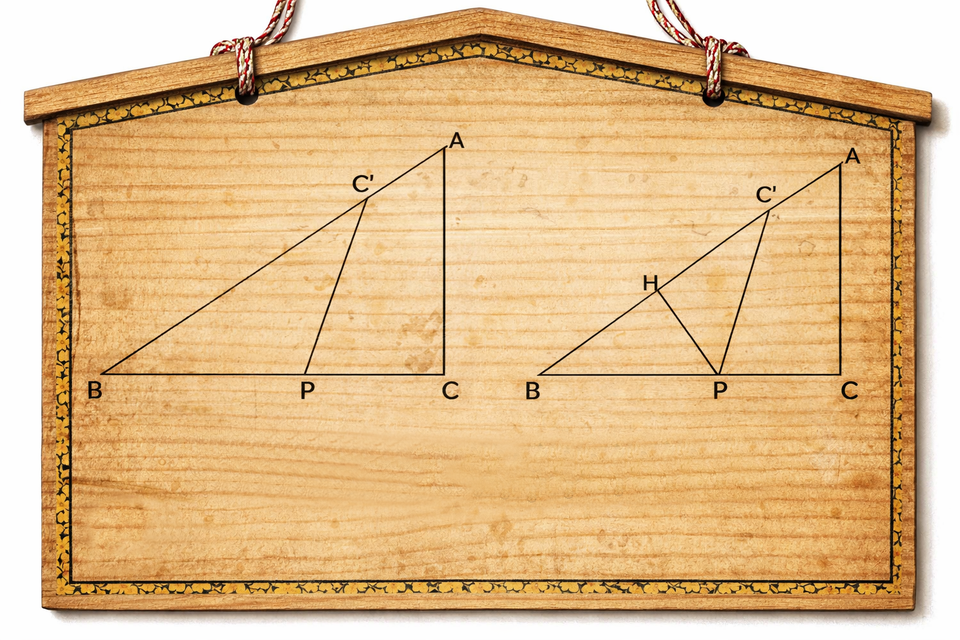
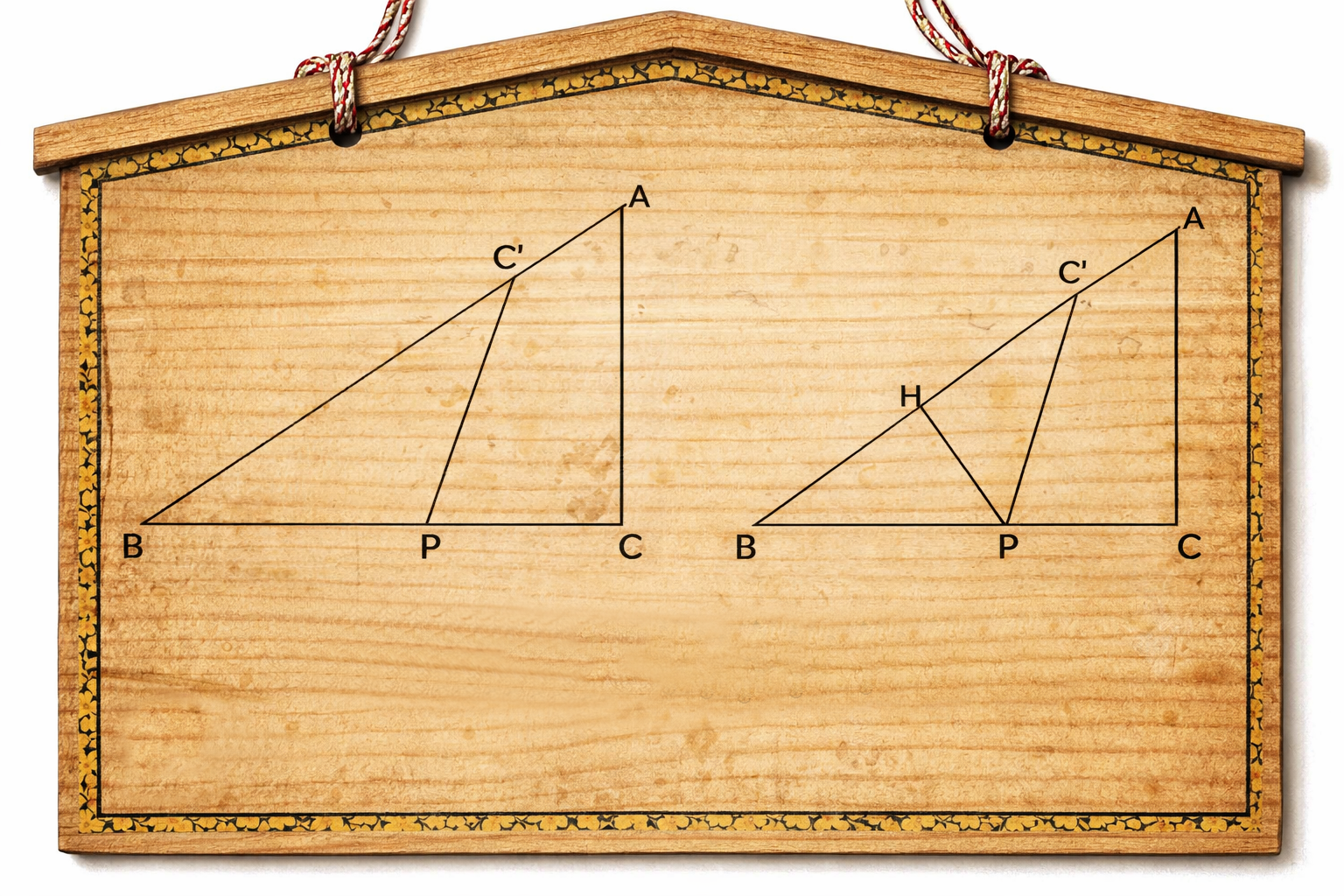
In the right triangle ABC, with a right angle at C, point C′ lies on the hypotenuse AB such that BC′ = BC. Point P is chosen on leg BC so that segment C′P divides the triangle into two equal-area parts. Prove that 2PC′ = AB, or that PC′ is half the hypotenuse.
Proof. Consider the classical argument given in modern discussions of sangaku.
Drop the perpendicular PH from P to the hypotenuse AB.
The area of triangle BPC′ is
1/2 · BC′ · PH
and the area of the whole triangle ABC is
1/2 · BC · AC
By hypothesis, BC′ = BC, and C′P divides the triangle into equal-area parts, so
hence
Now consider triangles ABC and PBH. Both are right triangles and share the angle at B, so they are similar. Therefore
so
The same similarity also gives
that is,
But BC′ = BC, hence BH = BC′ / 2, so H is the midpoint of BC′. Since PH ⟂ AB, P lies on the perpendicular bisector of BC′, and consequently PB = PC′.
Thus,
or
as required.
This problem shows clearly how sangaku can be translated from the language of diagrams into rigorous modern geometry. It also fits a practical agricultural problem: dividing a triangular plot into two parts of equal area.
Problem 3. A trapezoid divided into equal-area trapezoids
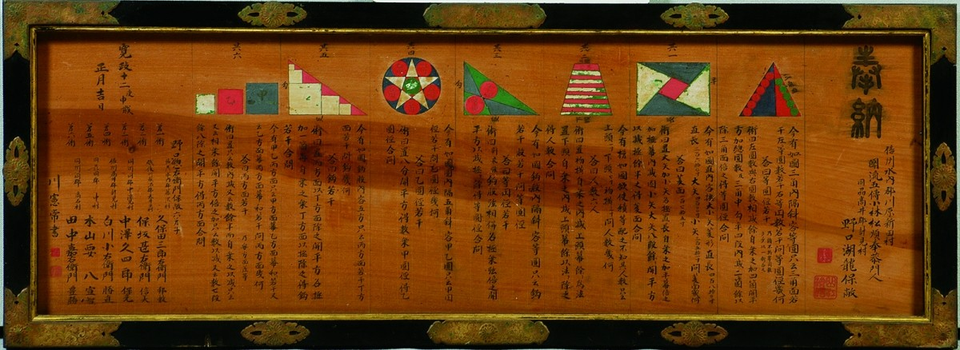
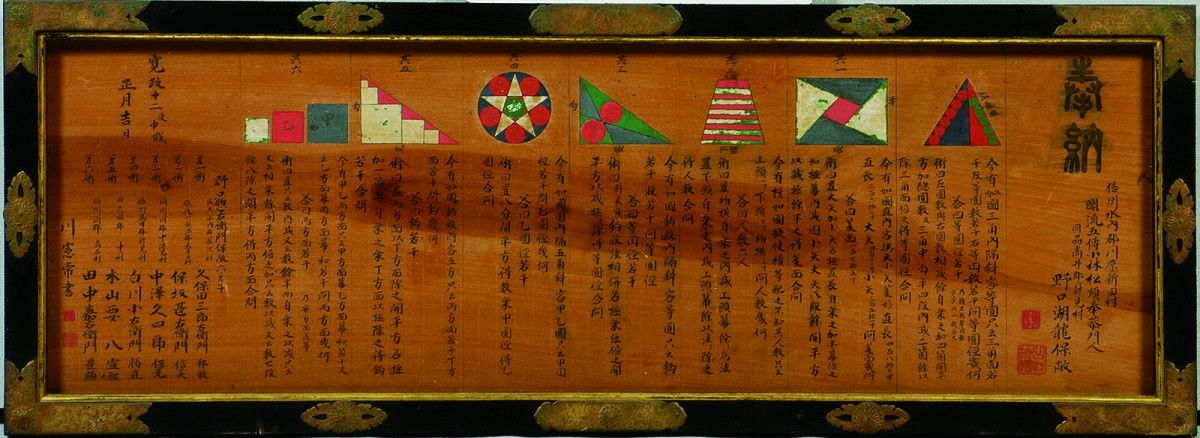
This problem comes from an actual tablet of 1800. In a modern formulation, it reads:
A trapezoid has lower base b, upper base a and height h. It must be divided into n smaller trapezoids of equal area. Let the lower base of the topmost, and therefore smallest, trapezoid be k. Find n in terms of a, b and k.
The solution follows from similarity. If the trapezoid’s width changes linearly from a to b, the height of the small uppermost trapezoid is
Its area is:
The area of the whole trapezoid is:
Since all the small trapezoids have equal areas,
Therefore,
This is almost olympiad geometry, yet it comes from an actual XIX-century temple tablet rather than a modern textbook.
Why these problems matter
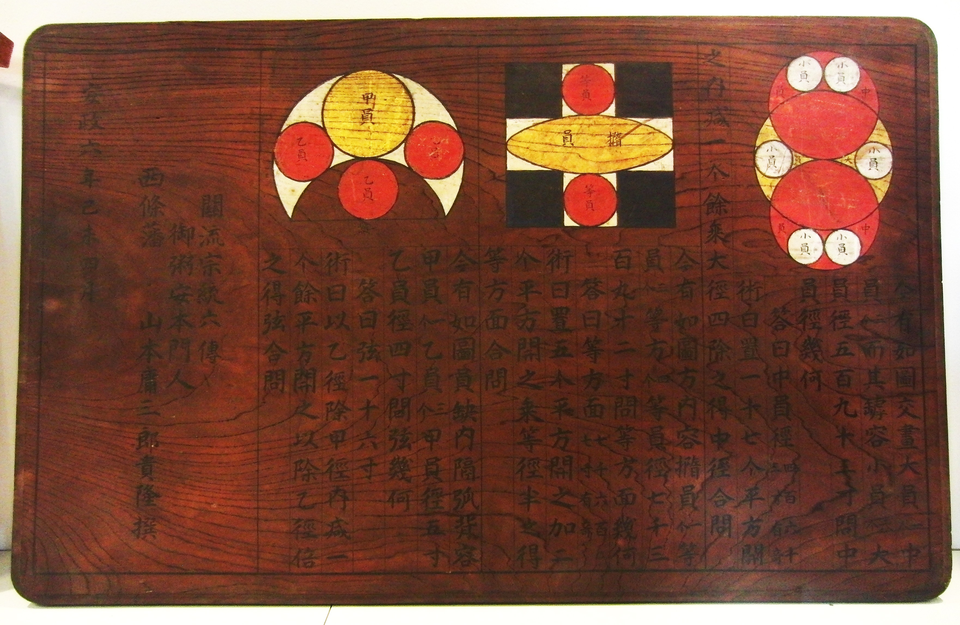
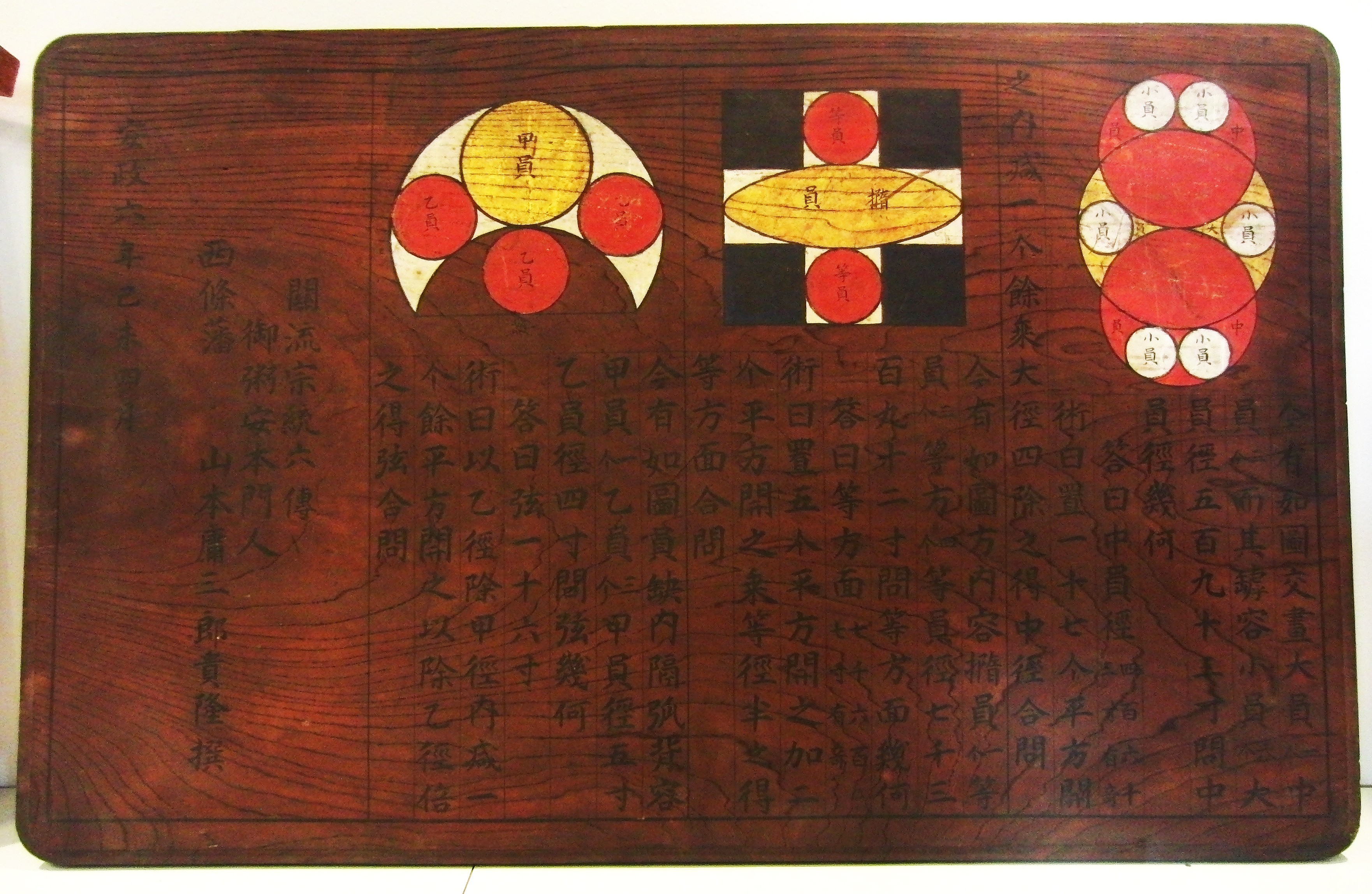
These examples show that sangaku are more than attractive circles on a board. They embody a serious geometric culture: similarity, areas, tangency, the passage from diagram to formula, and sometimes highly nontrivial calculations. All this existed as a public mathematical practice — an exhibition of problems beneath a temple roof — rather than as a dry treatise.
Travelling mathematicians also played a special role in preserving this tradition. One, Yamaguchi Kazu (Kanzan), kept a travel diary during his journeys through Japan and copied hundreds of sangaku problems he saw in shrines and temples. These records reveal both the problems themselves and the connections between the learned people, schools and places where this culture flourished.
Sangaku attract us for reasons beyond any claim to contain the world’s hardest problems. Their power lies elsewhere. They offer a rare instance of mathematics serving simultaneously as an offering, a public puzzle, an artwork and a monument to local learning. In Europe, geometry generally lived in treatises and classrooms. In Edo-period Japan it also hung under shrine roofs, among prayers, ema tablets and the scent of wood.
That is why sangaku still make such a strong impression: they show that mathematical beauty can be rigorous and also visible, almost festive.