
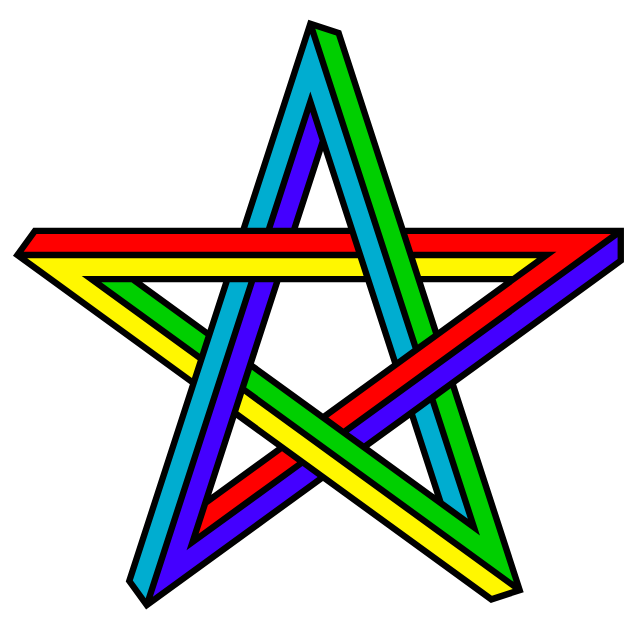

The pentagram, or regular five-pointed star, was the Pythagoreans’ favourite geometrical figure. It served as their password and symbolized health and happiness. They drew it in the sand to greet one another.
The pentagram (pentalpha, pentageron, Pythagorean pentacle; Greek πεντάγραμμον, from πέντε, “five”, and γραμμή, “stroke, line”) is a star polygon formed by joining every other vertex of a regular pentagon.
It is also formed by the diagonals of a regular pentagon, or by extending a regular pentagon’s sides until they intersect.
The pentagram has remarkable properties. It can be composed of three “sublime triangles”: isosceles triangles of the form of triangle ABC:
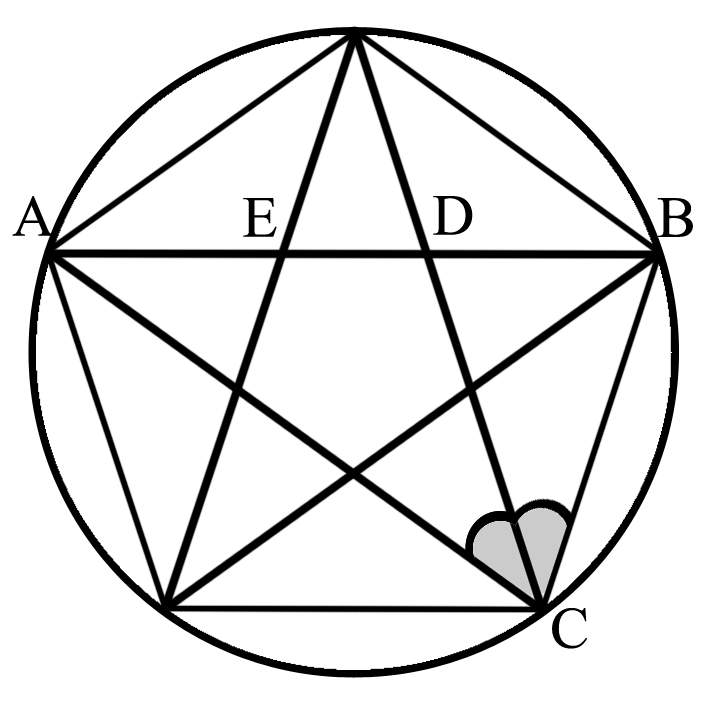

\triangle ABC is a “sublime triangle”:
The bisector of a base angle divides the lateral side in the “golden proportion”, in which the larger quantity is to the smaller as their sum is to the larger. One of the pentagram’s rays is this bisector. Thus, the rays of the pentagram form the golden ratio.
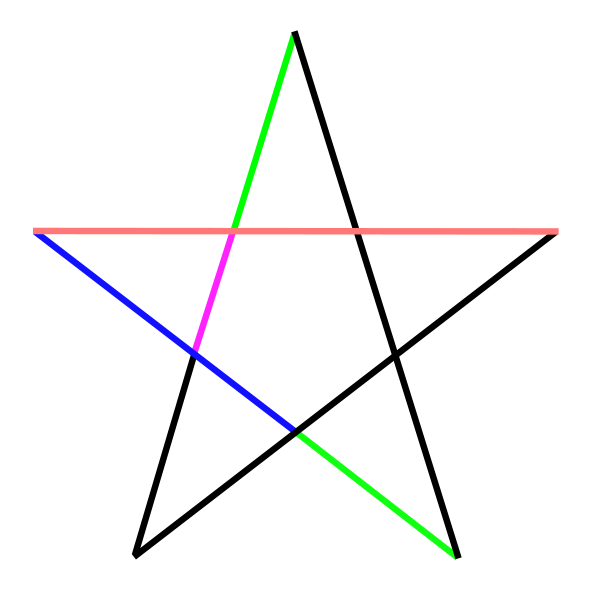

The segments of the pentagram are related by all the kinds of means known to the Pythagoreans: arithmetic, geometric and harmonic.
The earliest known depictions of pentagrams occur in the ruins of Uruk, the ancient city-state of the Sumerians and Babylonians in southern Mesopotamia, around 3500 BCE. Pentagrams also appear on Egyptian statues. Medieval occultism borrowed the pentagram from mathematics and astronomy.
In the early centuries of Christianity, the inverted pentagram was interpreted as a symbol of Christ.
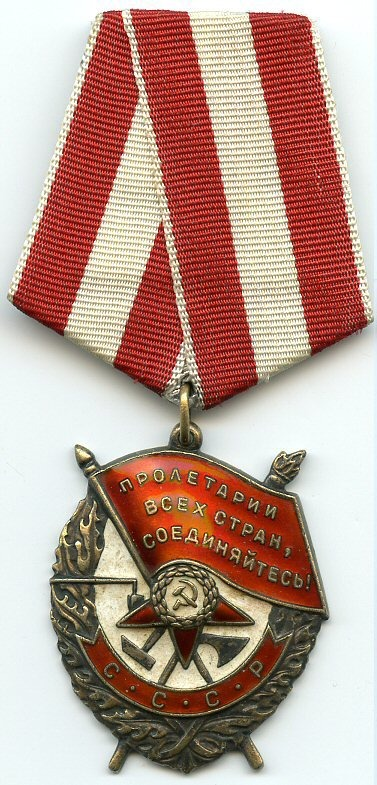
An inverted pentagram appeared on one of the USSR’s state decorations, the Order of the Red Banner.