
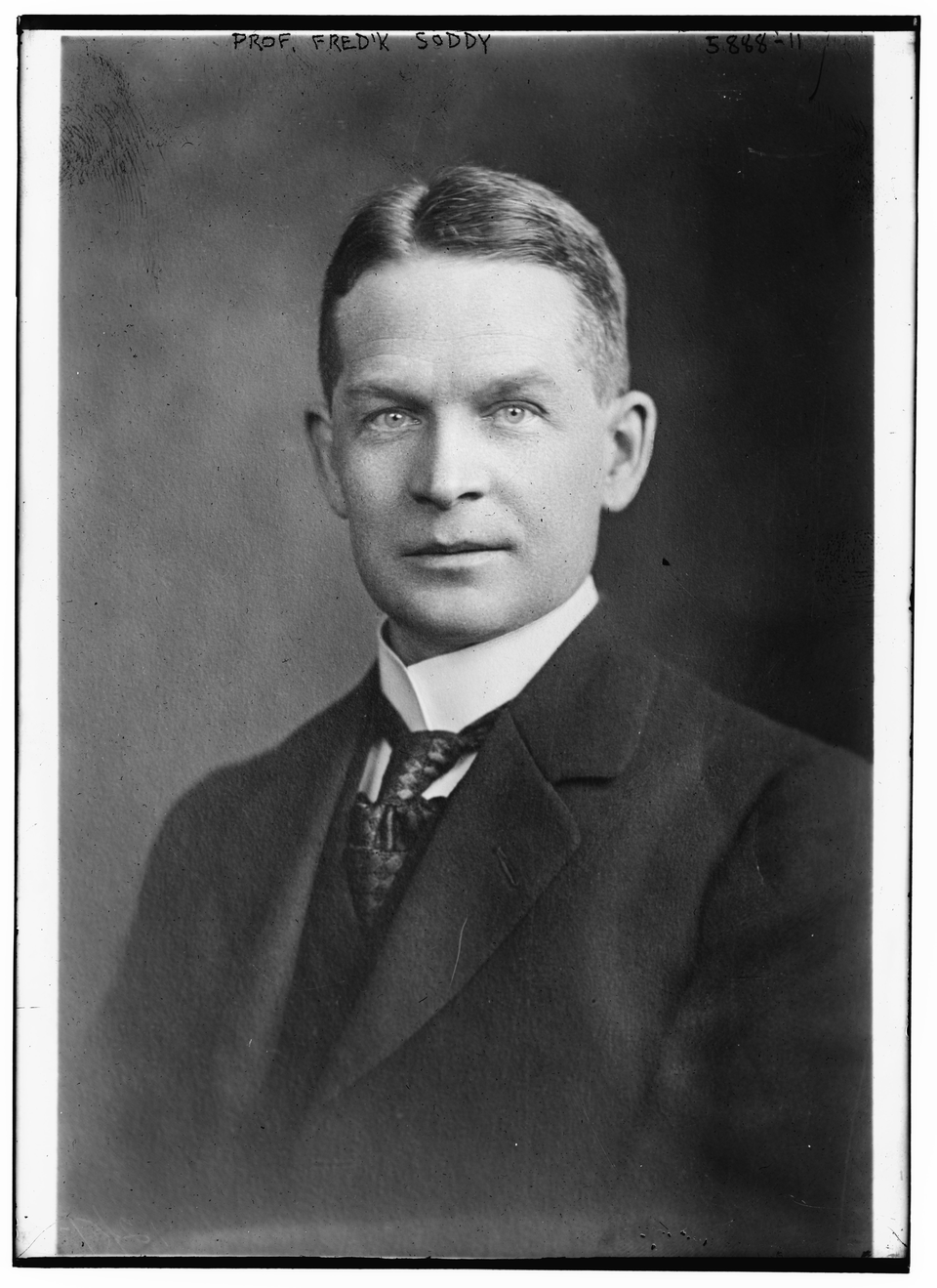

Frederick Soddy (1877–1956) was an English radiochemist, a Fellow of the Royal Society (1910), and a Nobel laureate in Chemistry for the discovery of isotopes (1921). Together with Ernest Rutherford, he proposed the theory of radioactive decay, which marked the beginning of the modern understanding of the atom and atomic energy.
In June 1936, readers of Nature received a pleasant surprise. This time, the celebrated chemist Soddy delighted the scientific world with a poem. It was called The Kiss Precise, freely rendered in Russian as “A Calculated Kiss”, and its first stanza, a verse passage expressing a complete thought, ran approximately as follows. The Russian rendering is translated here into English:
When lips come close to other lips,
The head may hold no thoughts.
But if four circles suddenly
Decide to kiss each other,
Only a geometer’s calculation
Will bring them to that kiss.
Two ways will do, neither is bad:
Three in one, or one among three.
If three in one, from within
They reach towards the giant.
Yet it is happy among three as well:
Three kisses, all from outside.
For pairs of lips to kiss maybe
Involves no trigonometry.
This not so when four circles kiss
Each one the other three.
To bring this off the four must be
As three in one or one in three.
If one in three, beyond a doubt
Each gets three kisses from without.
If three in one, then is that one
Thrice kissed internally.
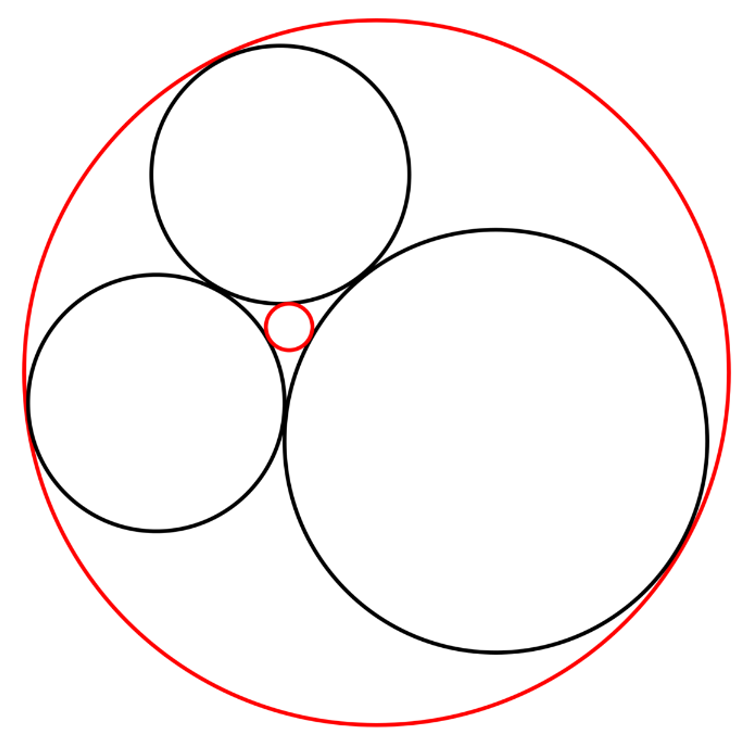

In the next stanza, Soddy presents his formula in the same poetic spirit: twice the sum of the squares of the reciprocal radii equals the square of their sum.
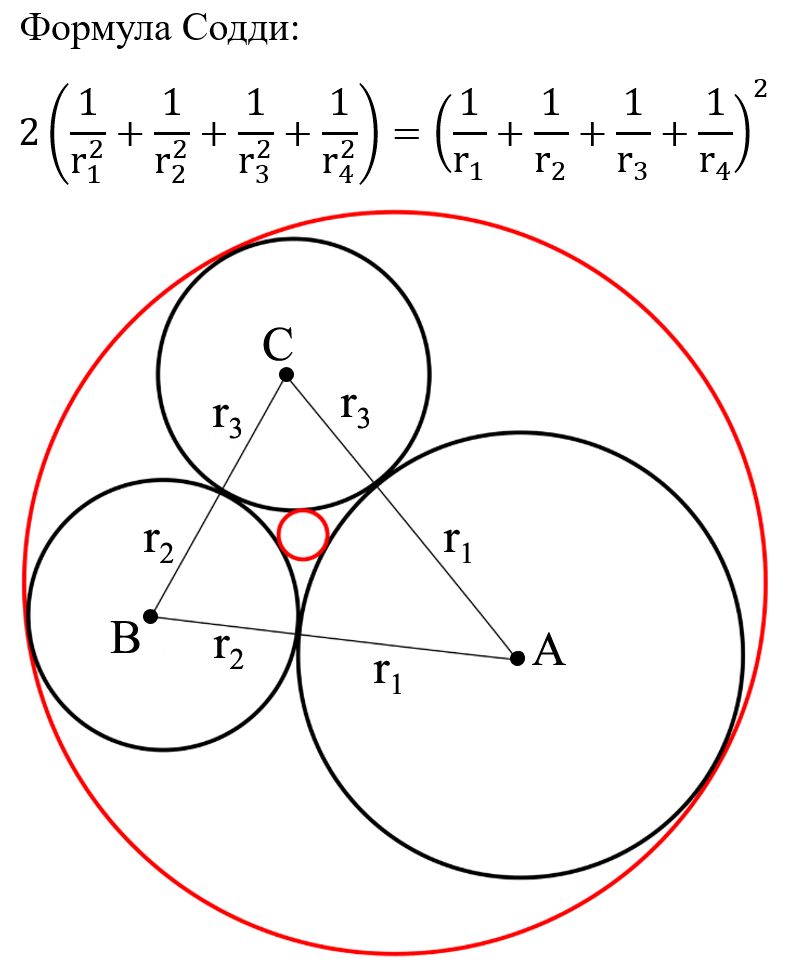

It was later found that René Descartes had already known this formula. Soddy, however, discovered it independently.
Descartes’ theorem states that the radii of any four mutually tangent circles satisfy a certain quadratic equation. Solving it allows us to construct a fourth circle tangent to three given circles.
The theorem is named after René Descartes, who formulated it in a letter to Princess Elisabeth of Bohemia in 1643.
The simplest statement of Descartes’ theorem uses the curvatures of the circles. The curvature of a circle is defined as k = ±1 / r, where r is its radius. The larger the circle, the smaller the magnitude of its curvature, and vice versa.
The positive sign is used when the circle is externally tangent to another circle. For circles tangent internally, the negative sign is used.
If a straight line is regarded as a degenerate circle with zero curvature, and therefore an infinite radius, Descartes’ theorem also applies to a straight line and two circles that are pairwise tangent. In this case, it gives the radius of a third circle tangent to the other two and to the line.
If four circles touch one another at six distinct points and have curvatures ki (for i = 1, 2, 3, 4), Descartes’ theorem states:
Although some accounts suggest that a proof of the theorem may date to ancient Greece or to the flourishing of Japan’s sangaku culture, its most likely discoverer is René Descartes.
Soddy rediscovered the formula in 1936. He also generalised the theorem to spheres.
Thorold Gosset generalised it to arbitrary dimensions. Proofs of these theorems can be found in the mathematical literature, but they are not particularly simple.