

This article considers what a crisis in science means and whether mathematics has experienced crises, or still does today.
First, let us define a scientific crisis. It should be understood as a category in the philosophy of science: a situation in which the scientific community questions a science’s methodological foundations. Established patterns for perceiving scientific data and acceptable explanations break down. A crisis may arise when anomalies appear and are recognized as examples contradicting a generally accepted theory. Such contradictions mostly stem from science’s inability, at that stage, to explain the difficulties encountered. Emerging from the crisis means finding methods and means of explaining them.
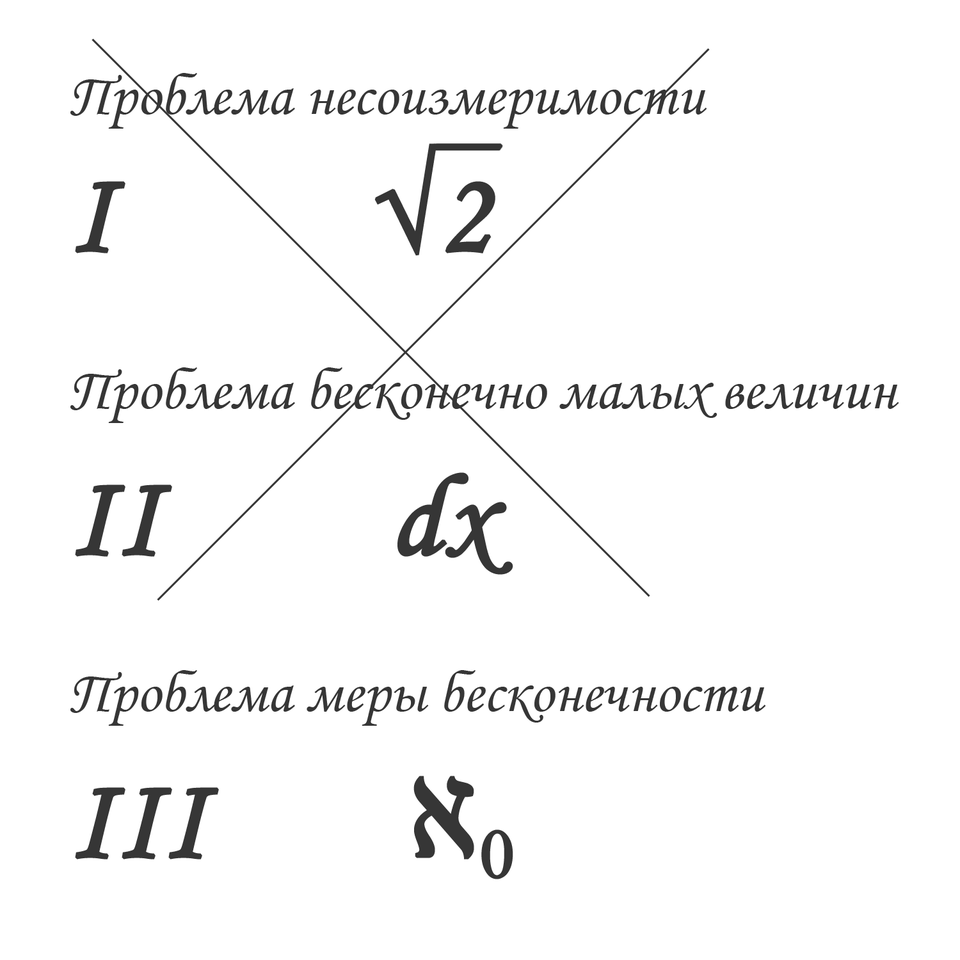
In the history and philosophy of mathematics, three crises are most often discussed.
The first crisis
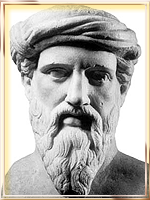
This may provisionally be called the ancient Greek crisis. It was in ancient Greece that mathematics began becoming a theoretical, deductive science with axioms, theorems and proofs, in the Pythagorean school of the 6th–5th centuries BCE.
“All is number”: numbers acquired a mystical meaning. Everything happening in the world was to be reduced to numerical harmony. That harmony was disturbed by the discovery that some line segments were incommensurable. Until then, all segments had been considered commensurable: the ratio of their lengths could be expressed as an ordinary fraction. The Pythagoreans discovered that the ratio of a square’s diagonal to its side could not be represented this way.

Two possibilities opened before the Pythagoreans. They could try to extend the concept of number by adjoining irrational numbers to the rationals, describe incommensurable quantities through numbers of another nature and thereby restore their principle that “All is number”. They could not, however, explain the phenomenon with the means available to their science. The Greeks therefore accepted that geometrical objects were quantities of a more general nature than fractions and integers, and tried to build all mathematics on a geometrical rather than an arithmetical basis. Thus “geometrical algebra” was adopted in the 5th century BCE.
Yet this compass-and-straightedge geometry did not solve the problem. There arose, for example, the famous three classical problems of antiquity: doubling the cube, trisecting an angle and squaring the circle. Geometrical algebra could not solve them. They were finally resolved only in the 19th century, with negative answers. That resolution depended on the same extension of the concept of number, the introduction and acceptance of irrationals, and a rigorous construction of the theory of real numbers. Although the Greeks had made a beginning — Eudoxus of Cnidus, 408–355 BCE — the problems were resolved only in the development of infinitesimal analysis based on rigorous models of the real numbers, in the 19th-century work of R. Dedekind, G. Cantor, K. Weierstrass and A. Cauchy.

Difficulties in understanding infinity and continuity also entered the crisis of ancient Greek mathematics. Zeno of Elea’s paradoxes, including the Dichotomy and Achilles and the Tortoise, and Democritus’ atomistic theory arose and required explanation.
Thus ancient Greek mathematics had already posed the questions associated with the crisis in the foundations of mathematics.
The second crisis
This arose from the use of infinitesimal methods. Mathematics’ creative revival began in the 17th century with Newton and Leibniz, although they too stood “on the shoulders of giants”. Their methods initiated differential and integral calculus, solving many problems of continuous processes. They relied on a non-rigorous concept of infinitely small quantities tending towards zero without ever reaching it. This unresolved problem at one time called mathematics’ scientific status into question. There was no clear definition of a limit: limits were described intuitively through mechanical and geometrical examples rather than rigorously defined.
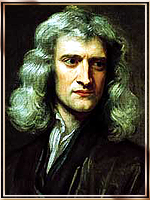

Deficiencies in Newton’s analytical methods provoked attacks on his theory of fluxions. In 1734 the English philosopher and bishop George Berkeley published a pamphlet known as The Analyst: The Analyst, or a Discourse Addressed to an Infidel Mathematician, Wherein It Is Examined Whether the Object, Principles, and Inferences of the Modern Analysis Are More Distinctly Conceived, or More Evidently Deduced, than Religious Mysteries and Points of Faith. The Analyst offered witty and, in many respects, justified criticism of Newton’s theory.
A way out was found only much later, in the early 19th century, by Augustin Cauchy. It rested on systematic use of the limit concept, a definition of a continuous function, the derivative as the limit of a ratio and the integral as the limit of sums.
Thus the rigorous construction of analysis resolved the problems of both mathematical crises.
The third crisis
This continues to the present day. It is associated mainly with set theory and with defining a measure of infinity.
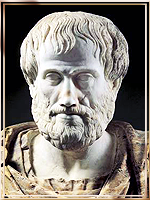
In his Physics, Aristotle defined two different types of infinity: potential infinity, an unending process of growth, and actual infinity, a quantity that really exists but has no finite measure.

Mathematicians long disputed these definitions and their use, until Georg Cantor proved the existence of infinitely many actual infinities. He proved that infinities can differ in cardinality. For example, the set of natural numbers N, a countable set, and the set of real numbers R, a continuum, have different cardinalities.
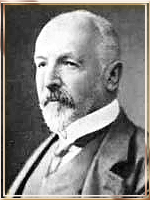

The problem of whether uncountable sets exist whose cardinality is smaller than the continuum but larger than that of a countable set — the so-called continuum hypothesis — arose almost as soon as set theory appeared. The move to a new level of abstraction of infinity generated many paradoxes in set theory. The best known are the liar paradox, the barber paradox and Russell’s paradox.
The third crisis raised the question of mathematics’ exactness and the soundness of its basic concepts. This touches its very foundation: the status of mathematics as a science, the legitimacy of constructing its objects, their possible existence and the criteria for the truth of statements about them.
Three approaches emerged to lead mathematics out of the third crisis: logicism, intuitionism and formalism. They require a separate discussion.
Kurt Gödel’s incompleteness theorems for arithmetic (1930) created new problems in set theory and the justification of mathematics. The first states that if formal arithmetic is consistent, it contains a formula that can neither be proved nor refuted. The second states that if formal arithmetic is consistent, the formula asserting that arithmetic’s consistency cannot be proved within it.
There is also another view of mathematical crises: the second and third are really stages of one and the same crisis in mathematics’ foundations. The result is one crisis rather than three. The “three crises” are a myth for the simple reason that they arise from a desire to view different periods of mathematical history through the same template.
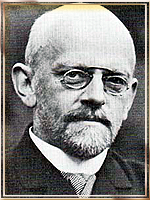
The principal conflict Hermann Weyl had in mind in 1921 when speaking of a “new crisis in the foundations” rested on the opposition between two particular mathematicians, David Hilbert and Jan Brouwer. Each had considerations of his own, more philosophical than mathematical, that led him to believe the foundations of mathematics were troubled and the situation was a crisis.

In fact, not all mathematicians considered their science to be in crisis. They were naturally well aware of uncertainties concerning basic concepts, such as the infinitely small quantity.
For example, Denis Diderot, chief editor of the famous Encyclopédie, emphasized mathematics’ thoroughly human character: “Man created a labyrinth and lost his way in it.” Lazare Carnot cites d’Alembert’s widely known words: “Go forward, and faith will come to you.”
The logical and set-theoretic paradoxes traditionally regarded as the source of the foundational crisis never seriously threatened mathematical results or their applicability to describing the physical world. Likewise, Kurt Gödel’s famous “limitation” theorems did little to limit working mathematicians’ creative activity. Nothing resembling a stagnation of mathematical research was observed then or is observed now. On the contrary, the era of the “third crisis” was an era of unprecedented flourishing in mathematical creativity.