
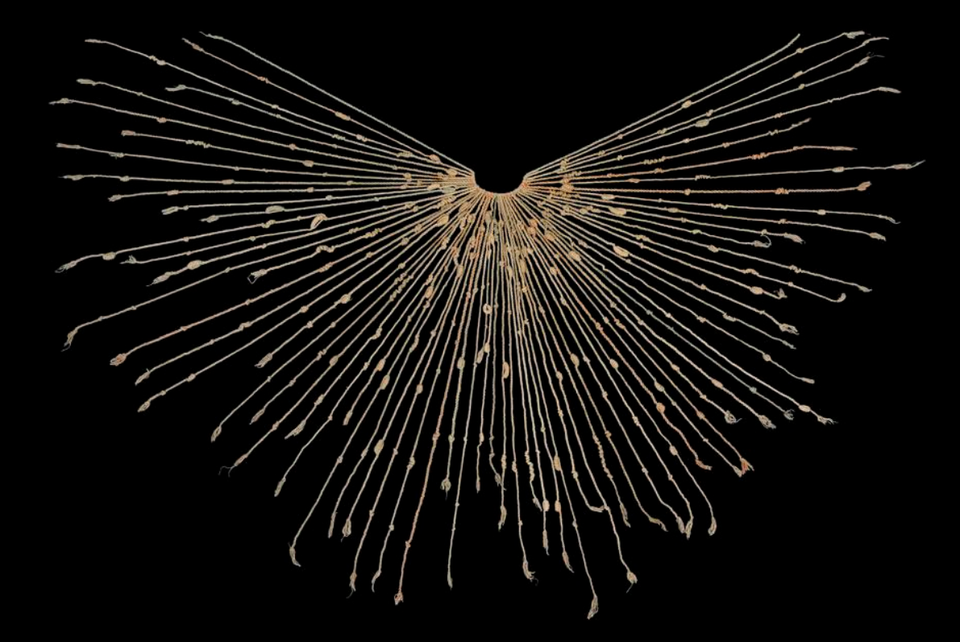

When we hear the word “writing,” we usually imagine signs on stone, papyrus or paper. In the Andes, however, another way of storing and transmitting information existed: in threads and knots. A khipu, also spelled quipu, was a system of cords, knots, colours and relationships between them. In the Inca Empire it was a working tool for governing an enormous country. Spanish chroniclers compared khipu to books; modern researchers confidently describe at least a well-developed numerical and accounting system.
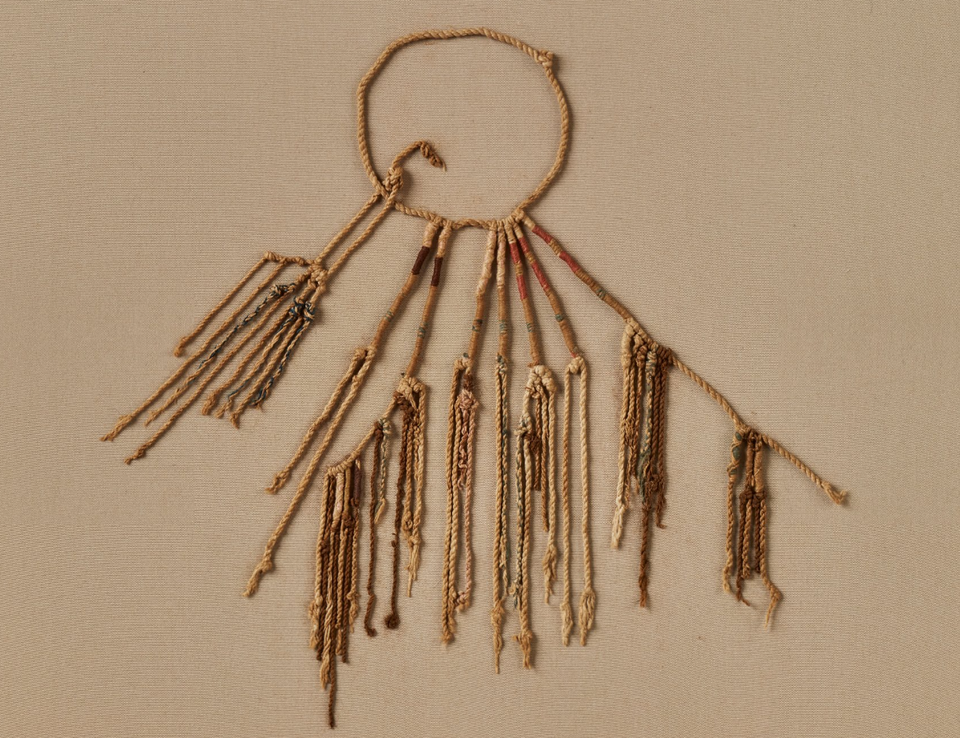
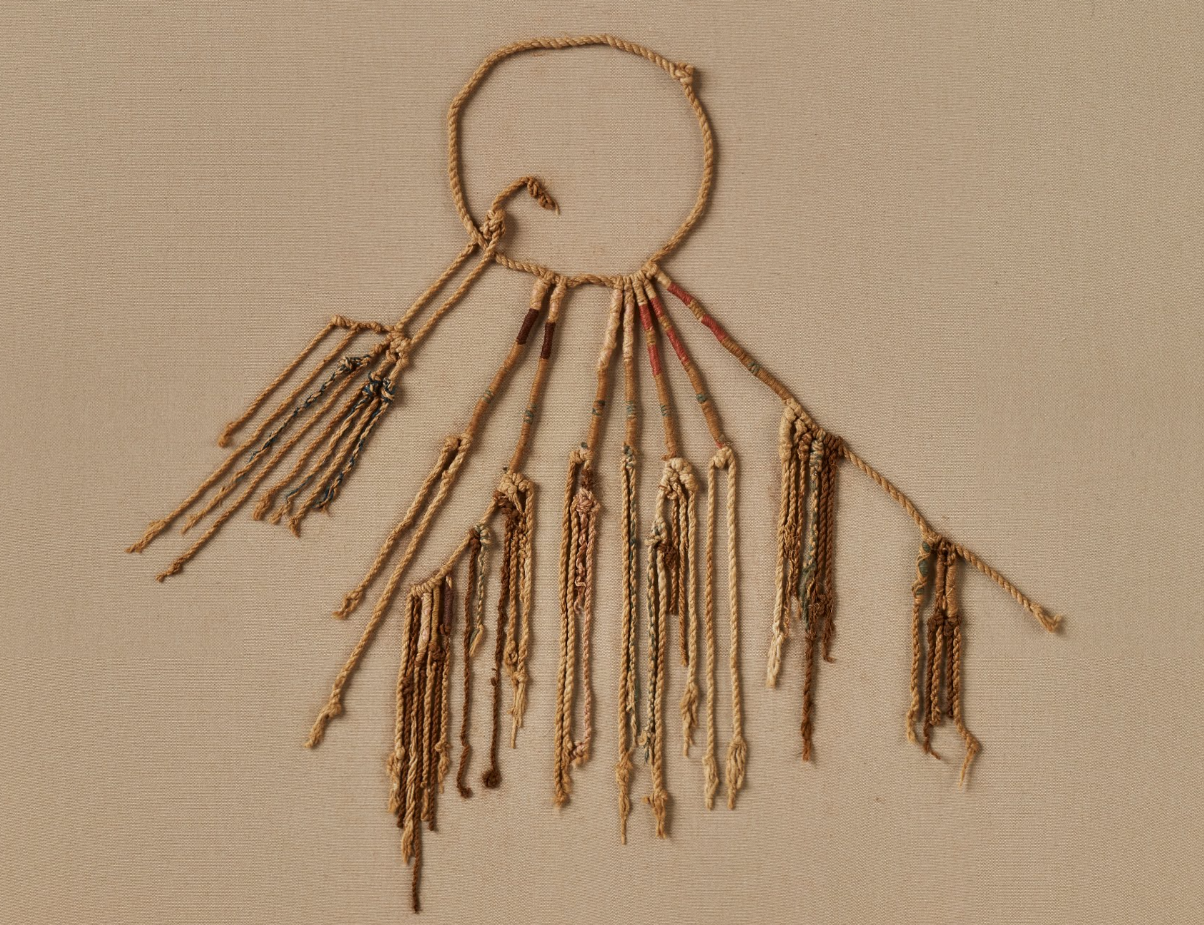
The Quechua word khipu means “knot.” A typical khipu consists of a main cord with pendant cords attached; these may have subsidiary cords and sometimes top cords. Materials were usually cotton or llama and alpaca fibres. The British Museum describes an Inca khipu as an object of systematically organized, dyed and knotted cords, comprising a primary cord, pendants and branches. The Museo Larco in Lima holds, for example, a khipu with 238 pendant cords in blue, green, brown, cream and white. This alone shows that it is a fairly complex information object, more than merely “a rope with knots.”
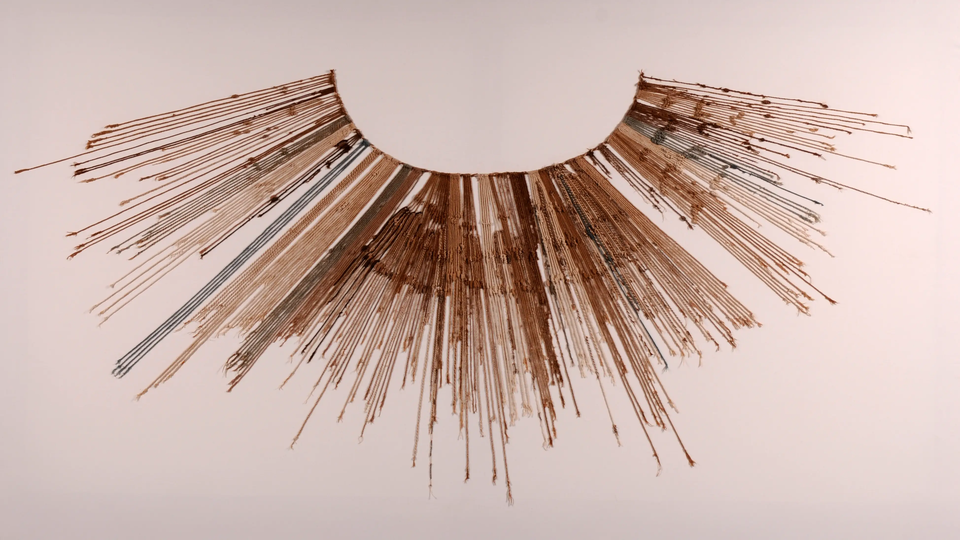
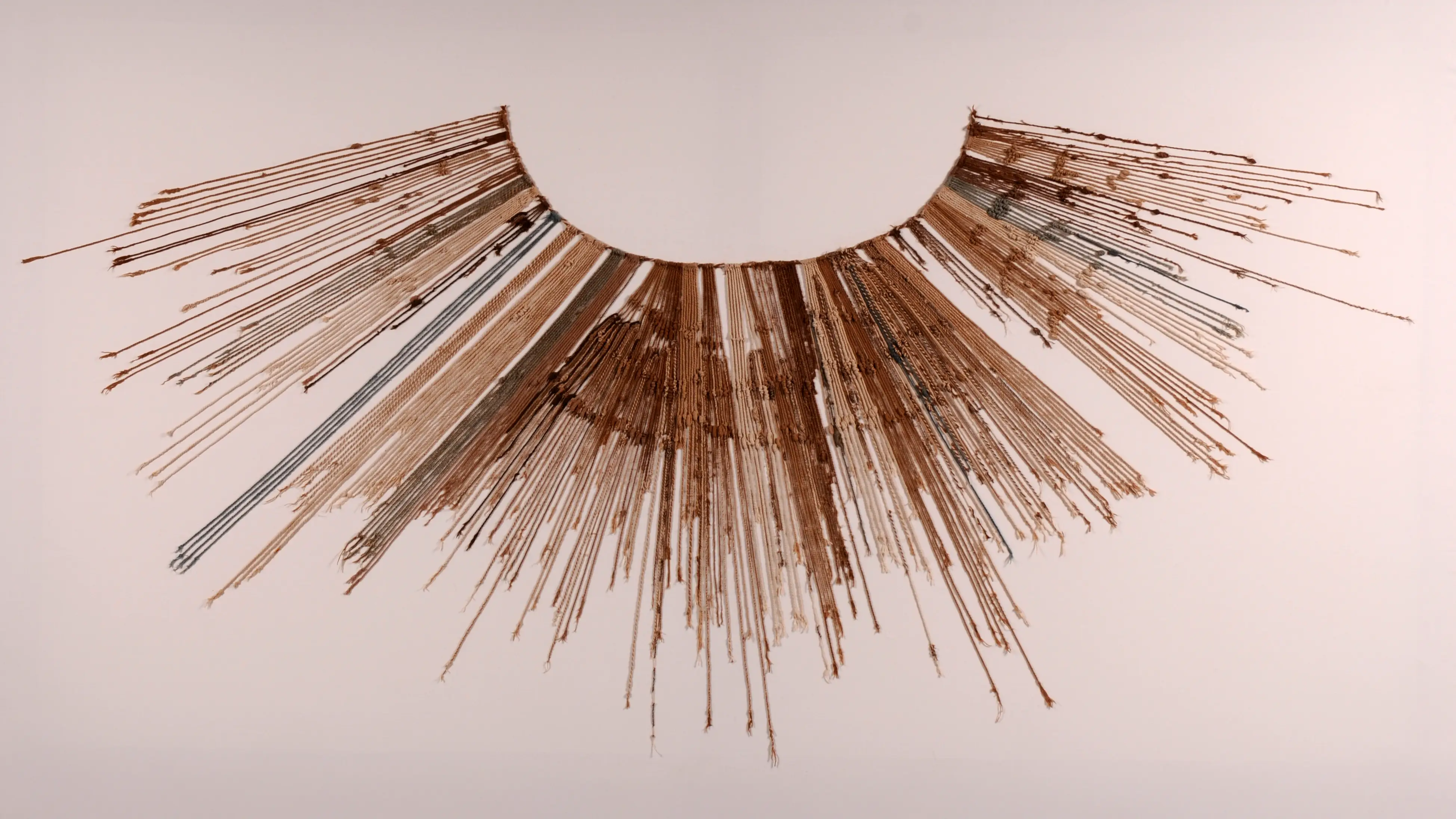
Quipu Inca, Museo Larco, Lima, Perú
For mathematical history, the crucial point is that the numerical component has been deciphered fairly reliably. The Inca used a decimal system: the position of knots on a pendant cord indicated units, tens, hundreds and so on. NIST, the United States National Institute of Standards and Technology, explicitly states that khipu knots follow decimal place-value rules, arranged as though each horizontal level corresponded to a successive decimal place. Britannica and Khan Academy give similar explanations.
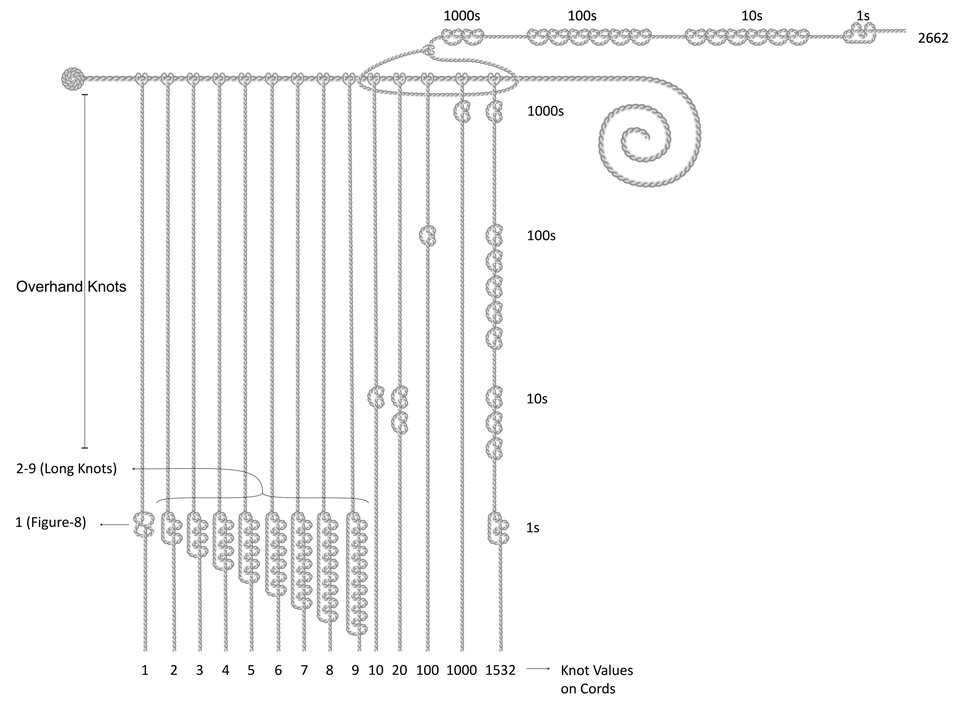
How did this work in practice? Special knots were used for units:
- A figure-eight knot meant 1.
- A long knot with two, three, four or more turns meant 2, 3, 4 and so on up to 9.
- A simple single knot in higher positions represented tens, hundreds and other powers of ten.
- An empty space at the appropriate place meant 0.
Britannica gives examples: 437 consists of four simple knots in the hundreds row, three in the tens row, and a long knot with seven turns in the units row. Likewise, 201 consists of two simple knots in the hundreds, an empty tens place, and a figure-eight knot in the units.
Now practise recognizing numbers with a small example.
Suppose one pendant cord has:
- three simple knots nearest the main cord;
- seven simple knots below them;
- a long knot with two turns at the bottom.
What number does the khipu record?
Answer: 372.
The three upper knots give 300, the seven in the middle row give 70, and the long knot with two turns at the bottom gives 2.
Altogether: 372 = 300 + 70 + 2.
This may be the most vivid moment in the whole history of khipu: an ancient cord suddenly reads almost like a column in a school exercise book. Its concept of place value is every bit as strong as that of our familiar written numerals.
Here is another example, with zero. If a cord has two simple knots in the hundreds, then an empty space, and a long knot with four turns at the bottom, it records 204. The gap matters just as much as a knot: it indicates the absence of tens. Khipu are therefore interesting as a complete positional accounting system as well as an ethnographic rarity.
Numbers were not the only information encoded. Researchers examine cord colours, the direction in which fibres are twisted, the way pendant cords are attached, and even whether a knot is tied in an S or Z direction. NIST emphasizes that twist direction, cord attachment and the resulting colour patterns may all have been significant alongside the knots. Numbers are only part of the khipu’s language.
What was all this used for? Primarily, managing the economy and people. Khipu helped account for warehouse stocks, taxes and obligations, herds, labour allocation and possibly census data.
Britannica states that Inca khipu were used at every level of bureaucracy, by regional administrators and local chiefs as well as in Cusco. NIST recalls the scale of administration: millions of people, roads extending thousands of kilometres, labour obligations, warehouses and supplies. Such a system could not have held together without effective accounting.
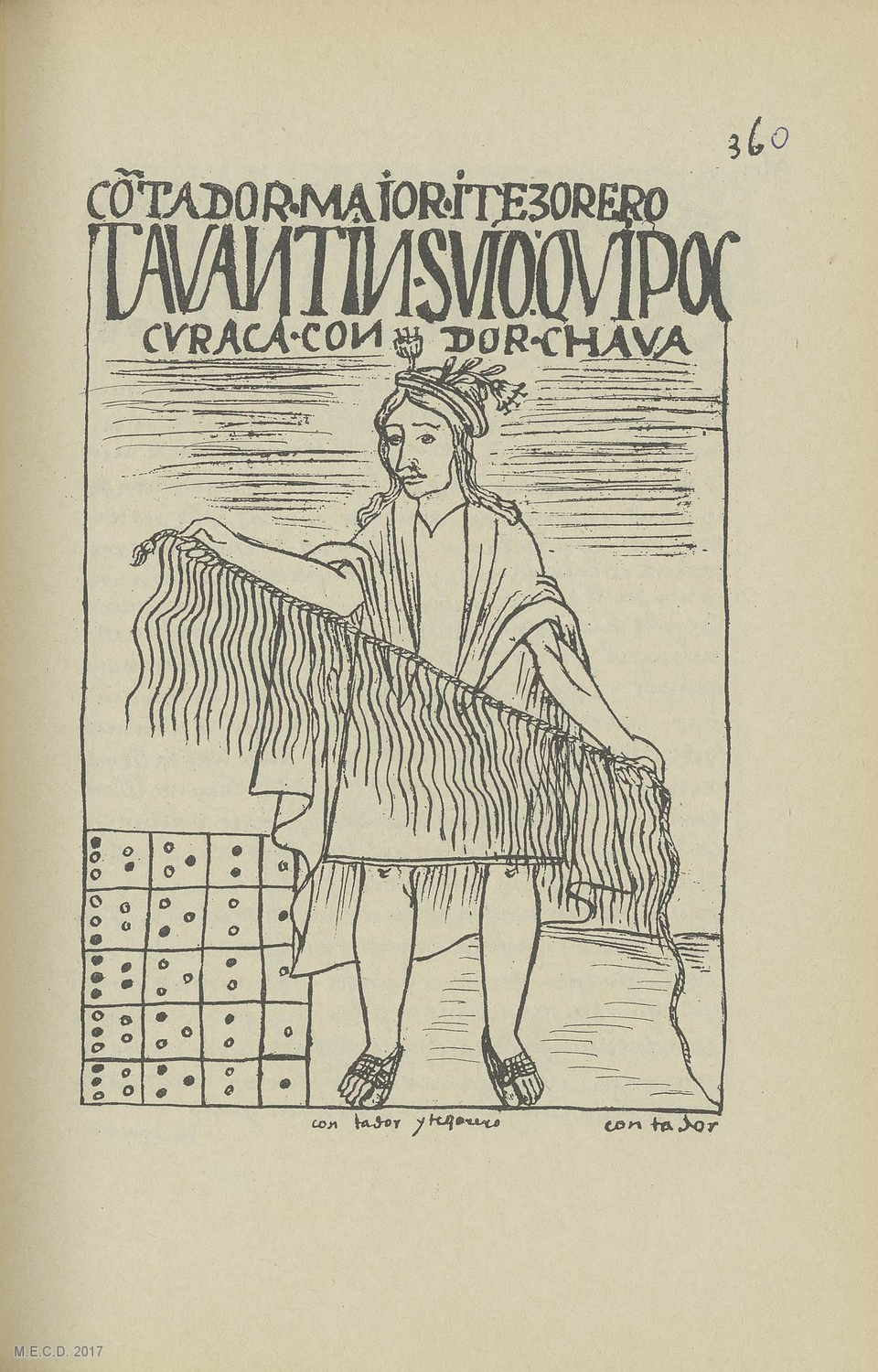
Khipu had their own specialists, the khipukamayuq: “keepers” or “makers of khipu.” Harvard Library translates the term as “khipu-authority.” Historical sources show that these specialists could not only make records but read, explain and cross-check them fluently. One study by Gary Urton even discusses a system of checks and balances: according to chronicles, communities could have several accountants keeping comparable records. This resembles a carefully designed administrative practice rather than disorganized memory aided by knots.
The Inca did not invent khipu from nothing. In its Peru exhibition guide, the British Museum states that the Wari introduced the system, which the Inca then developed. The Metropolitan Museum of Art likewise notes that the Wari prepared the ground for later Inca administration, including knotted recording systems. This was a long Andean tradition existing at least since the first millennium CE, with particularly strong development in the Inca Empire of the fifteenth and sixteenth centuries.
The history of khipu did not end immediately after the Spanish conquest. Many were destroyed, and some church and colonial authorities regarded them with suspicion. Yet sources also show continued colonial use in courts, local communities, and disputes involving property and administration.
José Carlos de la Puente Luna’s research on the early colonial Andes shows that khipu underlay lists and probanzas de méritos y servicios, formal testimony and documents concerning merits and service for courts or authorities. Local elites used these to substantiate quantities of supplies, services performed and even people provided to the Spaniards between 1532 and 1554. Khipu thus survived the empire’s fall and remained working instruments of local legal and economic systems for a long time.
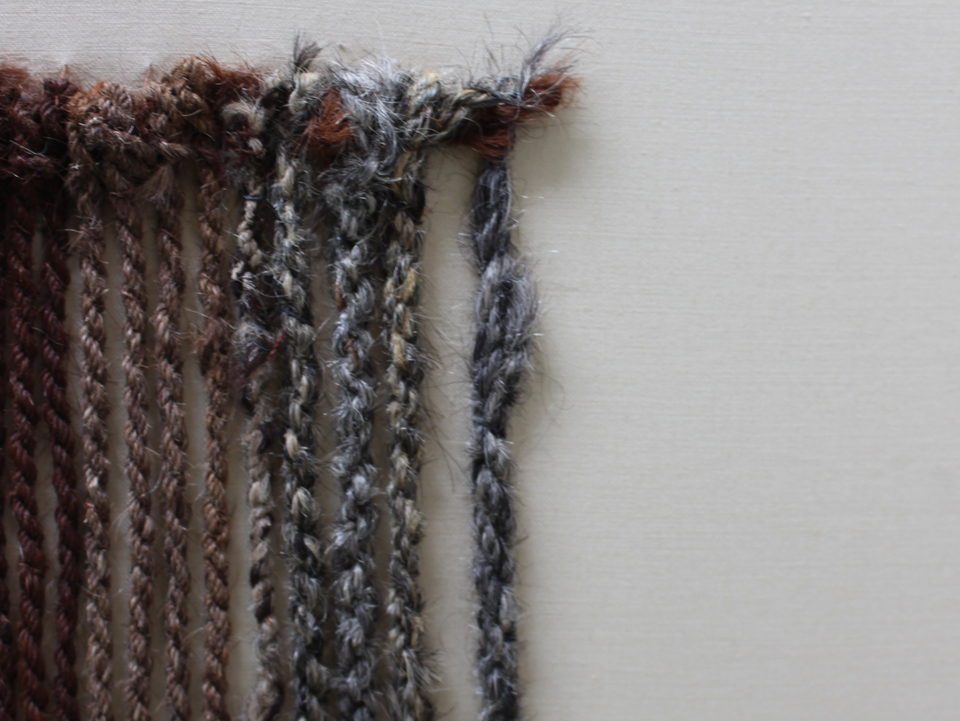
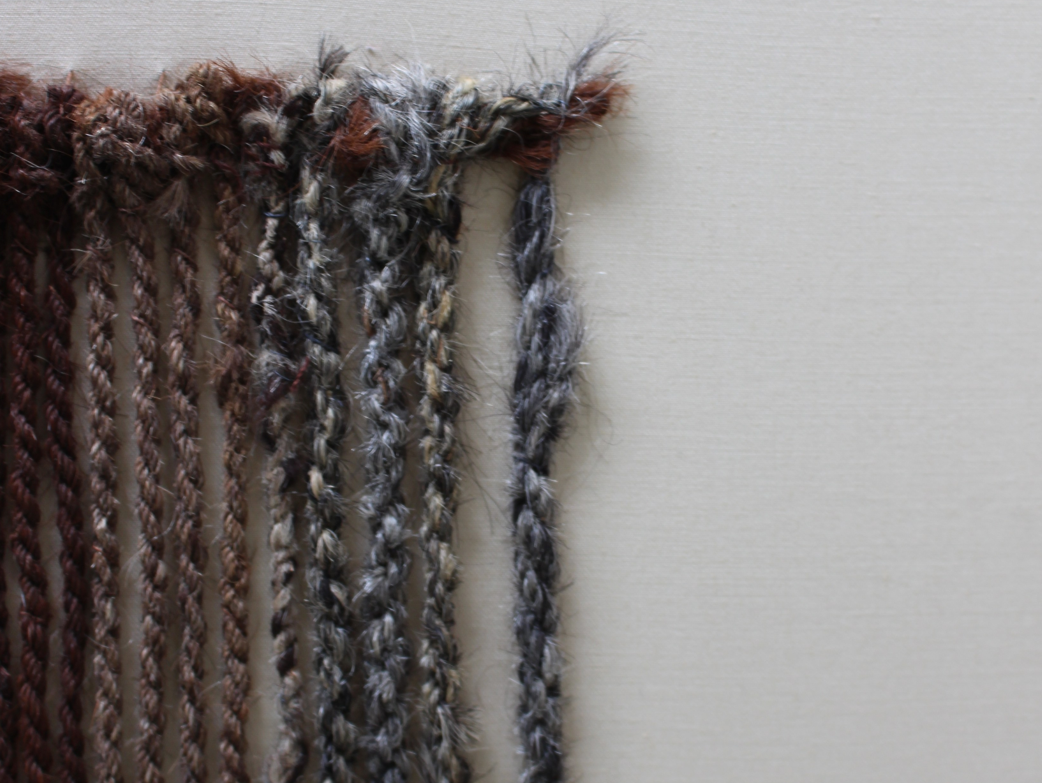
Still more interestingly, knotted recording survived in some places almost to our own day. Frank Salomon’s The Cord Keepers concerns a Peruvian village where a collection of cord documents remained part of communal memory. In her study of Anchucaya, Sabine Hyland writes that at least four communities in Huarochirí province used khipu into the twentieth century. Expert Mariano Pumajulca’s testimony, recorded in 1935, explains how khipu recorded the labour obligations of ayllus, kinship groups within a community. This is almost a living tradition.
Another important issue emerges here. While scholars generally understand the numerical component, non-numerical information remains an open question. Hyland’s research shows that special initial elements called kayte could indicate the topic or genre of some records. Her article explicitly states that a large kayte marked the beginning of reading and also identified the record’s subject. One example concerned a khipu recording ayllu members’ annual labour obligations in the 1930s. Studies also examine hybrid “khipu-alphabetic” texts, comparing knots with alphabetic labels.
This does not mean that all, or even most, khipu have been read as texts. More accurately, the numerical level is well deciphered, while researchers continue working on a more complex semantic and possibly partly textual level.
How many survive? The precise number depends on the catalogue. UNESCO reports that Harvard’s HDAKD database contains electronic records of 544 khipu from 88 museums on three continents. Britannica states that more than 600 have been found. The difference reflects different stages and methods of cataloguing. In any case, these are merely remnants of a once-rich tradition.
This is what makes khipu so fascinating. They stand at the meeting point of mathematics, bureaucracy, collective memory and textual messages. For a mathematical historian, they offer a rare chance to see counting, an empty place standing for zero, and data aggregation embodied in knots on cords as well as digits on paper. For a cultural historian, they remind us that counting and recording need not use a pen. For our readers, they are a wonderful reminder that mathematical history is much broader than the familiar school sequence “Egypt — Greece — Europe.” Sometimes it can literally hang in beautiful, multicoloured threads.