
When Charles V, King of Spain and Holy Roman Emperor, entered conquered Milan in triumph in 1541, Cardano, rector of the College of Physicians, walked beside his carriage. In response to this honour, he proposed fitting the royal carriage with a special suspension using two shafts whose movement would keep it horizontal. The empire’s roads were poor. Such a suspension system is now called a Cardan joint.

The Renaissance entered human history through more than the magnificent creations of artists, architects and poets. Many scientific discoveries made in this period surpassed all the achievements of ancient and Arab scholars.
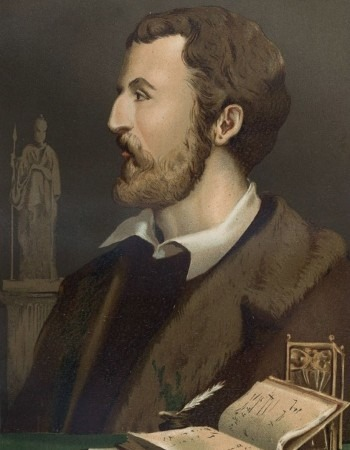

Among the Renaissance’s other intellectual giants, the name of Girolamo Cardano (1501-1576) is unfairly overlooked. He was a celebrated Italian physician, mathematician, mechanician and philosopher. Leonardo da Vinci preceded him; another titan, Galileo Galilei, followed. If we set aside human faults, weaknesses and prejudices and judge by the breadth of his knowledge and interests and the achievements he left to posterity, Cardano stands alongside those geniuses. Yet his place in the history of science remains ambiguous. Shakespearean passions still surround his name. Some writers even now speak of “Cardano’s broken oath.”
Cardano was born the illegitimate son of Fazio Cardano, a prominent Milanese lawyer and friend of Leonardo da Vinci. Fortunately, his father formalized his relationship with Cardano’s mother before dying, although their son was already an adult, had graduated from the University of Pavia and had become a doctor of medicine. Cardano regarded himself primarily as a physician — and not merely a good one, but an outstanding one, no worse than Hippocrates, Asclepius, Avicenna or Paracelsus. That was his character.
Indeed, his medical practice prospered for much of his life. He treated noble patients and had powerful patrons. He became a professor of medicine at the ancient University of Bologna and wrote works on medicine and pharmacy. He became known throughout Europe. In his writings, Cardano described ways of treating as many as five thousand difficult diseases. He was a skilled diagnostician.
Medicine did not absorb him entirely. He became a well-known inventor. We have already mentioned the famous Cardan shaft. The device bears his name, although it was used in ancient China. He also invented a combination lock. He is known to have argued that perpetual motion was impossible and to have studied optical, electrical and magnetic phenomena.
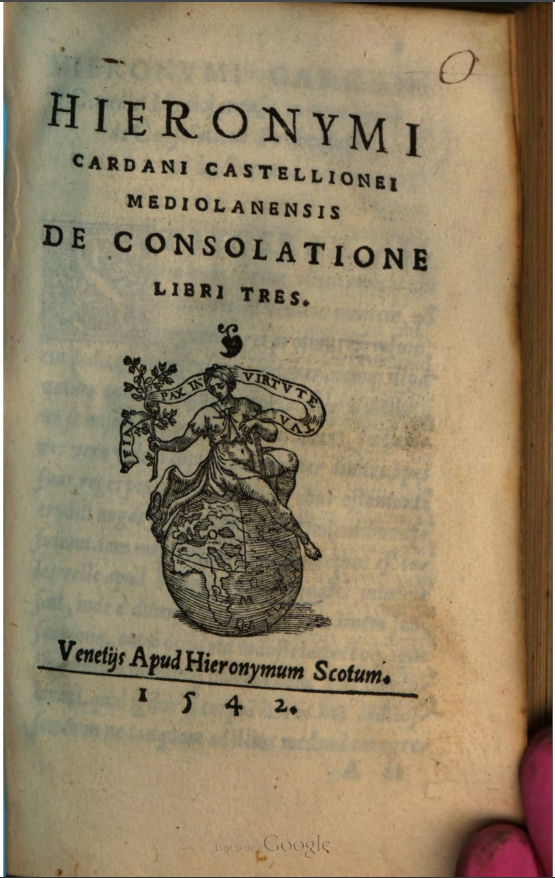

His literary career was equally varied. He published more than three hundred books, on medicine and mathematics but also philosophy, astrology and ethics. His encyclopedic treatises On Subtlety and On the Variety of Things, comprehensive accounts of the state of the natural sciences, were used as textbooks in Europe for a long time. On Consolation, translated into English, was especially popular. It is believed to have inspired Shakespeare’s Hamlet, and Hamlet himself delivers “To be or not to be” with this book in his hands.
With the substitution
any such cubic equation reduces to the depressed form
Its roots are:
The cube roots must be chosen consistently so that \alpha\beta=-p/3. The roots of the original equation follow from x_j=y_j-b/(3a).
Cardano’s formula for the roots of a cubic equation
Cardano also became absorbed in mathematics. The history of Cardano’s formula is one of mathematics’ dramatic stories. Every school pupil knows the formula for the roots of a quadratic equation. A comparable formula exists for an equation of the third degree, and it is called Cardano’s formula. Historians regard it as the first major achievement of European mathematicians after centuries of stagnation.
“He solved an equation — so what?” you might say. But that is a modern perspective. In Cardano’s time there was neither symbolic algebra nor even negative numbers. The formula placed him among Europe’s leading mathematicians. Yet the formula and its naming after Cardano have repeatedly been discussed as an example of dubious honour.
Another Italian mathematician, Niccolò Fontana, nicknamed Tartaglia, already knew these methods, though for particular cases. Cardano tried unsuccessfully for a long time to obtain his secret, but eventually succeeded. He swore to Tartaglia that he would not disclose it even after his own death, nor publish it before Tartaglia himself did.
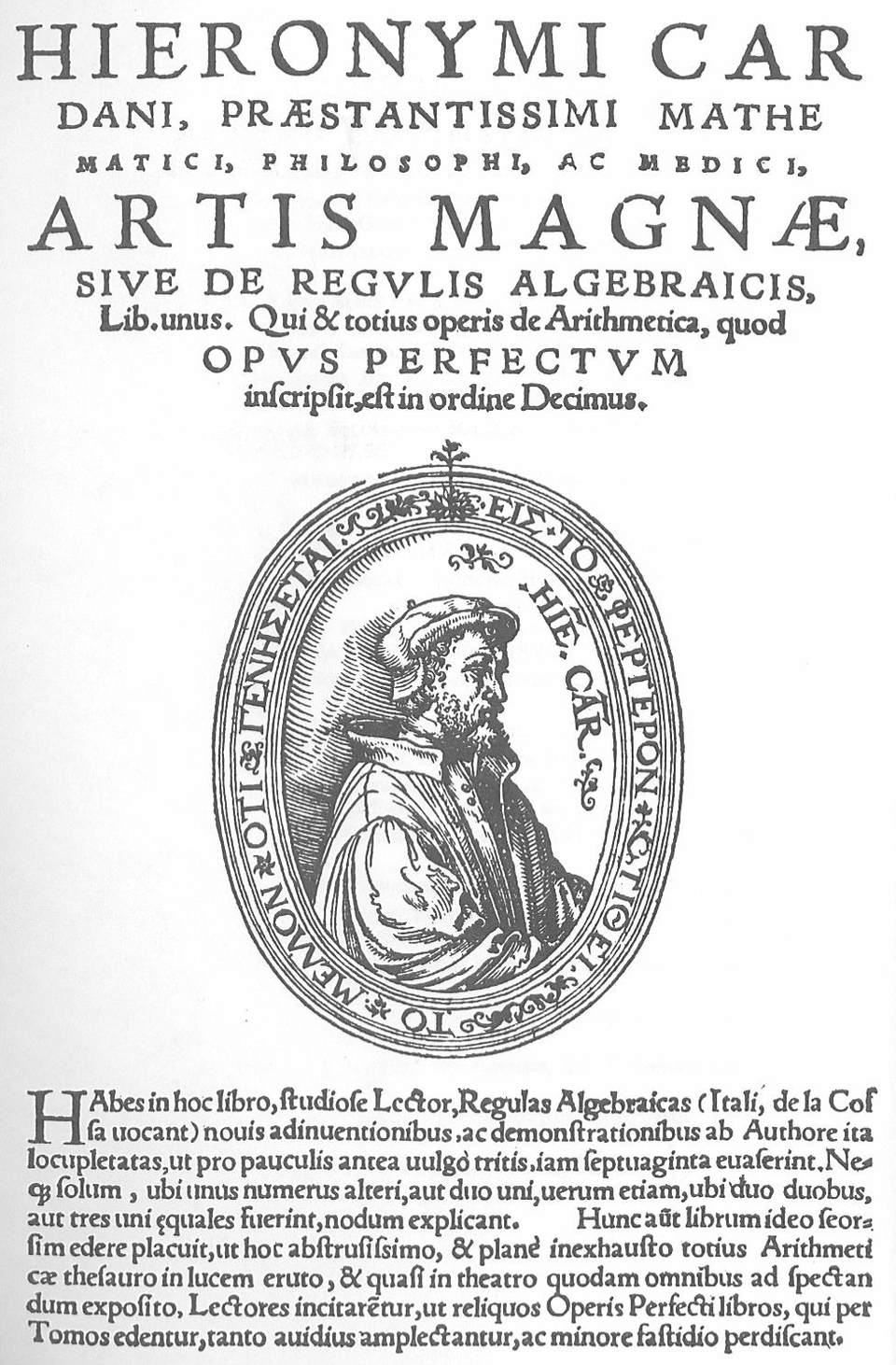

Cardano not only understood Tartaglia’s method but developed it further. He therefore considered himself entitled to publish the general formula. It first appeared in his famous The Great Art (Ars Magna, 1545), his principal mathematical work and a major step toward the new algebra. Although Cardano acknowledged Tartaglia’s authorship, Tartaglia’s name was forgotten over time. Tartaglia was furious, grew to hate Cardano, and attacked and complained about him for years. This earned him only a reputation as a quarrelsome failure.
Astrology was another of Cardano’s favourite pursuits. He cast horoscopes for a hundred great people. Popes used his horoscopes; thirteen held office during his lifetime. This did not save him from the Inquisition. In 1570 he was summoned to Rome and imprisoned for several months. Perhaps those horoscopes nevertheless counted in his favour.
He spent his last years in Rome under Pope Gregory XIII’s patronage. Cardano died on 21 September 1576. According to a familiar legend, this was the date given in the horoscope he had cast for himself, and he deliberately starved himself to prove his demonic power.
The discovery of a method for solving cubic equations stimulated the development of mathematics as a whole. Yet mathematicians still disagree: was Cardano entitled to publish Tartaglia’s formulas, even if only in the interests of science?