

Contents:
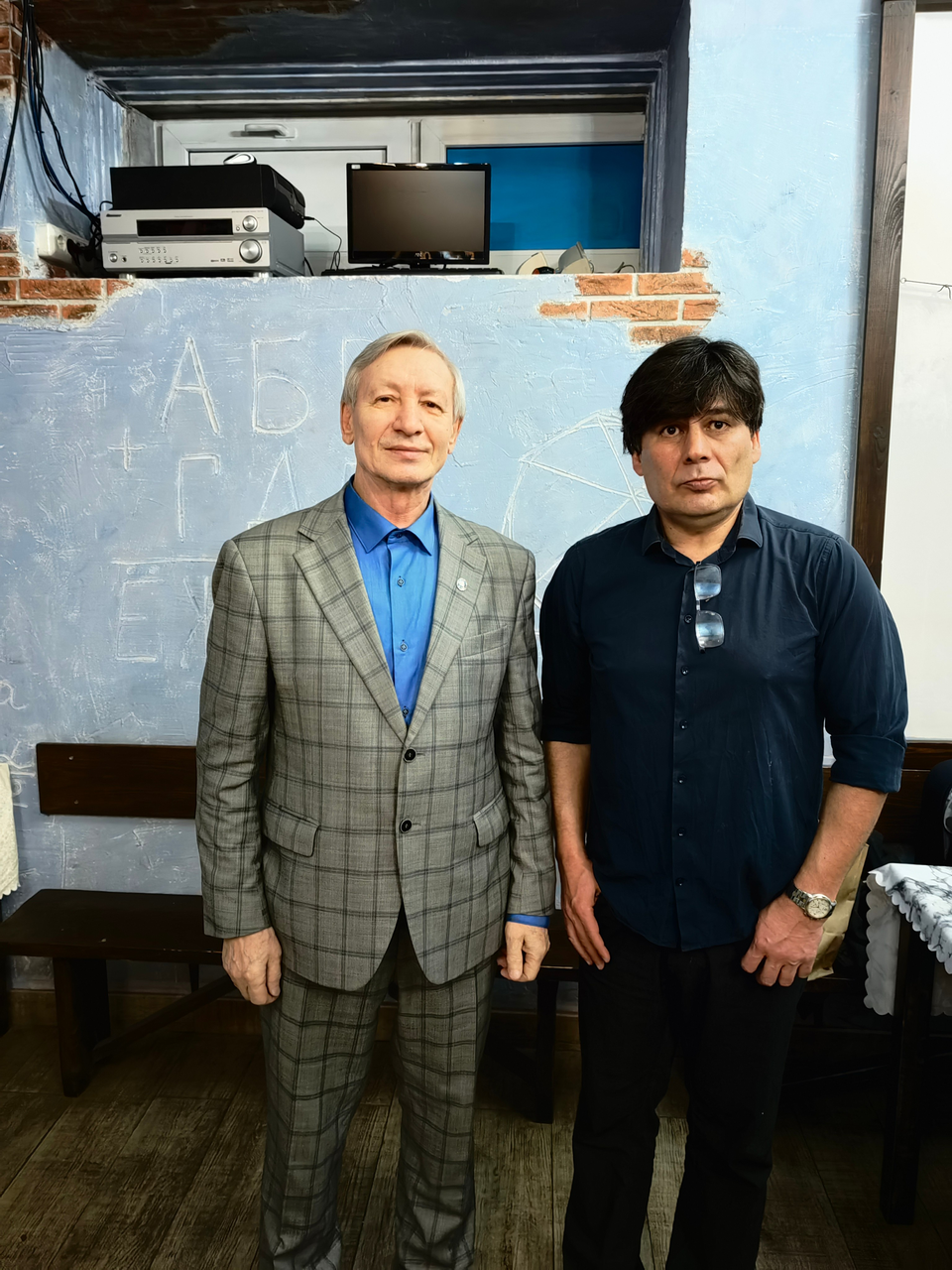
On 25 December 2025, the Moscow Centre for Continuous Mathematical Education hosted the 166th meeting of the Mathematics Teachers’ Seminar, the final meeting of 2025. Its title was “Under the Sign of Kvant”, and it proved apt: the discussion concerned both the magazine and the distinctive culture of mathematical reading that grew around it.
The meeting’s presenter, Nikolai Nikolaevich Andreev, spoke about the history of the legendary magazine Kvant, then about its new website, kvant.digital: its structure and features, including search, navigation by section and use of the archive, as well as what had already been achieved and what still needed improvement.

Why Kvant is more than a magazine
For many people, the word “Kvant” evokes the joy of discovery and learning something new, far removed from the required school curriculum. It means the pleasure of solving a problem independently, by choice rather than because it was assigned. For some it was their first real conversation with science; for others, it helped them choose a profession or provided decisive support in preparing for examinations and olympiads.
The magazine was given this role from the beginning. Its chief editors were the outstanding scientists Isaak Konstantinovich Kikoin and Andrey Nikolaevich Kolmogorov, and the initiative to establish it came from Pyotr Leonidovich Kapitsa. For them, popularisation was a mission in its own right.
Before Kvant: predecessors before the Revolution
Kvant had predecessors in pre-revolutionary Russia. The history of popular mathematical reading stretches back a long way:
- Journal of Elementary Mathematics (1884–1886): 36 issues edited by V. P. Ermakov with the participation of E. K. Shpachinsky;
- Bulletin of Experimental Physics and Elementary Mathematics (1886–1917): 674 issues, with editors including E. K. Shpachinsky, V. A. Zimmerman and V. F. Kagan.
The first issue of Kvant appeared early in 1970.
Kvant’s structure: sections, circles and the Problem Book
Over time, the magazine developed regular sections that became, for many readers, a familiar route through each issue:
- opening articles on mathematics and physics;
- “Kvant for Younger Schoolchildren”, abbreviated KMSh in Russian, with problems and notes for the youngest readers;
- “Mathematical Circle”, “Kaleidoscope” and other sections;
- “Olympiads”, “A University Applicant’s Workshop” and “Examination Materials”, vital in the era before the internet;
- “Games and Puzzles” at the beginning and the “Chess Page” at the end.
Kvant’s Problem Book became a phenomenon of its own: original mathematics and physics problems, followed by their solutions several issues later. It was a rare genre in which competition mathematics and pure mathematics met good presentation and respect for the reader.
The Kvant Library and the first digital archives
In 1980, at the editorial board’s initiative and with support from the USSR Academy of Sciences, the Kvant Library book series began appearing. For several generations, it provided a home library of mathematical reading: compact, intelligent and remarkably varied.
The digital archive was another important step in the 2000s. The “old” archive website first appeared at kvant.mccme.ru, later at kvant.ras.ru, gradually bringing together material from past years.
The new kvant.digital website: what makes it valuable
The magazine’s new website, kvant.digital, was launched on 7 October 2025 by the Laboratory for Popularisation and Promotion of Mathematics at the Steklov Mathematical Institute of the Russian Academy of Sciences. V. M. Busev, creator of the project “Mathematics Education: A Public Electronic Library”, scanned the magazines and processed the images. The website’s design and software were created by R. A. Koksharov, the long-standing illustrator and web developer for the Mathematical Etudes project.
The first impression is of a modern, convenient archive. It is a practical tool for teachers and mathematical circles, school pupils and students, offering much more than scans arranged by year:
- high-quality images;
- full-text search of recognised text;
- navigation by section, author and problem;
- comfortable reading on phones and computers.
The seminar discussed both the website’s structure and a broader question: what does it take to make a large archive come alive, so that people use it, compile selections from it, and create school and university projects based on its material?
In place of an afterword
In an age of endless feeds and short videos, a substantial magazine can seem like a relic of the past. Kvant stands apart through its culture: calm reading, interesting problems, clear writing and respect for curiosity.
It is wonderful that this culture now has a modern home: convenient, fast and open.