


Lewis Carroll, whose real name was Charles Lutwidge Dodgson (1832–1898), is known for Alice and also as a mathematician and author of elegant logic problems. One of his classical puzzles concerns pirates and the “minimum shared misfortune”.
“In a fierce battle, 70 of 100 pirates lost one eye, 75 lost one ear, 80 lost one arm and 85 lost one leg. What is the minimum number who lost an eye, an ear, an arm and a leg?”
Problems involving the number of elements in finite sets also occur in school mathematics. This one can be solved in several ways, including logically without formulas. Try solving it yourself before consulting the solutions below.


Solution 1. Using sets
First, let us use set operations and the algebraic formulas of set theory.
Let N(A) denote the number of elements of set A, I the universal set for this problem, and C(A) the complement of A in I: A + C(A) = I, C(A) = I − A.
Set theory uses a different notation: А + В denotes union, АВ intersection, and А − В set difference. The complement of А is denoted by А with a bar above it; here we write C(A).
Let A be the set of one-eyed pirates, B the one-eared, C the one-armed and D the one-legged. These sets may intersect pairwise. C(A), for example, denotes the pirates who retained both eyes.
We must estimate the number of elements in the intersection ABCD.
Then I = C(A) + C(B) + C(C) + C(D) + ABCD.
The Euler–Venn diagram for the problem is shown below.
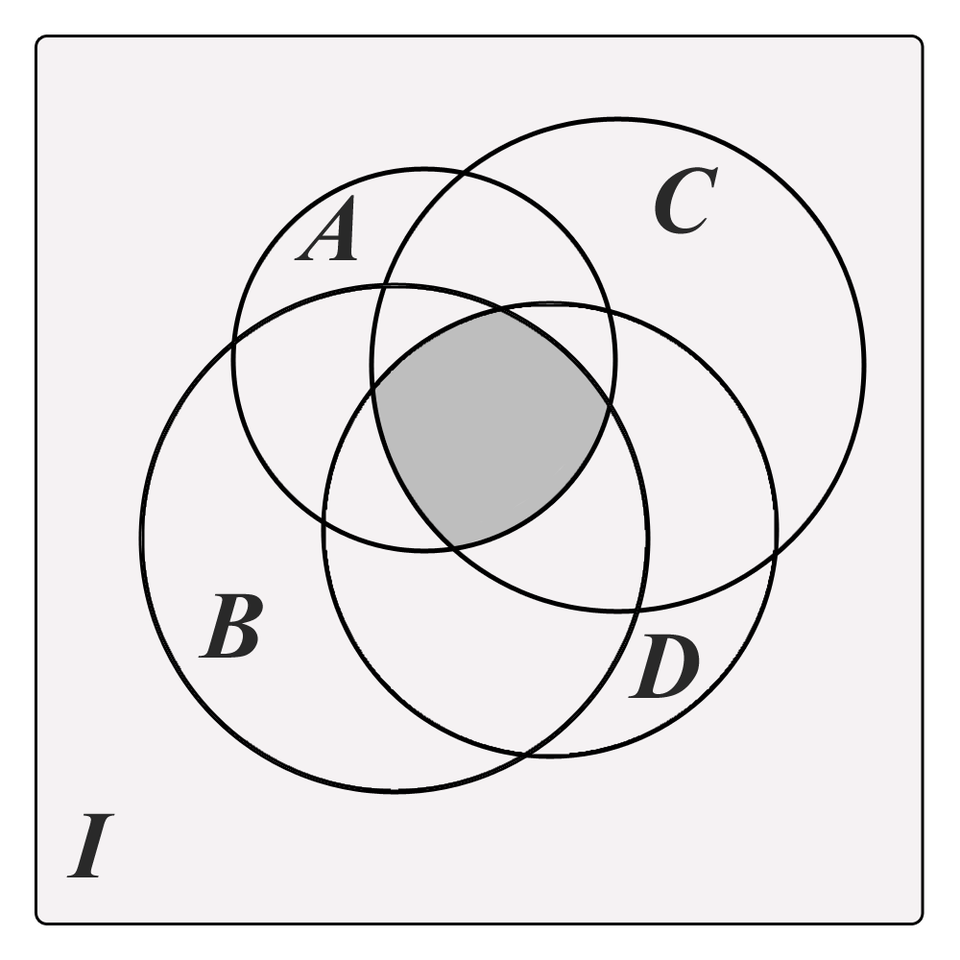

It follows that the number of elements of I is no greater than the sum of the numbers of elements in C(A), C(B), C(C), C(D) and ABCD. It would equal that sum if C(A), C(B), C(C) and C(D) were pairwise disjoint.
C(A) has 30 elements, C(B) has 25, C(C) has 20 and C(D) has 15. Therefore 100 ≤ 30 + 25 + 20 + 15 + N(ABCD), N(ABCD) ≥ 100 − 90 = 10.
Thus at least 10 pirates lost an eye, an ear, an arm and a leg.
Answer: 10 pirates.
Solution 2. A logical argument
To minimize the number of pirates with all four injuries, maximize the number who retained at least something unharmed.
Count the greatest possible number of “lucky ones”:
- Pirates with both eyes intact: 30
- Pirates with both ears intact: 25
- Pirates with both arms intact: 20
- Pirates with both legs intact: 15
If these groups did not overlap, the number retaining something unharmed would be as large as possible: 30 + 25 + 20 + 15 = 90.
The remaining 100 − 90 = 10 pirates would then have none of those body parts entirely unharmed. These 10 are precisely those who lost an eye, an ear, an arm and a leg.