
(On the occasion of his 120th birthday)
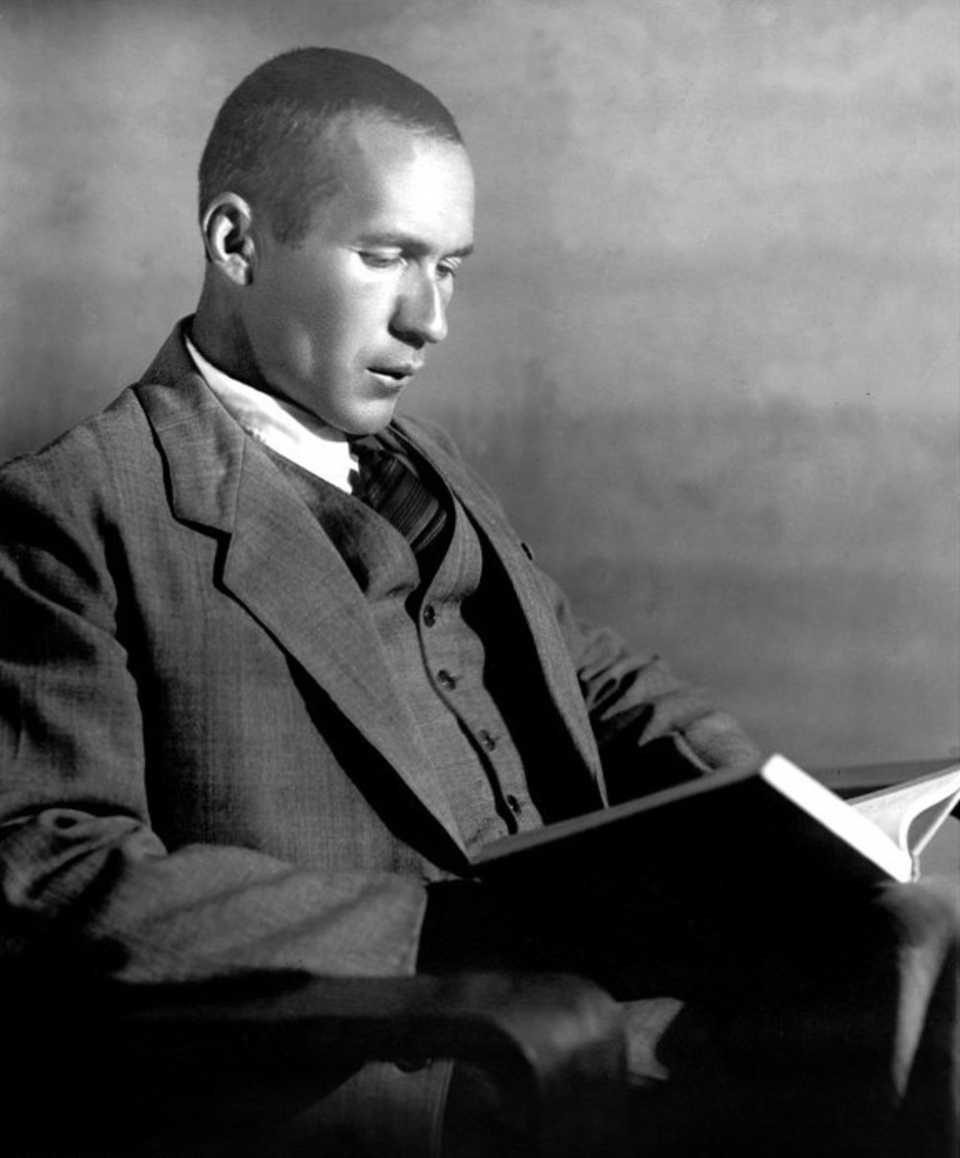

“I wish to emphasise the legitimacy and dignity of the position of a mathematician who understands the place and role of his science in the development of the natural sciences, technology and all human culture, yet calmly continues to develop ‘pure mathematics’ according to the internal logic of its development.”
A. N. Kolmogorov
The principal stages in the development of modern mathematics are commonly associated with the working lives of five great mathematicians: Newton, Euler, Gauss, Poincaré and Kolmogorov.
Andrey Nikolaevich was born on 12 (25) April 1903 in Tambov. His mother’s sisters raised him first in Yaroslavl and then in Moscow. One of them, Vera Yakovlevna Kolmogorova, formally adopted him.
His future mathematical gifts appeared early. Andrey’s aunts organised a school in their home for children of different ages and taught them themselves. They produced a handwritten magazine, Spring Swallows, containing pupils’ creative work: drawings, poems and stories. Young Andrey’s first “scientific works” — arithmetic problems he invented himself — also appeared in it.


Among them was the familiar button problem: in how many ways can a button with four holes be sewn on, using all four? Andrey liked two methods best: two parallel stitches and a cross. At five years old, the boy published his first mathematical work in the same magazine.
Here is how he solved another well-known problem, finding the sum of the numbers from 1 to 100. Young Andrey devised a method of his own, different from Gauss’s:
Andrey Nikolaevich Kolmogorov was an outstanding Soviet mathematician, a member of the Academy of Sciences (1939) and of the USSR Academy of Pedagogical Sciences (1968).
He studied at Moscow State University and became a pupil of N. N. Luzin.
From 1930 he was a professor at Moscow State University.
He headed the departments of probability theory, mathematical statistics and mathematical logic, and was dean of the Faculty of Mechanics and Mathematics (1954–1958).
He was president of the Moscow Mathematical Society (1964–1966 and 1974–1985).
A Hero of Socialist Labour (1963).
Recipient of the USSR State Prize (1941) and Lenin Prize (1965).
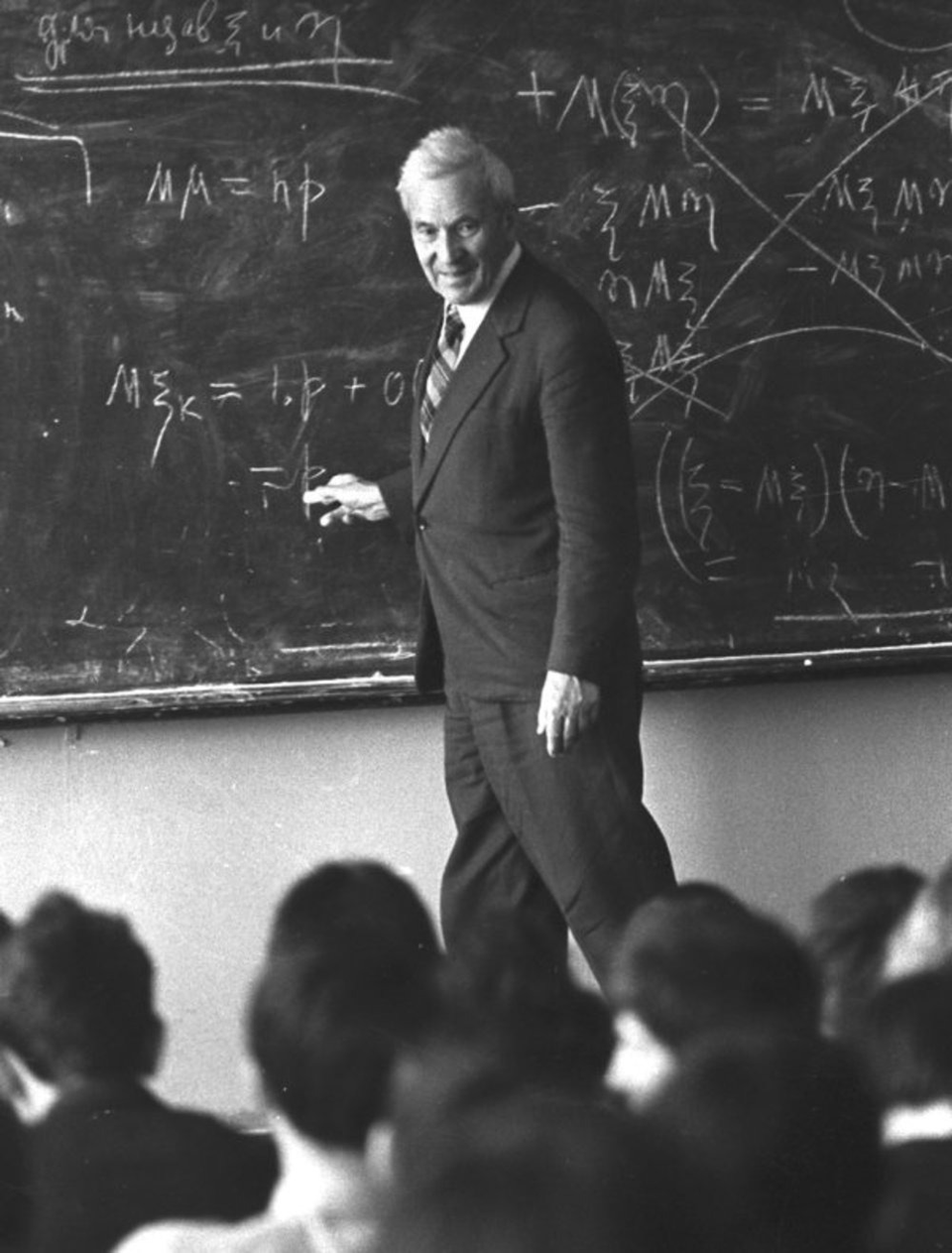

Kolmogorov made foundational contributions to many areas of modern mathematics: real-variable function theory, probability theory, the theory of Markov stochastic processes, topology, set theory, constructive logic, functional analysis, mechanics, applied mathematics, statistics, information theory, algorithmic complexity and dynamical systems. One can count some twenty areas of mathematics in which he worked. He belonged to the type of encyclopaedic researcher capable of bringing fresh ideas to any branch of human knowledge.
Although Kolmogorov worked hard throughout his life, he never lost his sense of humour. He jokingly turned “partial differential equations” into “unfortunate differential equations”, the technical term “finite differences” into “different limbs”, and “probability theory” into a “theory of troubles” — all plays on the Russian words.
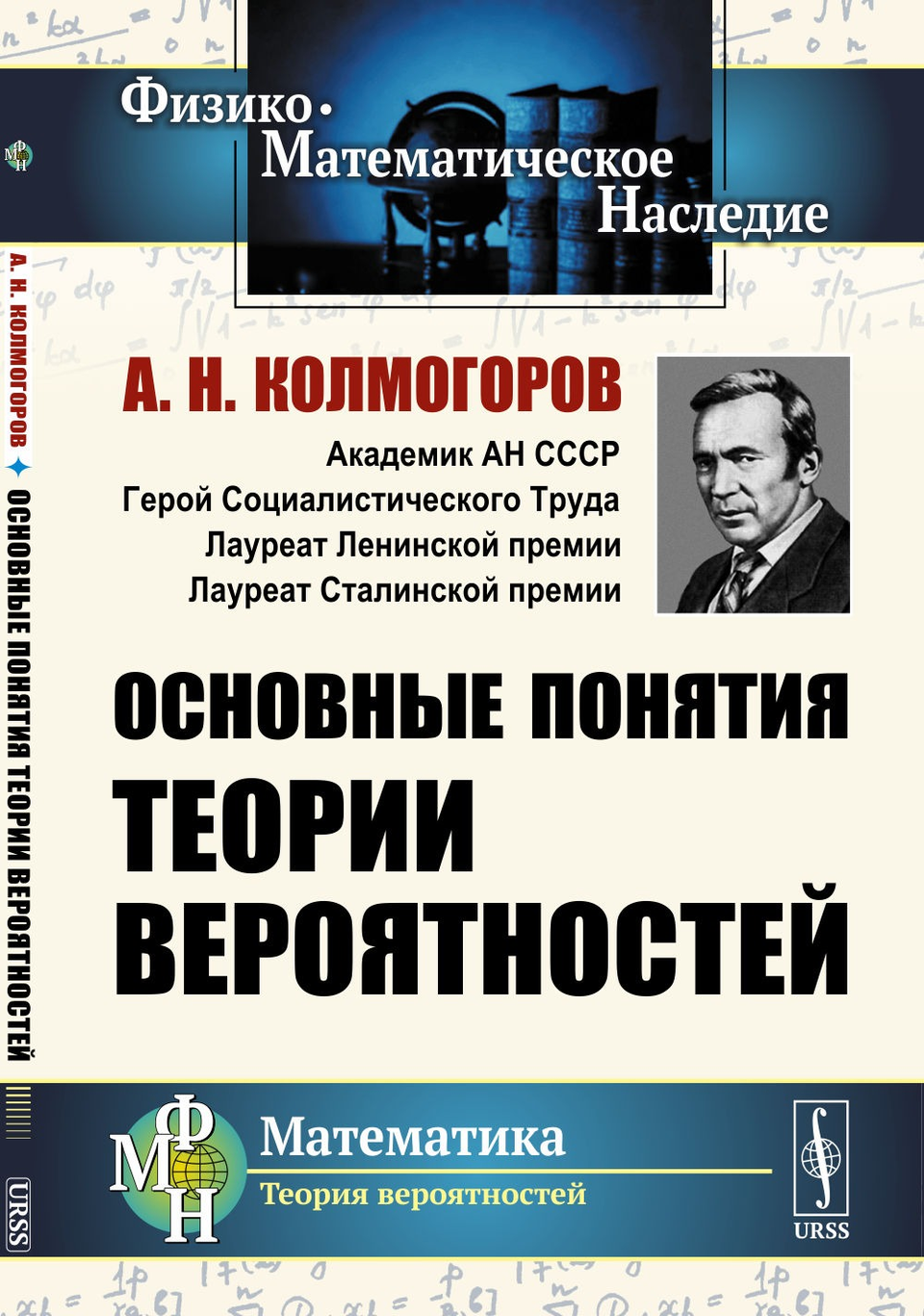

He wrote textbooks in many mathematical disciplines and their applications: Foundations of the Theory of Probability, Elements of the Theory of Functions and Functional Analysis, Introduction to Mathematical Logic, and Probability Theory and Mathematical Statistics.
Kolmogorov’s most important scientific contribution was the axiomatic construction of probability theory (1929). His axiom system united set theory, function theory and probability theory. It made possible the development of continuous stochastic processes, including an exact mathematical description of Brownian motion.
He established major schools in function theory and probability theory. Many of his pupils became world-famous mathematicians, including V. I. Arnold, I. M. Gelfand, B. V. Gnedenko, A. I. Maltsev, S. M. Nikolsky and V. M. Tikhomirov.
Kolmogorov also researched mathematical methods in the theory of firing and statistical methods for controlling mass production. During the war, he used his probability research to determine the most advantageous dispersion of projectiles in firing.
He studied the history and foundations of mathematics and philosophy as well. We recommend the collections Mathematics in Its Historical Development, On the Profession of Mathematician, and Mathematics: A Science and a Profession.
One entertaining fact from his biography is that the great mathematician’s first scholarly work was actually in history. After successfully delivering his report and receiving a flattering assessment, he asked the historian S. V. Bakhrushin for clarification: “But I have proved my result, haven’t I?” A pupil of the great V. O. Klyuchevsky, Bakhrushin replied with the principled firmness characteristic of the pre-revolutionary historical school: “Good heavens, young man! You have found only one piece of proof so far. That is too little for a historian. At least five are needed.” When Kolmogorov told this anecdote, he would add jokingly: “And then I finally went into mathematics, where one proof is enough.”
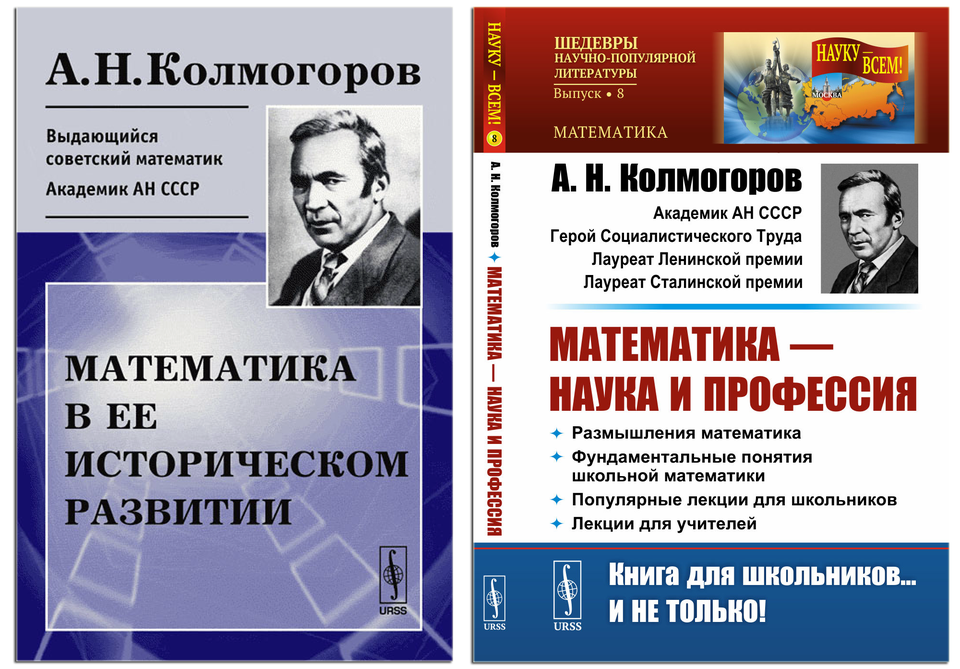

In the history of mathematics, it is customary to refer to Kolmogorov’s definition of its subject matter and his division of its history into periods. He believed that an adequate formal definition of the subject of mathematics was impossible, and defined it through its history. His famous article “Mathematics” in the Great Soviet Encyclopaedia (1954) begins with F. Engels’s definition: “Pure mathematics has as its object the spatial forms and quantitative relations of the real world, and therefore very real material.” At the same time, he emphasises that the range of quantitative relations and spatial forms studied by mathematics continually expands in response to the needs of the natural sciences, giving this definition an ever richer content.
From 1936, Kolmogorov devoted considerable effort to the Great and Small Soviet Encyclopaedias. He headed the mathematics section of the Great Soviet Encyclopaedia and wrote many articles for both.
In the debate “Can a machine think?”, Kolmogorov took a fairly radical position. In a 1964 article, he stated that “the possibility in principle of creating fully fledged living beings built entirely on discrete, digital mechanisms of information processing and control does not contradict the principles of materialist dialectics.”
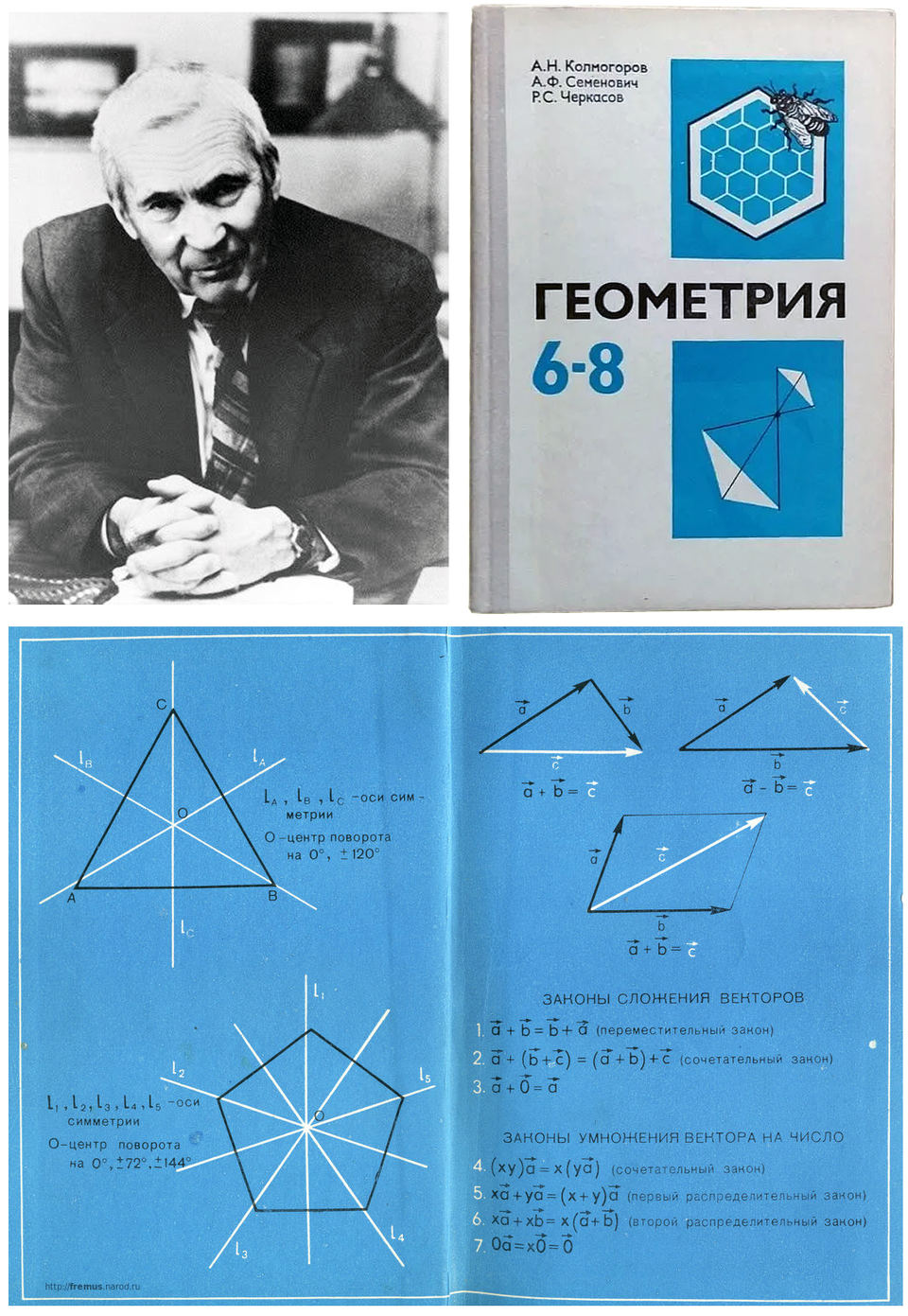

Kolmogorov devoted much time and effort to reforming school mathematics education (1960–1980). He wrote and edited school textbooks, syllabuses and curricula, and published on methods of teaching mathematics at school. The results of this work received mixed assessments and continue to provoke considerable debate.
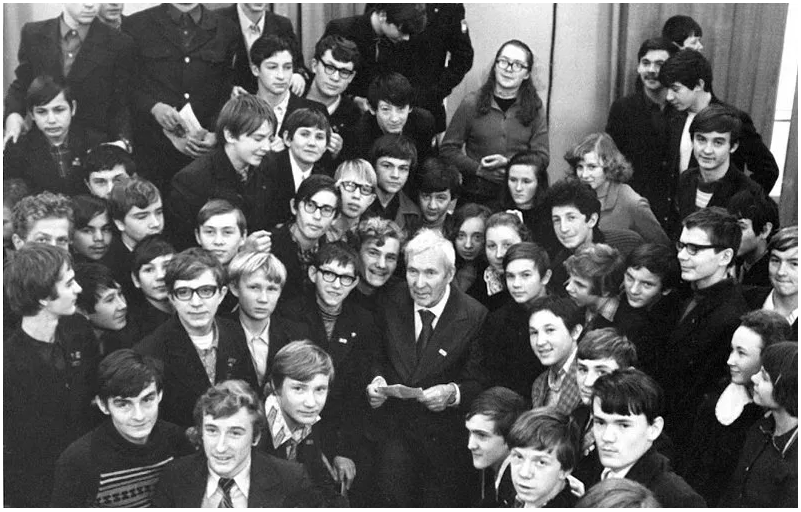

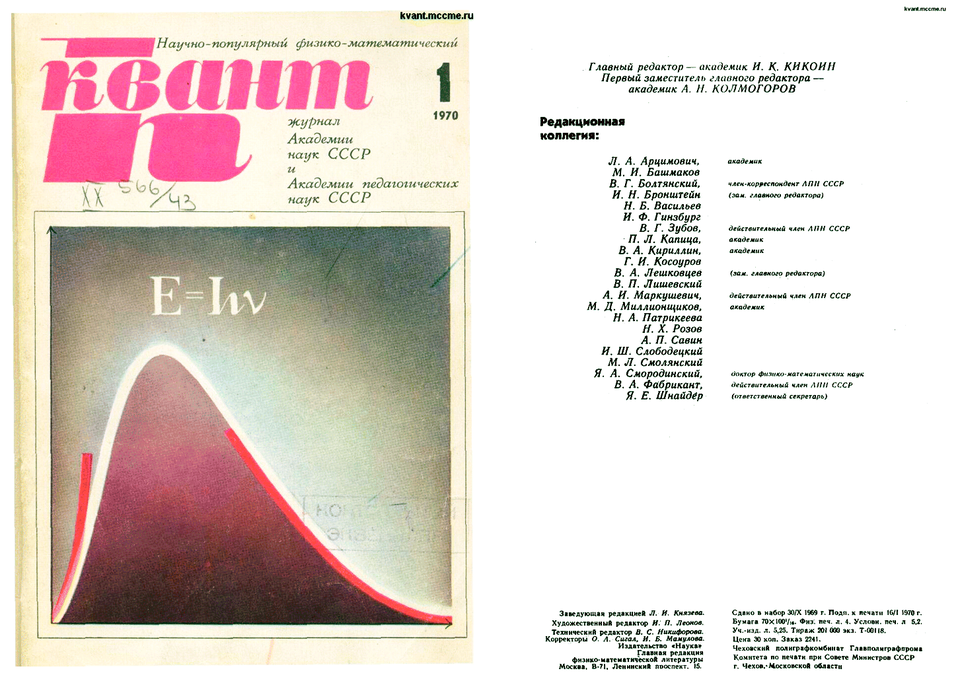
At his initiative, Moscow State University also established a boarding school for gifted children, now the University’s Specialised Educational and Scientific Centre, the A. N. Kolmogorov School. In 1970, Kolmogorov and Academician I. K. Kikoin founded Kvant magazine.

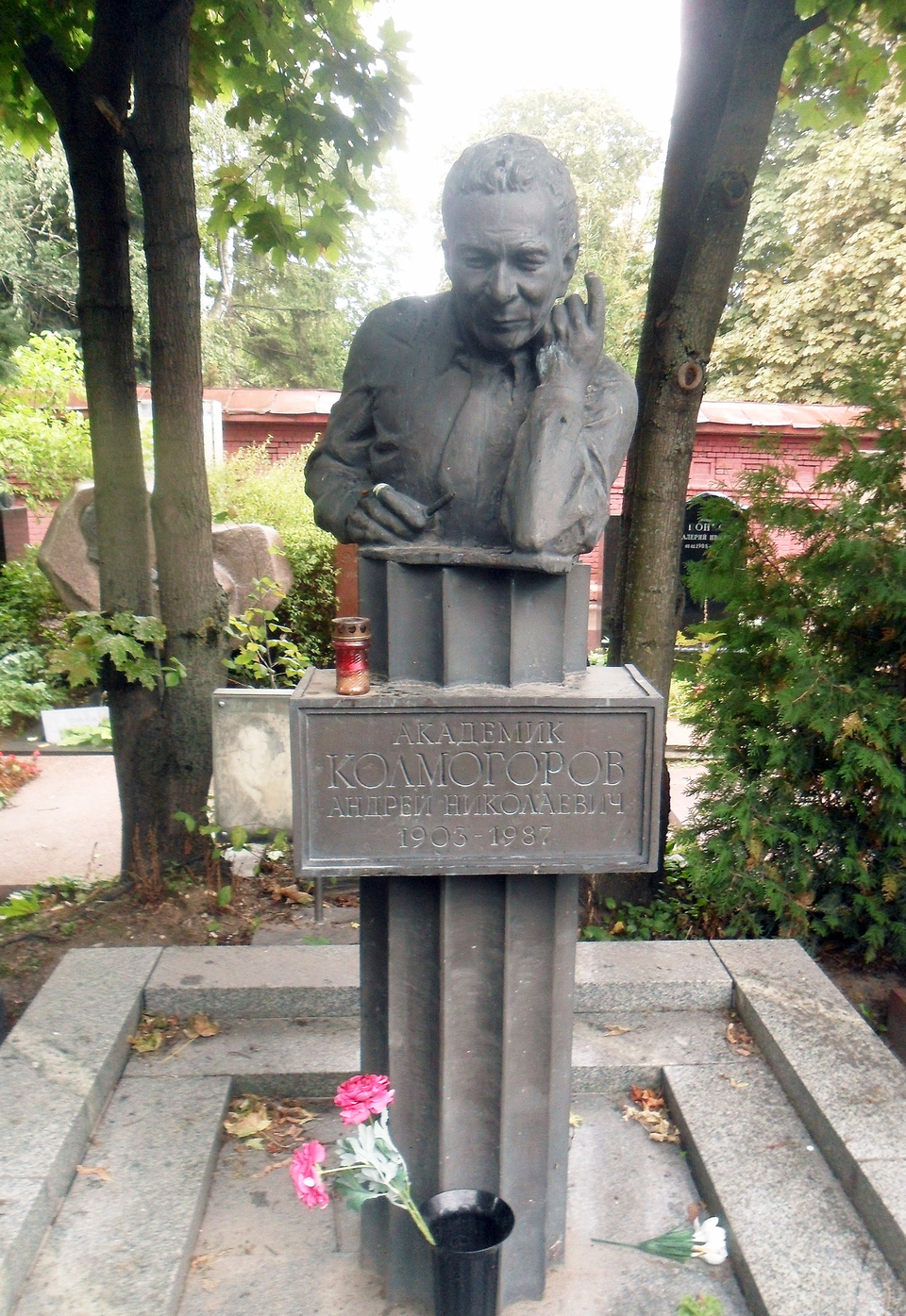
Andrey Kolmogorov died on 20 October 1987 and was buried in Novodevichy Cemetery in Moscow.