
(On the 975th anniversary of Omar Khayyam, 1048–1131)
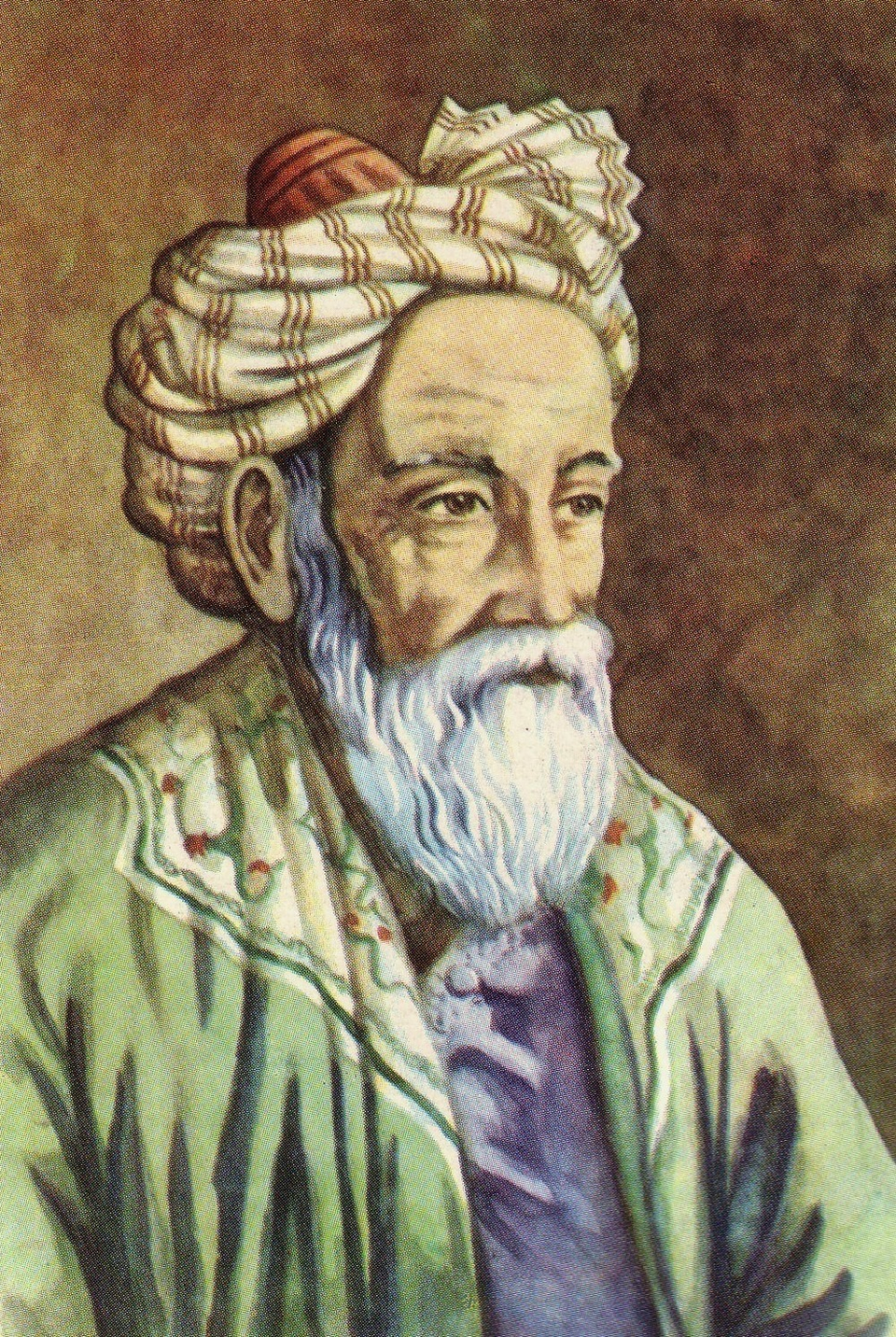

He suffered attacks from the clergy and survived only through the patronage of powerful rulers. He lived for 83 years and died in poverty. In his spare time he drew up his horoscope, from which scholars established his exact birth date: 18 May 1048. He devoted himself to astronomy and mathematics, regarded himself as a disciple of Avicenna, and wrote poetry only in his leisure hours — yet it was his verse that made him immortal. There was a period in the history of science when Khayyam the poet and Khayyam the mathematician were thought to be different people.
…Khayyam was dining in his room at the observatory in Isfahan, and the attendant Ali did not want to disturb him. But the young man insisted on an immediate meeting. He said he had travelled a long way through the sun-scorched desert, risking his life, and would not leave until he had seen the great poet. Ali was bewildered: learned men worked here, but he had heard of no great poet. Rustam, a young poet from Balkh, wanted to speak with Khayyam about verse. “So much hardship on a long journey for the sake of poetry,” thought the hakim, the sage, but he invited the visitor in. He decided to find out what this was all about.
The young poet gazed admiringly at his idol, scarcely believing they were breathing the same air. Khayyam asked why he wanted to speak specifically to him: were there not many other poets? “But can any of them compare with you?” “What have I to do with this? I observe the motions of the heavenly bodies and ponder the meaning of life.” Rustam was at a loss: this learned astronomer was unfamiliar to him. He decided to recite his favourite rubai.
A stream flows across the earth, sparkling with rainbow colours and making enchanting sounds. But ahead lies a cleft, and the stream vanishes as though it had never existed.
“Are the verses I am reciting not yours? Then you are the great poet.” But the sage avoided the answer: “Only time judges a poet. I cannot claim so lofty a title. Yes, I am Omar Khayyam. But I must disappoint you: I am an astronomer and mathematician. If you want to be a poet, heed my advice: study the sciences, especially mathematics and philosophy. A poet is above all a wise man.”…
People say that I have calculated
The whole course of time. Yet only two days
Have I removed for ever from the calendar:
Tomorrow, which we do not know; yesterday, which we cannot bring back.
Omar, son of Ibrahim, nicknamed Khayyam, meaning “tentmaker”, was born in Nishapur in northern Iran and was buried there.
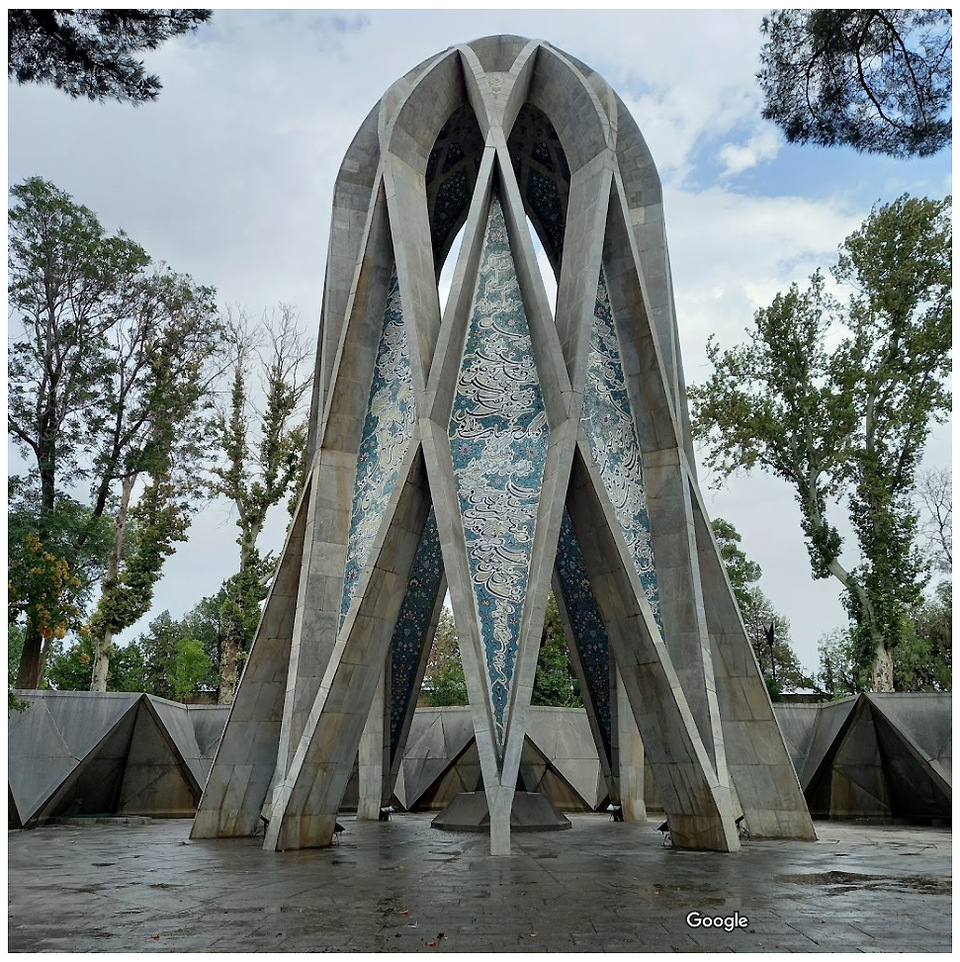

The Khayyam Memorial is the city’s most famous landmark, perhaps even the country’s. In his youth he lived in Bukhara and Samarkand, studying astronomy and mathematics.
Arabic mathematics was then more advanced than European mathematics. Around 1069, Khayyam wrote a Treatise on the Demonstration of Problems of al-Jabr and al-Muqabala. The term “algebra” comes from the Arabic “al-jabr”, denoting one method of transforming equations: restoration. Khayyam was the first mathematician to develop a theory for solving equations up to and including the third degree and to give a general classification of all equations. He defined the subject of classical algebra as the solution of equations.
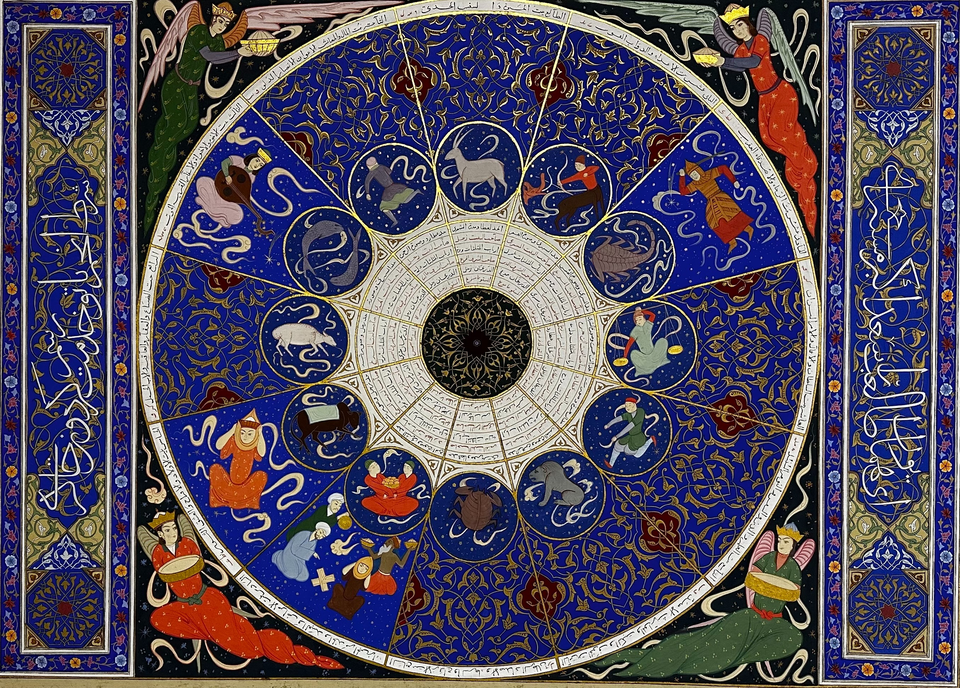

Many Eastern rulers invited him to their courts. He also attracted notice in his homeland. The chief vizier of Malik-Shah, sultan of the powerful Seljuk Empire, invited the young scholar to the capital, Isfahan. In 1074, an observatory was built there to Khayyam’s design and under his direction, the finest built up to that time. Omar Khayyam spent more than 40 years there. With like-minded friends, he compiled the Malik-Shah Astronomical Tables and worked on reforming the solar calendar. The reform was implemented in 1079; the calendar operated in Iran for almost 900 years and was abolished only in 1976. Khayyam’s Jalali calendar is known to be more accurate than the Gregorian calendar. Its error is only 19 seconds a year, 7 seconds more accurate than modern timekeeping. It has 8 leap years in 33 years rather than 32.
The calendar’s main purpose was to tie Nowruz, the beginning of the year, as closely as possible to the spring equinox. The year began on the day of that equinox. Its spring and summer months lasted 31 days, and all months in the second half of the year lasted 30 days. In common years, the last month had 29 days. Khayyam’s calendar accumulates an error of one day in 5000 years, while the present Gregorian calendar accumulates one day in 3330 years.
Parallel lines also concerned the scholar. He took up Euclid’s fifth postulate, a problem that scholars had tried unsuccessfully to resolve for a thousand years. In 1077, he completed Commentaries on the Difficult Postulates of Euclid’s Book. Without realising it himself, Omar Khayyam came close to the problems later solved by the brilliant Russian geometer Nikolai Lobachevsky. By studying geometry through numbers, he also anticipated Descartes, the creator of analytic geometry. Khayyam worked in geography, natural science and philosophy too. The whole world now recognises him as an encyclopaedic scholar.
He had no inclination towards family life and left no descendants. What remains of him is his rubai and his mathematical and philosophical writings in Arabic and Persian. A considerable legacy!
Two parallels: rhyme and number —
And perhaps Khayyam was fortunate
To command both so readily…
The boat of life has more than one oar.
(E. Efimovsky)
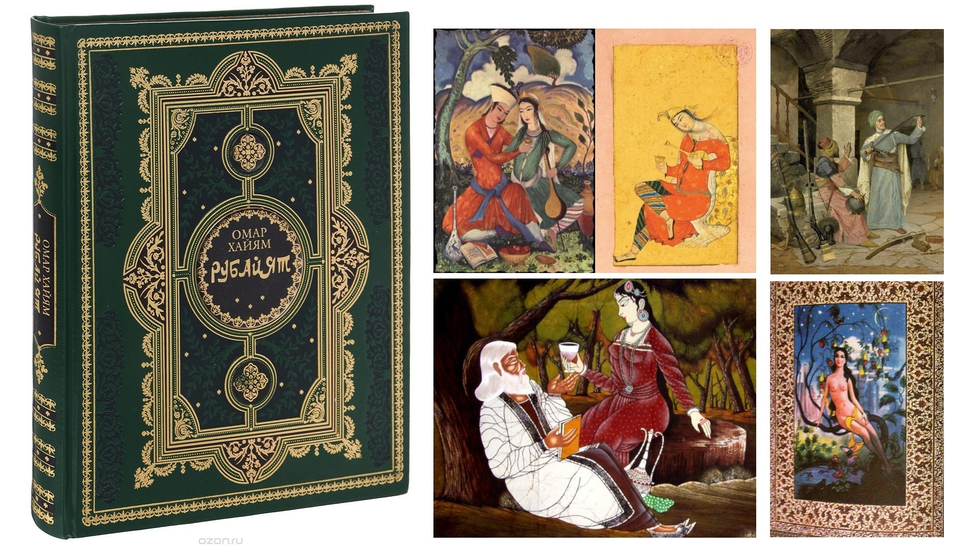

Omar Khayyam wrote poetry throughout his life. It was a need, yet he did not think of poetic fame. He felt that his “real” work lay in mathematics, astronomy and philosophy. His name nevertheless remained known in history primarily through his quatrains. Their form, the rubai, is an age-old folk verse form still used by Persians and Tajiks. Khayyam’s rubai are distinctive miniatures, containing an entire life and deep human experience in four lines. His lyrical poems are always filled with profound philosophical meaning, while also expressing a longing for the joys of earthly life.
He refused to accept rule over his native Nishapur: “I do not wish to govern people, to command and forbid; I wish to devote myself to science and to people.”
It is good if your clothes have no holes.
Nor is it a sin to think of daily bread.
But all the rest I would not want even as a gift —
Life is worth more than all wealth and honours.
Today, Omar Khayyam is rightly regarded as one of the most prominent figures in the history of world poetry and science. His scientific treatises and rubai have been translated into all the world’s major languages.
From the Tatar version, rendered here in English:
Human being! Do not hurt or defile another;
Do not cast another into fire and trample them.
If you would avoid the torment of conscience —
Endure suffering, but do not make another suffer.
In English:
Pursuing knowledge in childhood we rise
Until we become masterful and wise
But if we look through the disguise
We see the ties of worldly lies.
Khayyam’s honorary titles at the height of his fame included Imam of Khorasan, the Most Learned Man of the Age, Knower of Truth, and King of the Philosophers of East and West.
Omar Khayyam’s poetic jewels shine as they did centuries ago, beyond the power even of his perfect calendar.