


“In studying the sciences, problems are more useful than rules.”
I. Newton

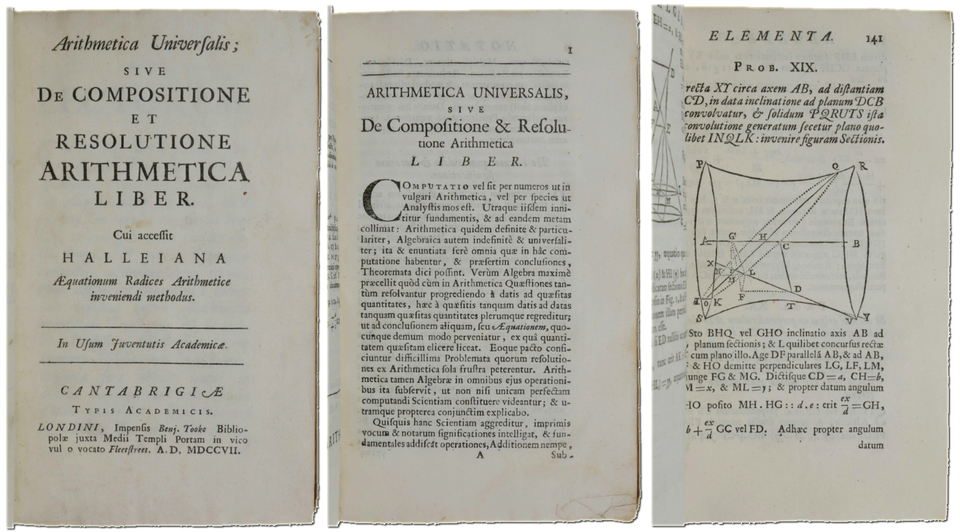
Isaac Newton was not only a great physicist but also an outstanding mathematician. He discovered differential and integral calculus independently of Leibniz. In 1707, a collection of Newton’s lectures on algebra appeared as Universal Arithmetic (Latin: Arithmetica Universalis), in which he presents various numerical methods. (The book is also known in Russian as General Arithmetic. Newton called algebra “universal arithmetic”, and the work made a substantial contribution to its development.) The problem below was first published in Universal Arithmetic.

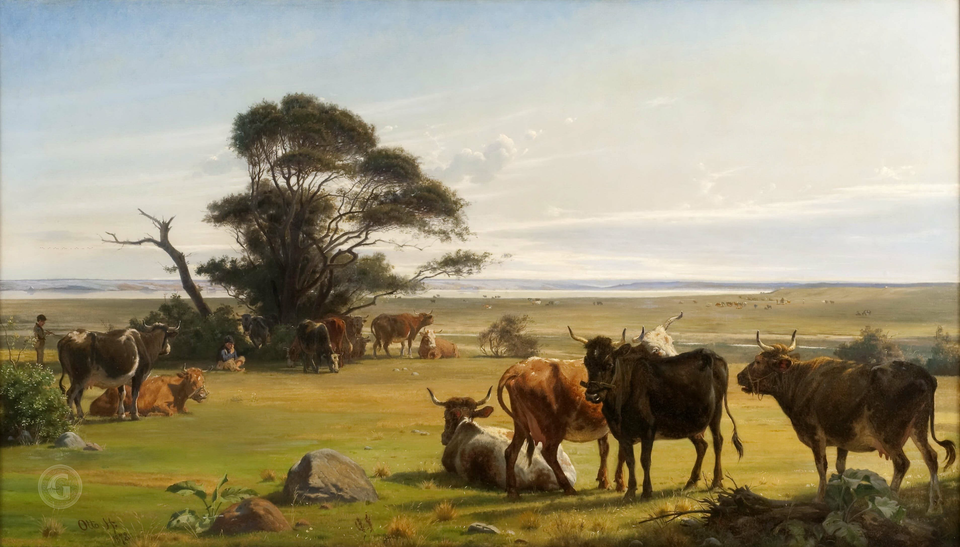
“The grass throughout a meadow grows at the same density and rate. It is known that 70 cows would eat it all in 24 days, and 30 cows in 60 days. How many cows would eat all the meadow’s grass in 96 days?”
When analysing and modelling this problem, many people mistakenly ignore the fact that the grass keeps growing. They then arrive at absurd answers, such as a fractional number of cows.
Indeed, 96 days is exactly 4 times as long as 24 days. So if 70 cows eat the grass in 24 days, then to make the meal last four times longer, the number of cows must be reduced by the same factor, giving 70:4 = 17,5. Does the problem perhaps contain an error? No.
There are various ways to solve it. We will present some interesting ones and invite you to think of others yourself.
Ya. I. Perelman also discusses the solution in his book Algebra Can Be Fun.
Method 1
Let x be the required number of cows. Introduce an auxiliary unknown y for the amount of grass that grows in one day, expressed as a fraction of the meadow’s total initial stock of grass, which we take as 1. The amount one cow eats in a day is then:
• on the one hand: (24y + 1) / (24 × 70)
• on the other: (60y + 1) / (60 × 30)
Equating these expressions gives an equation in y, with solution y = 1/480.
Find how much grass one cow eats per day:
In 96 days, x cows eat (1/1600)⋅96х = 96y + 1 units of grass.
Using the value y = 1/480, we obtain x = 20.
Answer: 20 cows.
Modern textbooks present this as an unusual work-rate problem.
Method 2 (an arithmetic solution)
Suppose one cow eats a certain amount of grass each day; call it 1 portion. In 60 days, 30 cows eat 1800 portions; in 24 days, 70 cows eat 1680 portions. This means that over 60 − 24 = 36 days, another 1800 − 1680 = 120 portions of grass grew, which the 30 cows have to eat. In total, they eat 1800 + 120 = 1920 portions. The answer is therefore that over 96 days, these portions will be eaten by 1920:96 = 20 cows.
Method 3 (a physical interpretation)
This method was proposed by I. Akulich in Kvant, 2016, No. 3, pp. 25–26. Let us recast the problem in terms of travel on a river.
“If a motorboat travels upstream at a speed of 70 km/h relative to the water, it reaches its destination in 24 hours. At a speed of 30 km/h relative to the water, it reaches the destination in 60 hours. What speed relative to the water does it need to reach the destination in 96 hours?”
Here the number of cows becomes the boat’s speed relative to the water, and the growing grass becomes the opposing current.
Let x be the boat’s speed relative to the water and y the speed of the current. The same distance travelled by the boat can be written in three ways, giving this system of equations:
This also gives the answer x = 20.
Method 4
-
30 × 60 = 1800 (days): the number of days for which one cow could feed on the grass initially in the field plus the grass that grows in 60 days.
-
70 × 24 = 1680 (days): the number of days for which one cow could feed on the initial grass plus the grass that grows in 24 days.
-
1800 – 1680 = 120 (days): the number of days for which one cow could feed on the grass that grows in 60 − 24 = 36 days.
-
1800 + 120 = 1920 (days): the number of days for which one cow could feed on the grass that grows over 60 + 36 = 96 days.
-
1920/96 = 20 (cows): 20 cows will eat it.
The answer is the same: 20 cows will eat all the grass in 96 days.