

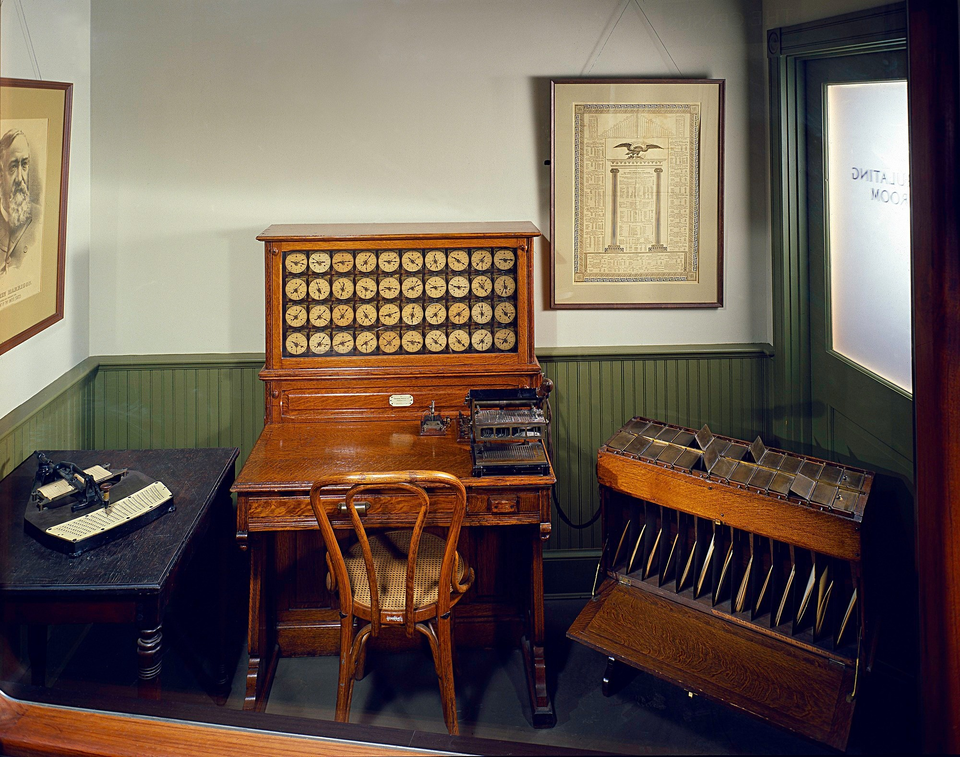

Today, the word “tabulator” will most often bring to mind the Tab key or the alignment of text in a table. In the history of computing, however, it meant a very different device: a calculating and analytical machine that processed statistical data recorded on punched cards.
The device occupied a position between the arithmometer and the computer. It was not yet an electronic computer in the modern sense, but it could already perform operations that would become fundamental to the twentieth century: reading encoded data, counting, grouping, summing and producing results.
The word comes from the Latin tabula, meaning “board”, “table” or “record”. The name captures the instrument’s central idea: turning many individual records into a summary table.
From hand counting to machine statistics
In the second half of the nineteenth century, national censuses became increasingly complex. It was no longer enough simply to count inhabitants: information on age, sex, marital status, occupation, birthplace and other characteristics had to be processed. Every new column on the census form increased the volume of calculation.
Processing the United States census of 1880 took about eight years. This was an alarming sign: the next census might begin before the previous one’s results had been fully processed.
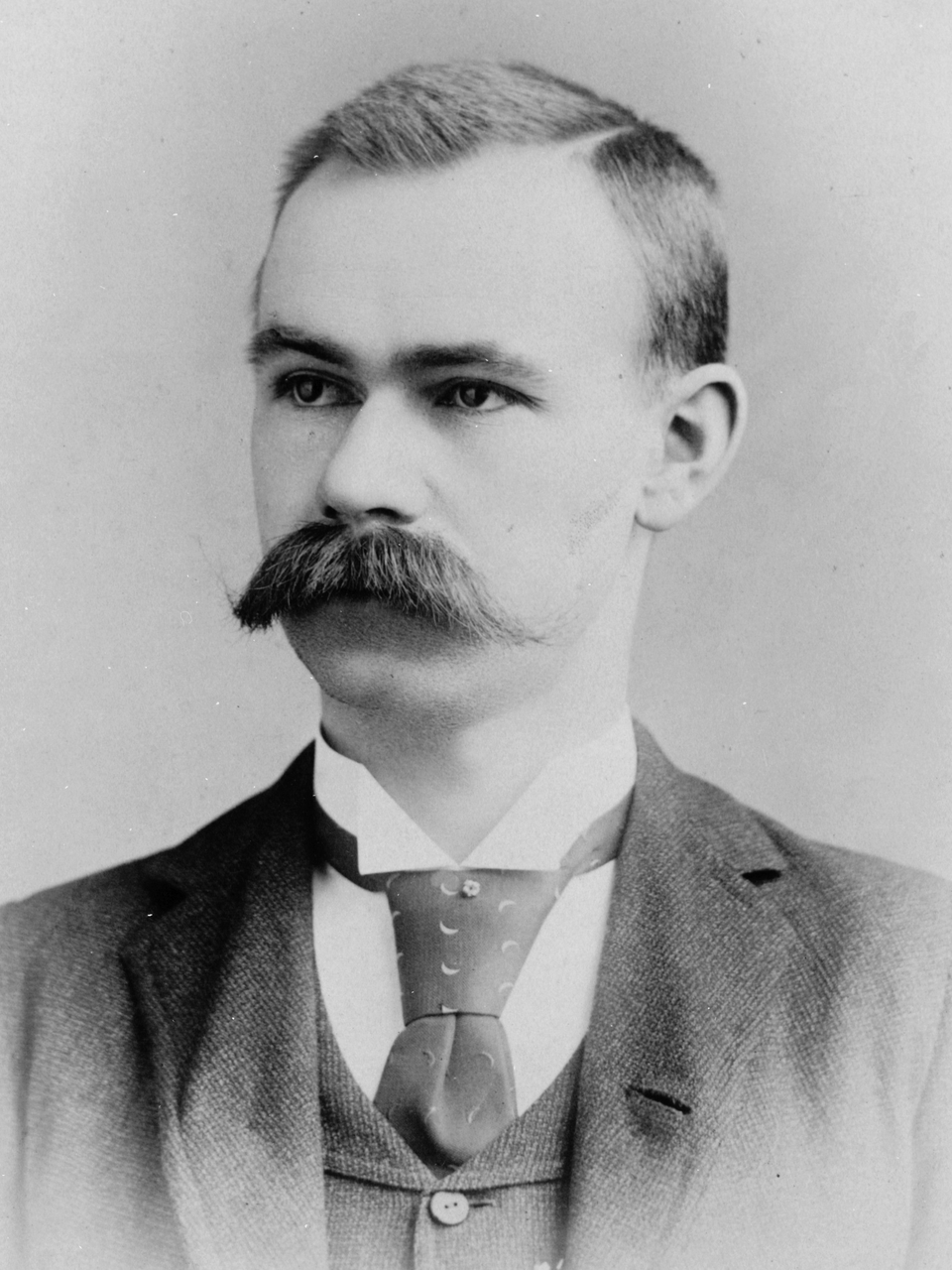
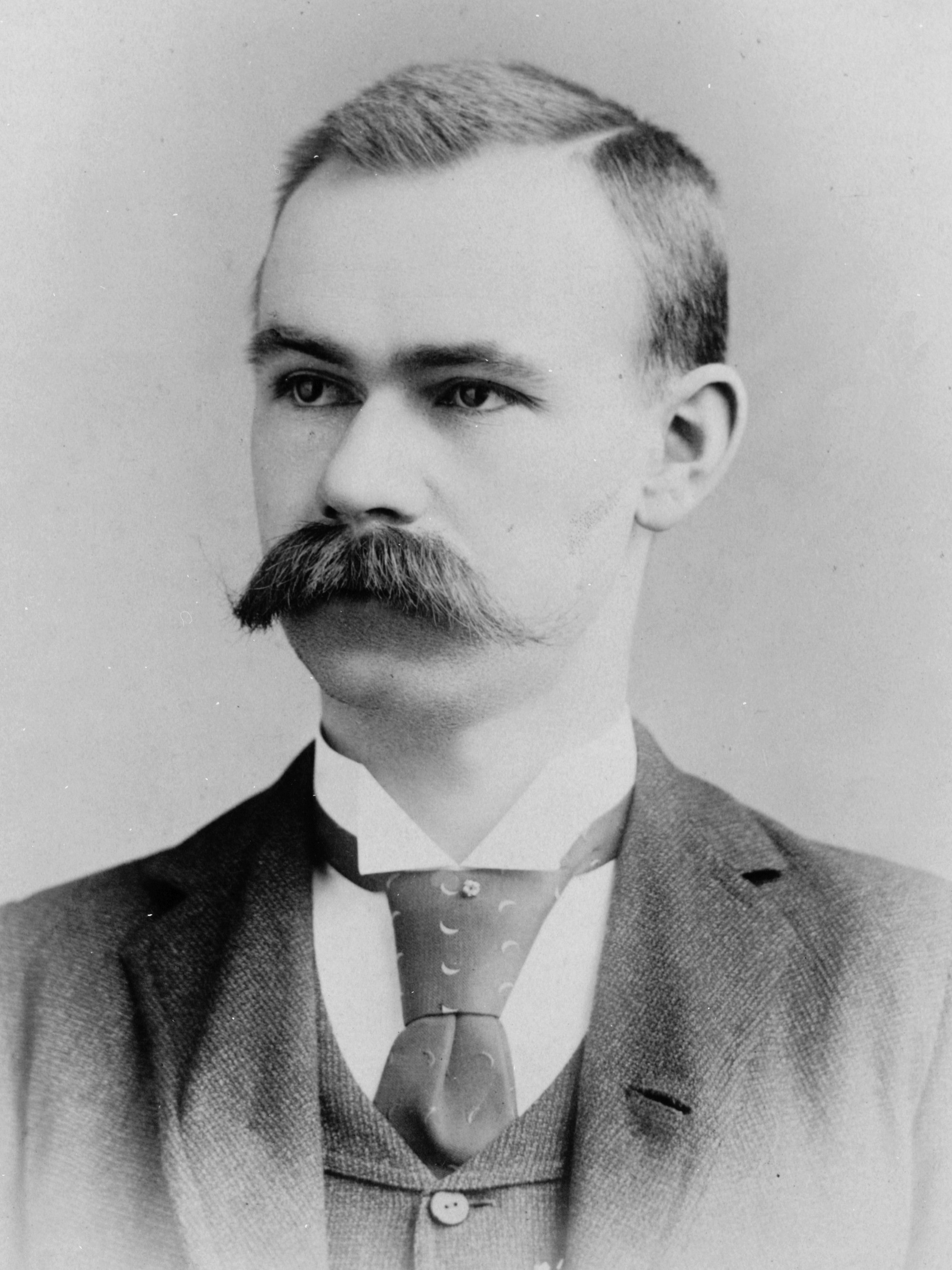
The American engineer Herman Hollerith (1860–1929), who worked at the Census Bureau, proposed replacing handwritten marks with machine-readable cards. Each person was represented by one punched card. Individual holes denoted particular characteristics: sex, age group, marital status, citizenship, occupation and so on.
In 1889, Hollerith received a patent for an electromechanical system for processing statistical data. In 1890, his machines were used for the United States census, demonstrating that large datasets could be processed by a purpose-built machine as well as by hand.
How Hollerith’s system worked
The system consisted of several connected devices rather than a single instrument.
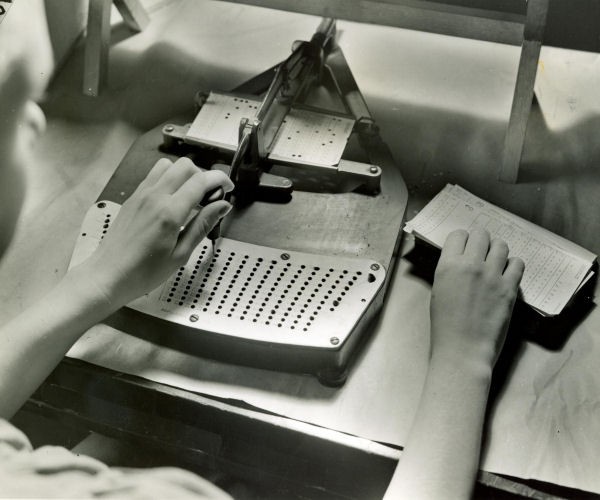
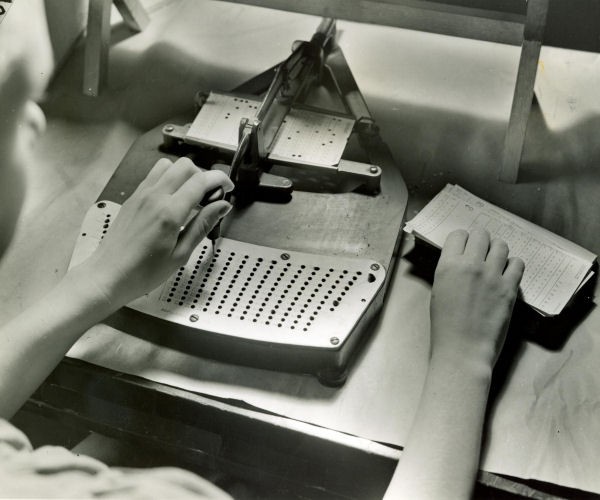
First, information was transferred from census forms to punched cards using punches and special templates. The operator made holes at predetermined positions on the card. Each position had a specific meaning.
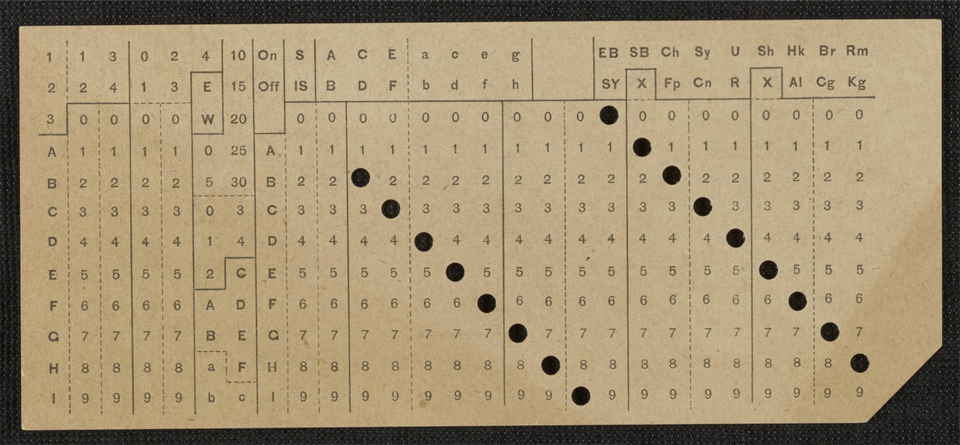
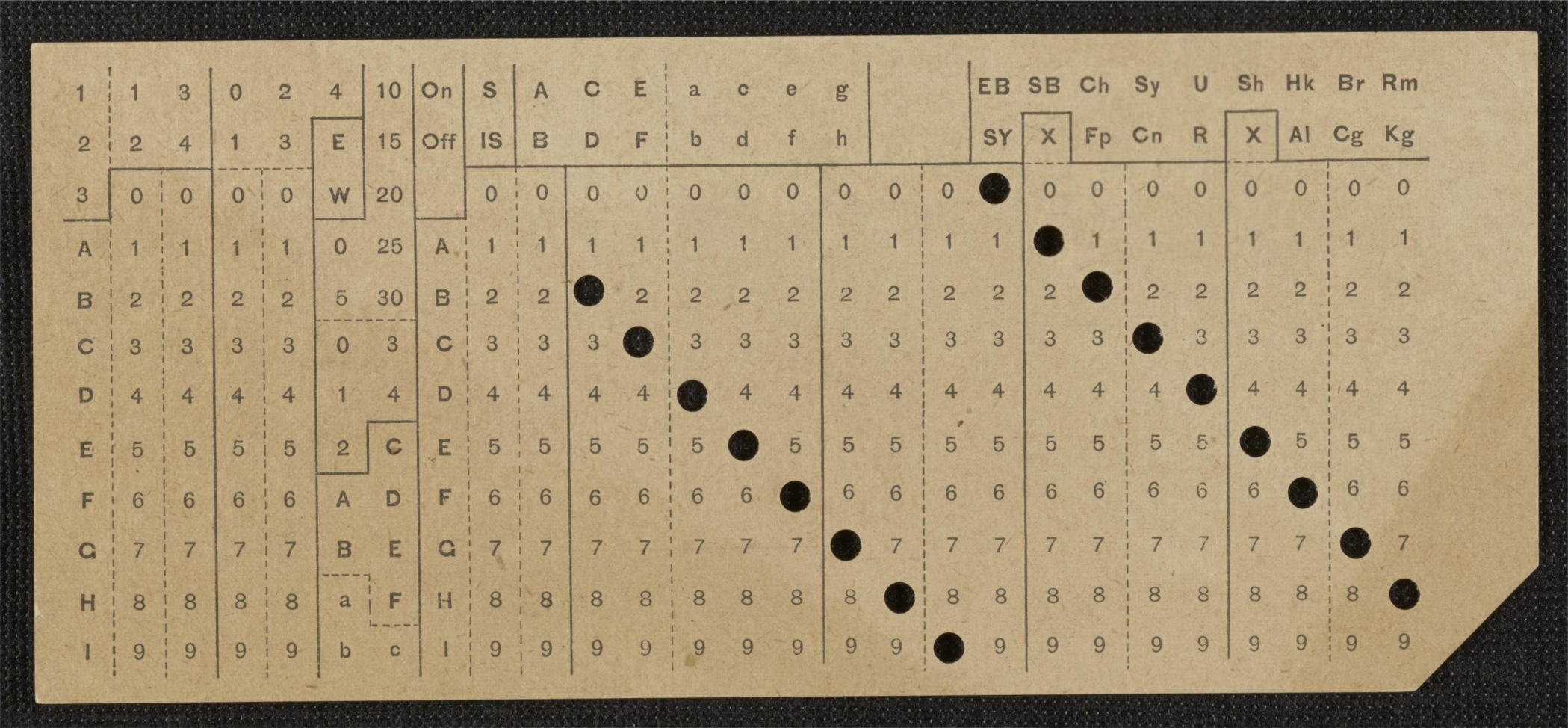
The card was then placed in a reader. In Hollerith’s early machines, this resembled a press: the card was clamped between two plates, and metal pins passed through its holes. A pin entering a hole completed an electrical circuit through a small cup of mercury. When the circuit closed, the corresponding counter advanced by one.
Each counter tracked a particular characteristic or combination of characteristics. One might count men, another women, a third a particular age group, and a fourth a combination of attributes.
After reading, the card was moved to a sorting box. The machine indicated which compartment the operator should put it in. Cards could thus be quickly divided into groups for further counts by age, residence, marital status, occupation and other characteristics.
Where is the mathematics?
At first glance, a tabulator is simply a machine for bureaucratic work. At its heart, however, lies a very important mathematical idea: data can be encoded and then processed according to predetermined rules.
Each punched card can be represented as a set of attributes:
a₁, a₂, a₃, …, aₙ
A hole in the required position means that the corresponding attribute is marked. No hole means the attribute is absent. In the simplest case, this resembles a sequence of zeroes and ones:
- 1: the attribute is present;
- 0: the attribute is absent.
To count how many cards have a chosen attribute, introduce an indicator xⱼ for each card:
- xⱼ = 1 if the attribute is present;
- xⱼ = 0 if the attribute is absent.
The number of cards with that attribute is then:
where m is the total number of cards processed.
In other words, the machine sums marks across many cards. This can tell us, for example, how many people belong to a certain category.
The tabulator’s real power lay in classification as well as simple counting. It could count combinations of attributes: people of a particular age, sex and marital status, for example. This was more than arithmetic; it was an early form of structured data processing.
In modern terms, each punched card was a table row, each field a column, and the tabulator performed simple grouping and counting operations. What we now do with a database query or an Excel pivot table was then done with electrical contacts, mechanical counters and the operator’s manual work.
The tabulator and the punched card
The punched card became the principal data carrier. It was easy to store, sort, check again and reprocess. This was an important difference from a handwritten ledger: the card was an individual record that could be moved independently of the others.
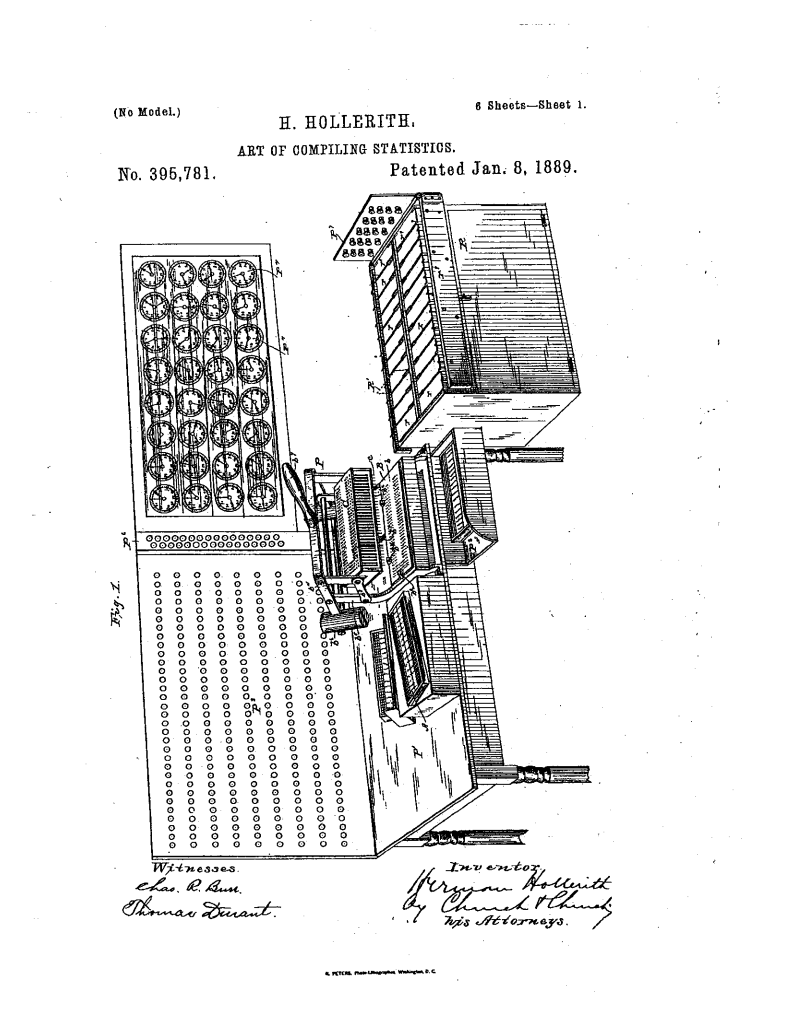
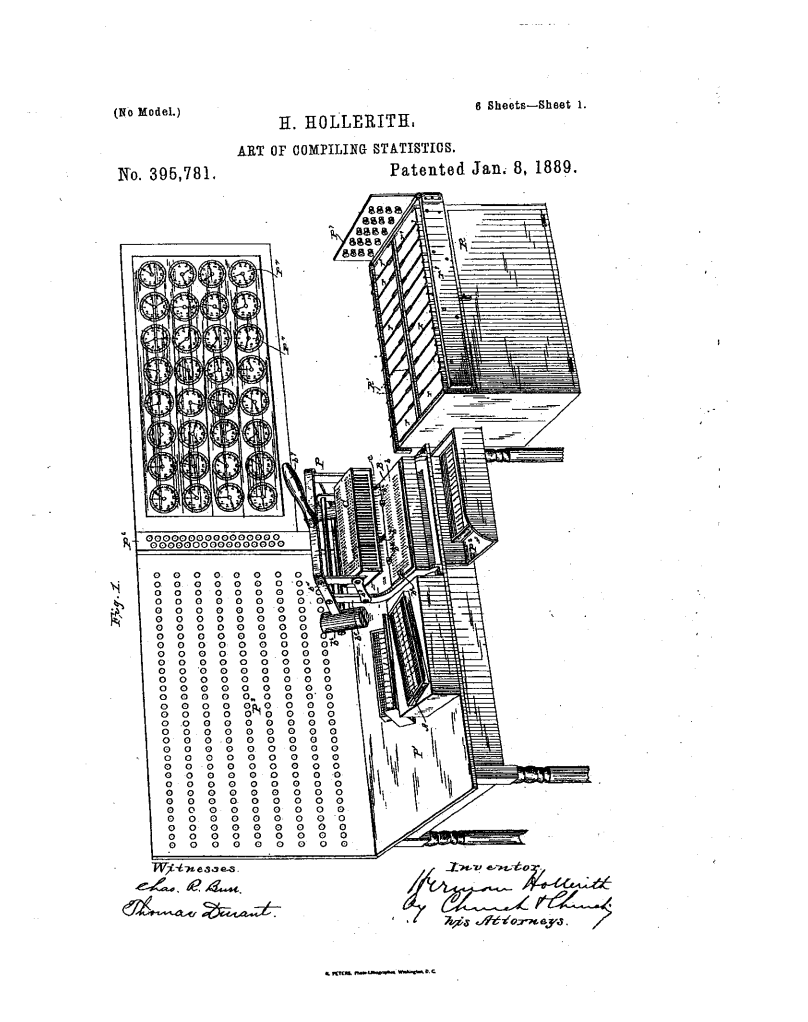
Hollerith’s patent makes this idea particularly clear. A single card holds information about one person or object, and the positions of its holes correspond to an established coding system.
In the early census system, a card primarily carried data rather than a program in the modern sense. Later, punched cards were used both to enter programs and to control computing machines. The original purpose was simpler, yet also more fundamental: making data machine-readable.
Why it mattered
The tabulator became one of the first widely used tools for automatic data processing. It did more than speed up calculations: it changed the organisation of work with information.
Before it, people compiled large tables by hand. Afterwards, data passed through a technological sequence: manual recording, encoding, reading, counting and sorting, followed by printing or a summary table.
In 1896, Hollerith founded the Tabulating Machine Company. In 1911, it became part of the merged Computing-Tabulating-Recording Company, renamed International Business Machines, IBM, in 1924. The tabulator is therefore often regarded as an important starting point for the modern data-processing industry.
In the first half of the twentieth century, tabulating machines were used for much more than censuses. They served accounting, insurance, railways, stock control, statistics, scientific calculation and the management of large organisations. Wherever many similar records accumulated, there was a need for a machine that could quickly turn them into summary tables.
A short example
Suppose there are 1000 cards, each describing one pupil. The encoded attributes are:
- sex;
- school grade;
- age;
- academic performance;
- club participation.
To find how many pupils in Grade 7 attend the mathematics club, a person would have to inspect every card and tally the count on paper. A tabulating system could first sort the cards by grade, then by club participation, and count the pupils in the required group.
Add another attribute, such as achievement above a certain level, and the count now involves several conditions. A modern user might say, “That is just an Excel filter and pivot table!” At the end of the nineteenth century, however, it was a major step in mechanising statistical calculation.
The dark side of machine record-keeping
The tabulator’s history also has a painful side. The same technology that sped up censuses, accounting records and statistical reports was used to control people.
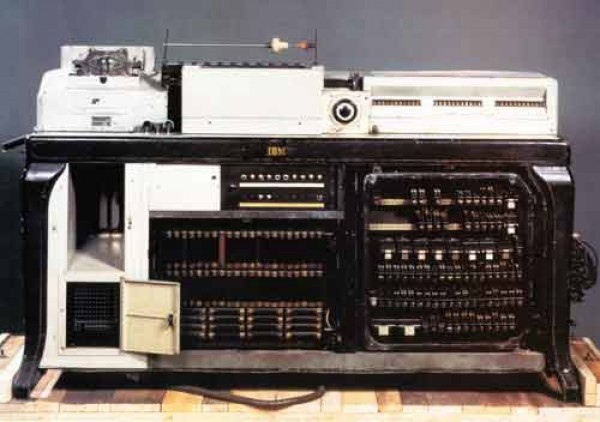
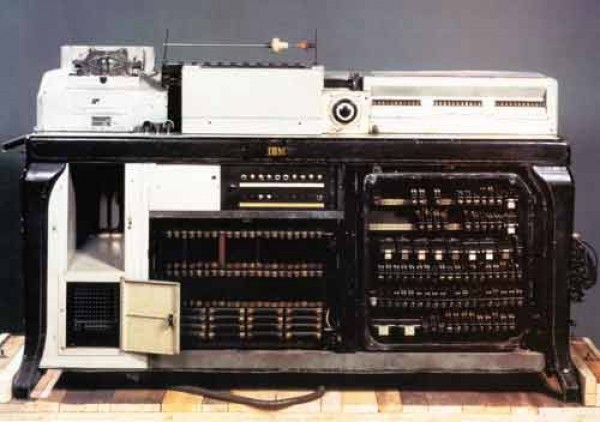
In Nazi Germany, Hollerith tabulating machines processed the censuses of 1933 and 1939. The German company Dehomag, Deutsche Hollerith-Maschinen Gesellschaft, associated with IBM, supplied and maintained these systems. Punched cards allowed people not only to be counted but also classified by origin, religion, residence, occupation and marital status.
Under a totalitarian state, such classification ceased to be neutral statistics. It became part of an administrative mechanism for identifying, isolating and persecuting people. This was particularly horrific for Jews, Roma, political opponents and other groups the regime declared “undesirable”.
Historians differ in their assessments of IBM’s responsibility as an American corporation and its degree of direct control over its German subsidiary during the war. Yet the use of tabulating machines and punched cards in Nazi record-keeping demonstrates an important point: a mathematical instrument does not exist outside society. It can advance science, help manage an economy and solve peaceful problems; in the hands of a criminal regime, the same technology becomes a tool of oppression.
The history of the tabulator is therefore more than a chapter in the history of computing. It is also an early lesson about data, power and the responsibility of those who create and use information systems. In the age of big data and artificial intelligence, that lesson feels especially current.
From tabulator to computer
The tabulator was not a computer in the full sense. It did not store a program in memory, execute arbitrary algorithms or provide general-purpose computation. It nevertheless took several fundamentally important steps.
First, it separated data from the human bookkeeper: information was stored on a medium that a machine could read.
Second, it showed that large-scale calculation could be organised as a process: preparing data, processing, checking, sorting and producing results.
Third, it connected mathematics, statistics, electrical engineering and the management of large amounts of information.
The tabulator is therefore more than a museum ancestor of the computer. It clearly shows how the practical problem of a population census gave rise to an entire culture of machine data processing.
Afterword
The tabulator has a special place in the history of mathematical instruments. A compass draws a circle, a planimeter measures an area, and a slide rule helps with multiplication and division. The tabulator works differently: it counts across a multitude of records rather than calculating with individual numbers.
This is the mathematics of tables, attributes, frequencies and groupings: the mathematics without which statistics, databases, reports, analytics and much of modern digital life would be impossible.
The story also carries a warning. When a person becomes a table row and their fate a collection of codes and assessments, technology ceases to be just technology. The tabulator reminds us that data processing always demands responsibility as well as accuracy.
Further reading
- Gilmullin, M. F. The History of Mathematical Instruments and Their Use in Teaching Mathematics (article, 2024).
- Manturov, O. V., Solntsev, Yu. K., Sorkin, Yu. I., and Fedin, N. G. Explanatory Dictionary of Mathematical Terms. — Moscow: Prosveshchenie, 1965. — 540 pp.
- Great Soviet Encyclopedia / Editor-in-chief A. M. Prokhorov. — Moscow: Sovetskaya Entsiklopediya, 1970–1978.
- Hollerith H. The Electrical Tabulating Machine // Journal of the Royal Statistical Society. — 1894. — Vol. 57, Issue 4. — P. 678–682.
- U.S. Census Bureau. The Hollerith Machine.
- Smithsonian National Museum of American History. Hollerith Tabulating Machine.
- Library of Congress. Plate, punch card, and instructions for Herman Hollerith’s Electric Sorting and Tabulating Machine, ca. 1895.
- Computer History Museum. Making Sense of the Census: Hollerith’s Punched Card Solution.
- United States Holocaust Memorial Museum. Dehomag / Hollerith punch-card system.
- Black E. IBM and the Holocaust: The Strategic Alliance between Nazi Germany and America’s Most Powerful Corporation. — New York: Crown Publishers, 2001.
- Significance Magazine / Royal Statistical Society. Punch cards, concentration camps and René Carmille.