

Among the many mathematical puzzles attributed to Albert Einstein, the problem of nine numbers and seven triangles has a special place. There is no direct evidence that Einstein himself devised it, but the puzzle is a brilliant example of combinatorial complexity and mathematical beauty.
What is the puzzle?
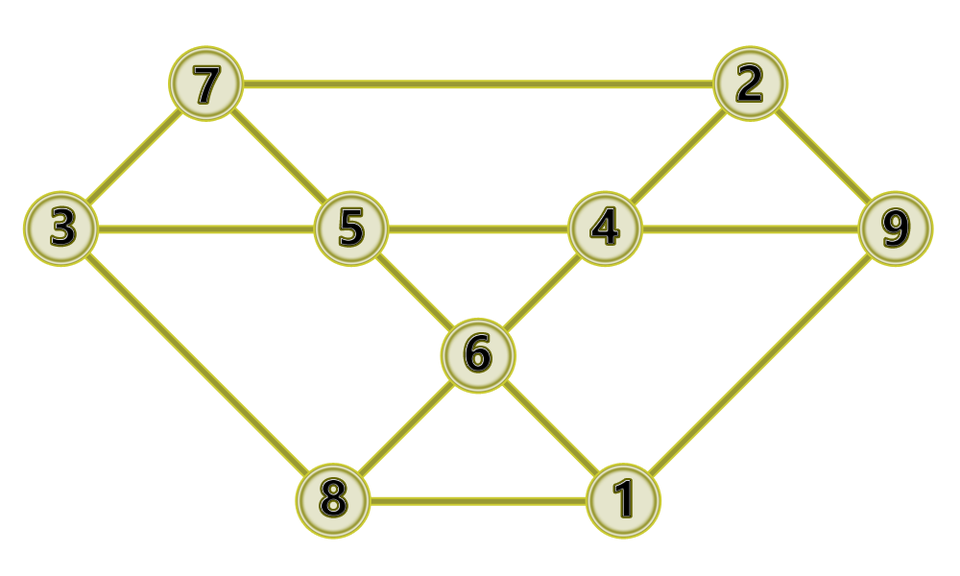
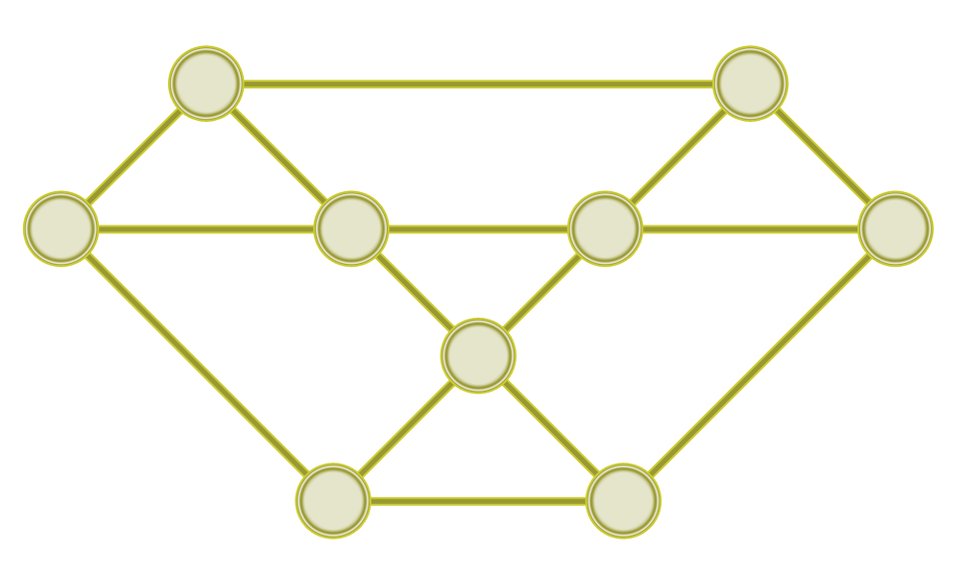
“Nine circles form the vertices of four small and three large isosceles triangles. Place the numbers from 1 to 9 in these circles so that the sums of the numbers at the vertices of all seven triangles are equal.”
Note: for the large triangles, count only the numbers at the three outermost vertices.
Try solving the puzzle yourself first. Remember that each number belongs to two or three triangles. Care is essential: a mistake in one triangle can affect all the others.

Historical background
The puzzle first appeared in the English-language Journal of Recreational Mathematics in the 1970s under the title The Triangle Sum Puzzle.
It is thought to be a variation on magic squares and other puzzles in which numbers are arranged in a structure with prescribed sums.
Solution
The sum of the numbers from 1 to 9 is 45. Each number belongs to several triangles, but the layout is such that three of the small triangles have no vertices in common, while the fourth contains the central values.
This means that the sum of the numbers in each triangle must be 15.
We recommend beginning with the central triangle and placing the numbers 4, 5, 6 there. After that, the puzzle can be solved logically by combining the conditions and using symmetry.