
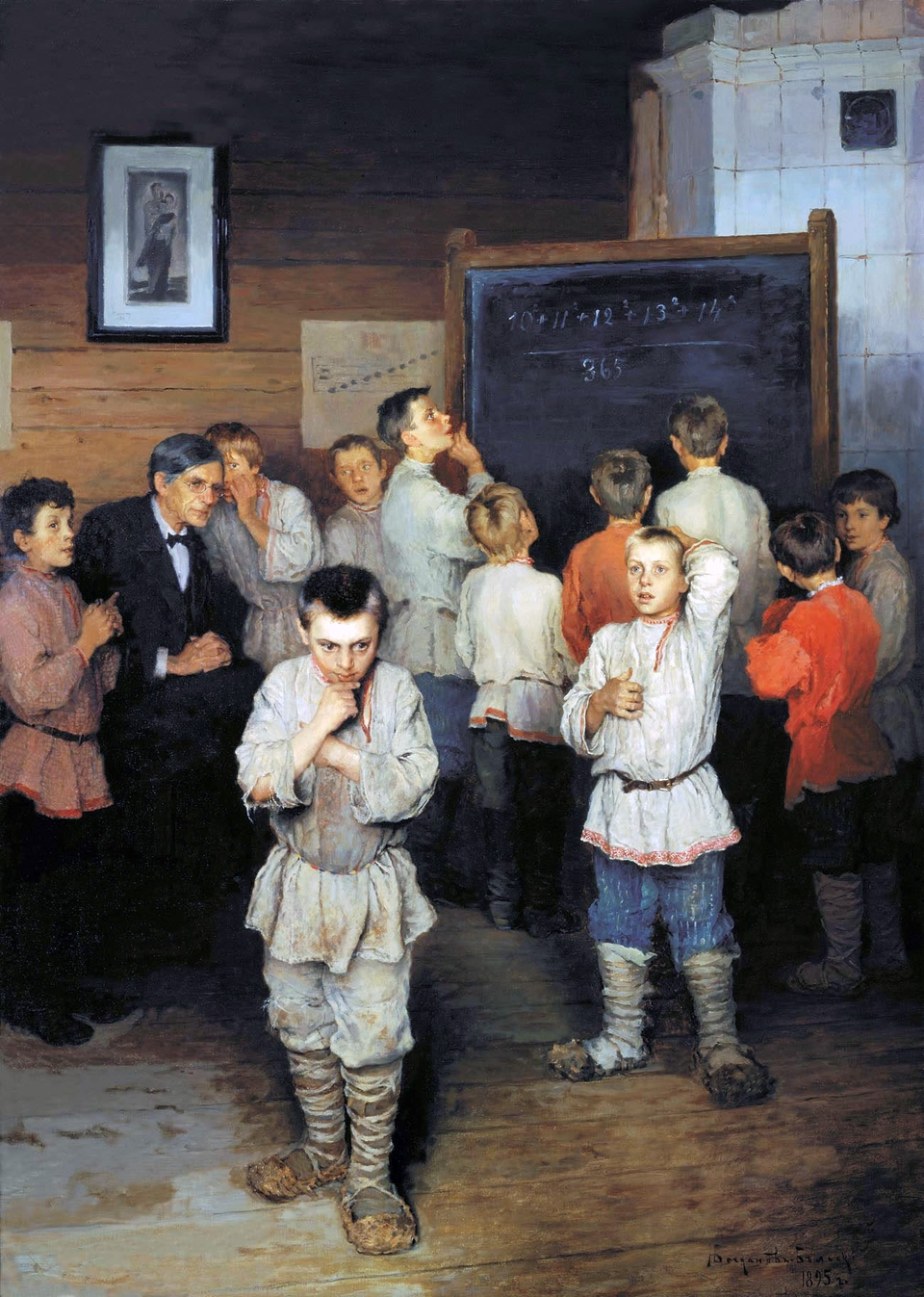

Many mathematics enthusiasts know N. P. Bogdanov-Belsky’s painting Mental Arithmetic in S. A. Rachinsky’s Village School (1895).
It shows the celebrated village teacher, educator, Moscow University professor, botanist and mathematician Sergey Alexandrovich Rachinsky with his pupils.
In the 1870s, amid the Narodnik movement, Rachinsky gave up his career, his home in Moscow and his professorship, and returned to his native village of Tatevo in Smolensk Governorate, now in Tver Region. For the rest of his life, he taught mathematics and other subjects in a village school for peasant children. He developed a distinctive method of teaching mental arithmetic, instilling the foundations of mathematical thinking in village children. Incidentally, the painter Bogdanov-Belsky was one of his pupils.
The blackboard shows a mental-arithmetic problem:
(10² + 11² + 12² + 13² + 14²) ÷ 365
There are several ways to solve it.
First try calculating it mentally.
To gain experience with similar problems, we offer another beautiful method: “Rachinsky’s sequences”, which he devised independently and used to create mental-arithmetic problems.
Look carefully at Rachinsky’s numerical identities and try to notice their patterns:
1) Each identity uses an odd number of consecutive natural numbers. Denote this number by 2k + 1, and the first number by n. The numbers are then n, n + 1, n + 2, … , n + 2k.
2) The sum of the squares of the first k + 1 numbers equals the sum of the squares of the last k numbers:
Such a sequence of natural numbers is called a “Rachinsky sequence”.
At first sight, no pattern is apparent: what is the relationship between n and k, and what are the sums on the left and right of the different identities?
Algebraic equations can reveal the pattern.
For k = 1, we obtain n² + (n + 1)² = (n + 2)², giving the quadratic equation n² − 2n − 3 = 0. Its roots are n = 3 and n = −1.
For n = 3, we get the first Rachinsky sequence, consisting of three numbers: 3² + 4² = 5² = 25.
For n = −1, which is not a natural number, we get the identity 1 = 1.
The next equations can be investigated in the same way.
For k = 2: n² + (n + 1)² + (n + 2)² = (n + 3)² + (n + 4)², n² − 8n − 20 = 0. Its roots are n = 10 and n = −2.
For n = 10, we get the second Rachinsky sequence, consisting of five numbers:
This is precisely the identity used to solve the problem in the painting: (365 + 365)/365 = 2.
Next, try constructing the seven-number Rachinsky sequence yourself:
Then answer these general questions:
1) Find the quadratic equation whose positive root n can be expressed explicitly in terms of k and produces a Rachinsky sequence of 2k + 1 numbers.
This means that, for a given integer k ≥ 1, there is exactly one Rachinsky sequence.
2) Prove that the successive differences of the numbers n = n(k) form an arithmetic progression with common difference 4.
3) Find expressions S(k) for the left and right sides of the kth Rachinsky identity: S(k) = n² + (n + 1)² + … + (n + k)².
Before looking at the solution below, do try to find the answers yourself! :)
Solution
Cancel the identical terms on both sides:
Use the familiar identity:
This gives the quadratic equation:
Its roots are:
For n=2k^2+k, we obtain the required Rachinsky sequence of 2k+1 natural numbers. The case n=-k is excluded because it is not a natural number.
- The resulting identity:
2) Using the derived formula n = 2k² + k = k(2k + 1), which relates n and k, form the difference 2k² + k − (2(k − 1)² + (k − 1)) = 4k − 1.
This means that the successive differences of the numbers n = n(k) form an arithmetic progression with common difference 4.
Indeed, 10 − 3 = 7, 21 − 10 = 11, 36 − 21 = 15, …
If necessary, the first numbers in the identities can therefore easily be computed in succession with the recurrence relation nₖ = nₖ₋₁ + 4k − 1.
For example, n₄ = n₃ + 16 − 1 = 21 + 15 = 36.
It is easier, however, to use the formula n = k(2k + 1) = 4(8 + 1) = 36.
This formula makes it easy to construct further Rachinsky identities. For example, for k = 4 we obtain the nine-number identity:
3) S(k) = n² + (n + 1)² + … + (n + k)², where n = 2k² + k.
We need the familiar formula for the sum of the squares of the first k numbers:
This gives the following formula:
or