

We must know; we shall know.
— David Hilbert, Göttingen
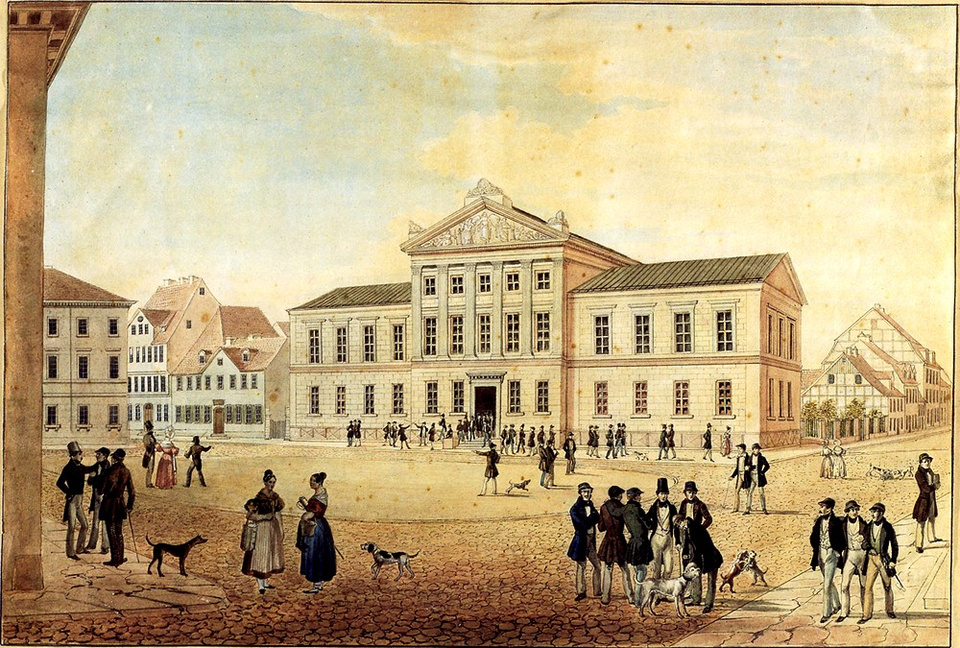
Georg August University of Göttingen (German: Georg-August-Universität, Lower Saxony) is one of the world’s major research and educational centres.
The university began operating in 1737. During the Enlightenment, it became known as a school of law, since more than half its students devoted themselves to jurisprudence. It was also popular among young Russian noblemen interested in German idealist philosophy. Many future Decembrists attended lectures in Göttingen.
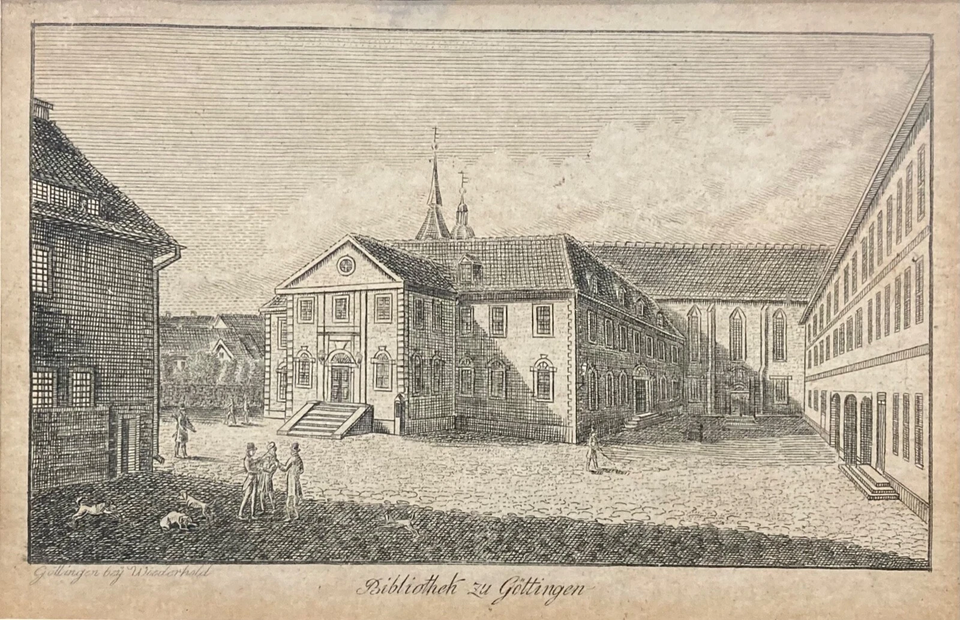

By the end of the XIX century, the natural sciences, especially mathematics, played a prominent part in university life. In the first decades of the XX century, Göttingen became a centre for many branches of modern physics. At least 45 Nobel laureates, chiefly in physics, chemistry and medicine, have been associated with the university.
By the XIX–XX centuries, the Göttingen mathematical school had become a true “Mathematical Olympus”, a “Mathematical Mecca”, where the course of world science was shaped. It fostered a unique intellectual environment uniting geniuses of different generations, from Gauss to Hilbert. The school gave the world brilliant theories and also developed a new approach to mathematics as a unified organism.
Even a brief list of the foremost scientists who worked at the university would suffice to convey Göttingen’s contribution to mathematics. We shall mention only a few who cannot possibly be omitted.
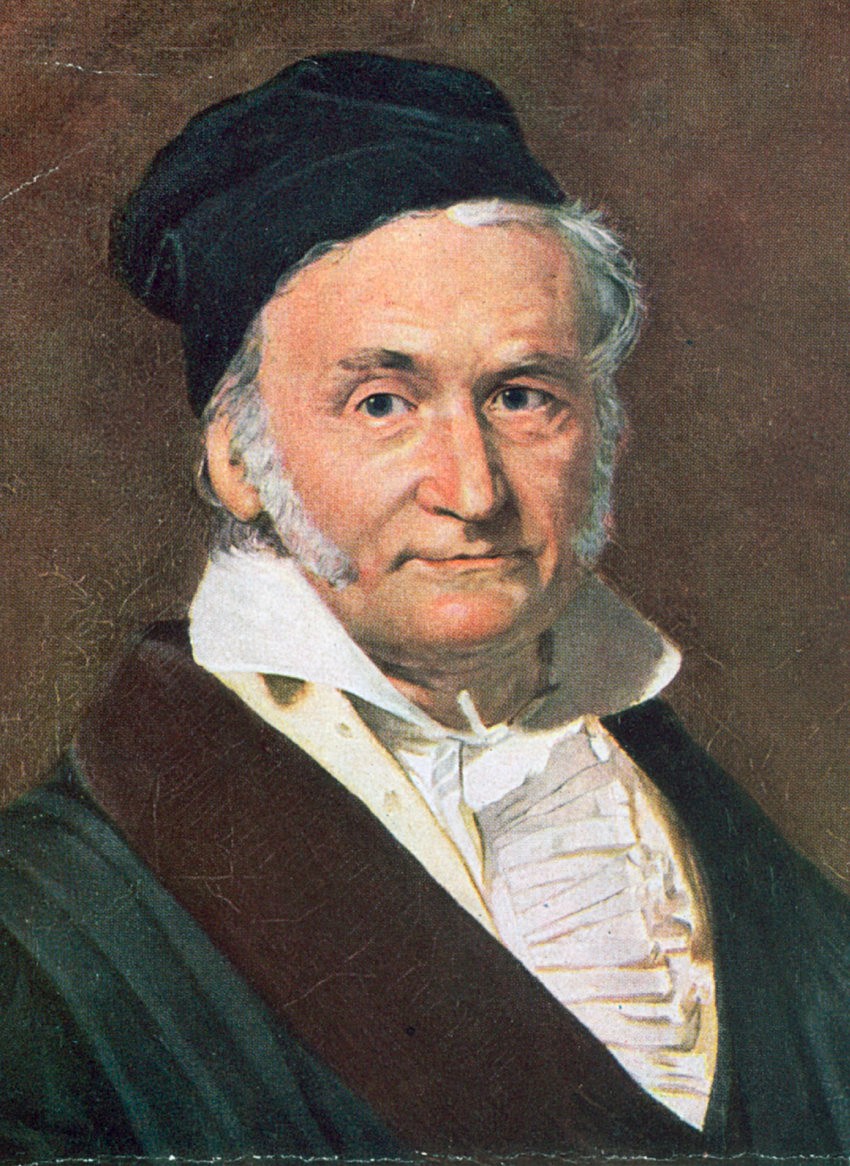

Carl Friedrich Gauss (1777–1855), the brilliant German mathematician, astronomer, physicist and surveyor, was born in Braunschweig and studied at Göttingen. From 1807 until his death, he was director of the astronomical observatory there and a university professor. His title “King of Mathematicians” can be regarded as recognition of his achievements.
Gauss also valued N. I. Lobachevsky’s discovery of non-Euclidean geometry highly. On his recommendation, Lobachevsky was elected a corresponding member of the Göttingen Scientific Society (1842) as one of the “outstanding mathematicians of the Russian Empire”.
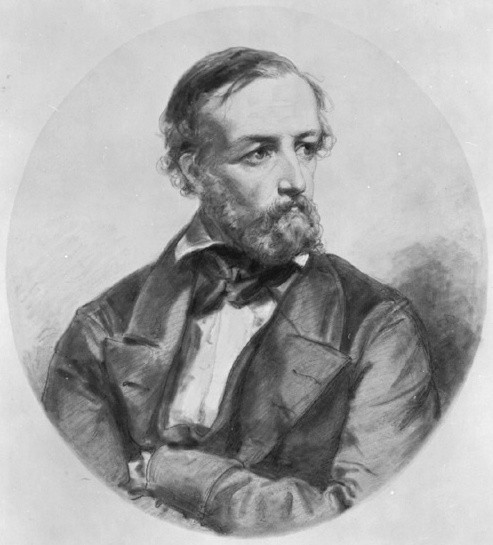

Gauss’s successor in Göttingen was the German mathematician Peter Gustav Lejeune Dirichlet (1805–1859). He made several major discoveries in number theory. His Lectures on Number Theory (1863) were translated into many languages and influenced later outstanding mathematicians, including Riemann, Kronecker and Dedekind.
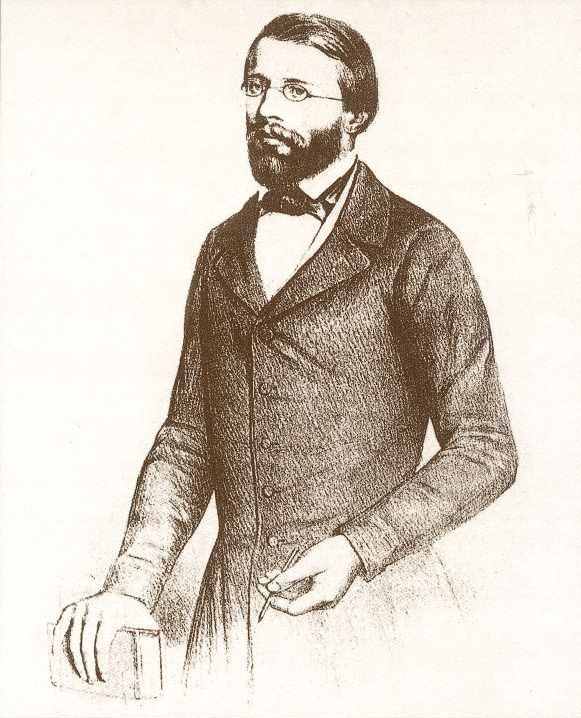

Georg Friedrich Bernhard Riemann (1826–1866) was an outstanding German mathematician and Dirichlet’s successor in Göttingen. His work profoundly influenced modern mathematics. In 1851, he defended his doctoral dissertation, Foundations for a General Theory of Functions of a Complex Variable. It initiated the geometric approach to analytic function theory and a new geometric science, topology.
In his memoir On the Hypotheses Underlying Geometry (1854), Riemann was the first after Lobachevsky’s discovery to develop the theory of space and classify all existing geometries, including non-Euclidean geometry. He introduced generalized Riemannian spaces, with the spaces of Euclidean and Lobachevskian geometry as special cases. This became the first recognition of Lobachevsky’s geometry.
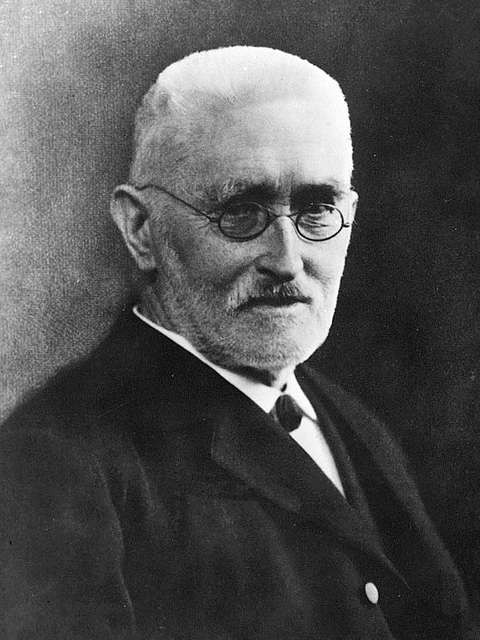

Richard Dedekind (1831–1916), a German mathematician and pupil of Gauss and Dirichlet, studied and worked in Göttingen. His writings laid the foundations of modern algebra, which studies groups, rings, fields, structures and modules. He introduced the concepts of a ring and an ideal. He was among the first to give real-number theory a set-theoretic foundation through Dedekind cuts (Continuity and Irrational Numbers, 1872).
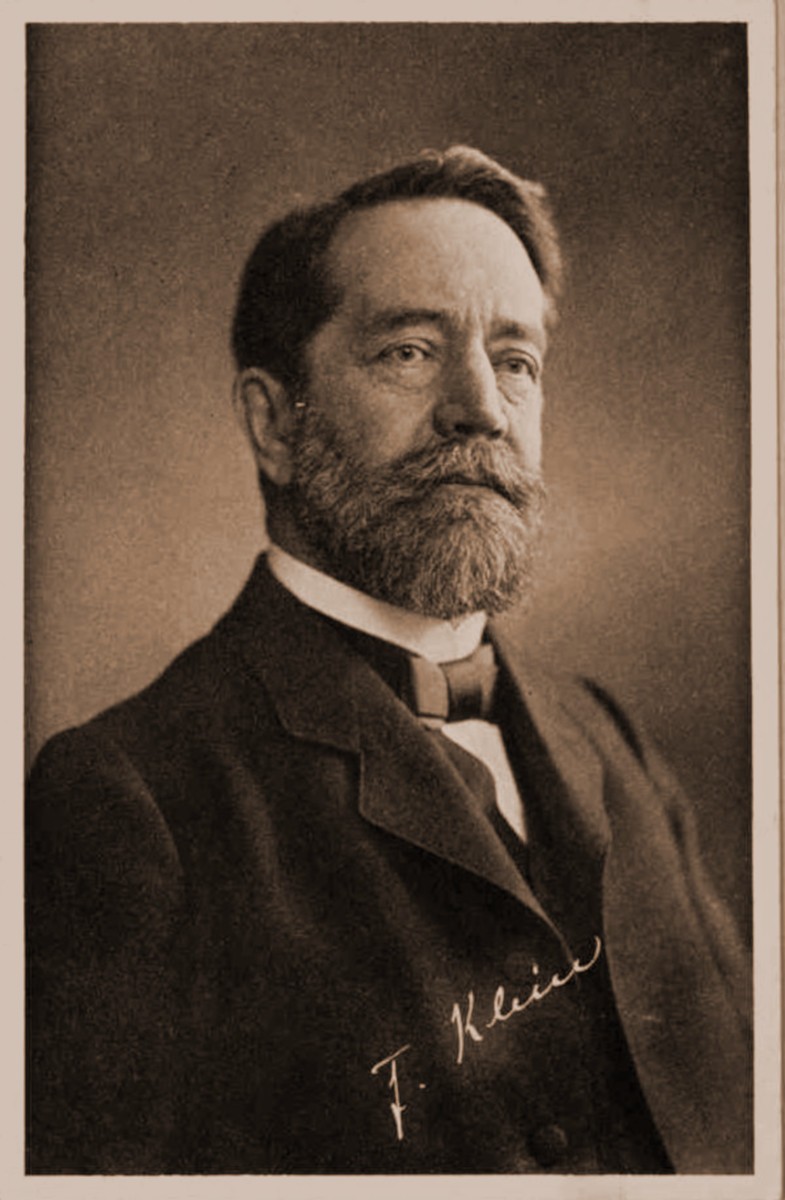

Felix Christian Klein (1849–1925) was an outstanding German mathematician. He graduated from the University of Bonn and began working at Erlangen in 1872. From 1886, Klein worked at Göttingen.
His inaugural professorial lecture, A Comparative Review of Recent Researches in Geometry, became known in the history of mathematics as Klein’s Erlangen Programme. It presented his idea for the foundations of geometry: every geometry becomes the theory of invariants of a particular transformation group. Klein’s model (1871), which realizes Lobachevsky’s axioms — Klein’s interpretation — is well known. It led to full recognition of Lobachevsky’s geometry.
Klein’s programme significantly influenced geometry teaching in universities and secondary schools for several decades. His principal works concern non-Euclidean geometry, continuous groups, elliptic functions and automorphic functions.
He paid particular attention to mathematics education, organizing the International Commission on the Reorganization of Mathematics Teaching (1908).
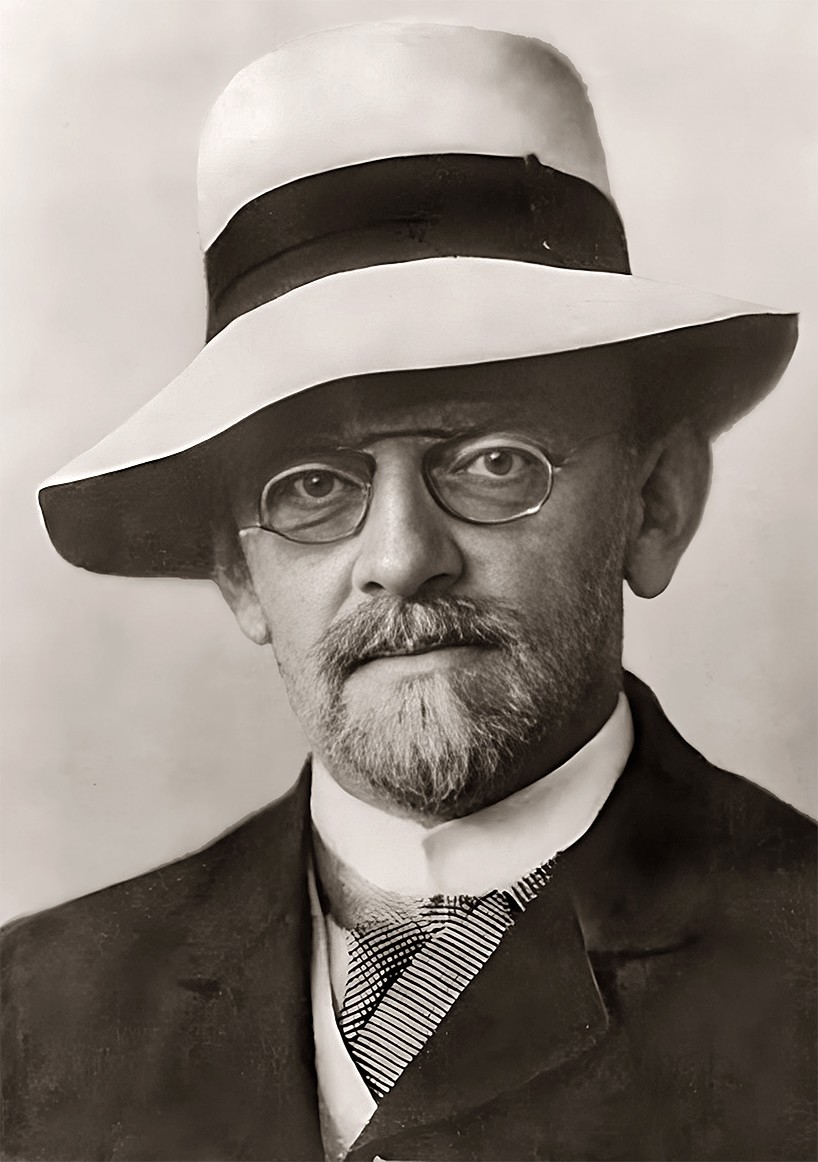

David Hilbert (1862–1943) was a German mathematician who profoundly influenced mathematics and physics in the late XIX and first half of the XX century. Born in Königsberg, he graduated from its university and taught there, then at Göttingen in 1895–1933. He created a leading world centre of mathematics there.
Hilbert led a large school whose interests encompassed almost all mathematics. He was a universal mathematician. In his famous Foundations of Geometry (1899), he gave a complete system of axioms for Euclidean geometry, classifying them into groups.
In 1900, at the II Congress in Paris, Hilbert formulated 23 problems whose solution, he believed, would promote further mathematical development. They became subjects of research throughout the XX century. Some were solved during the century. The list of Hilbert’s Problems affirmed the vitality of every field of mathematics.
During Klein and Hilbert’s overlapping years in Göttingen (1895–1925), the university became the world centre of mathematical research. Young mathematicians of different nationalities came to study their particular subjects as integral parts of mathematics as a whole. In the early XX century, Göttingen was called “the mathematical Mecca”.
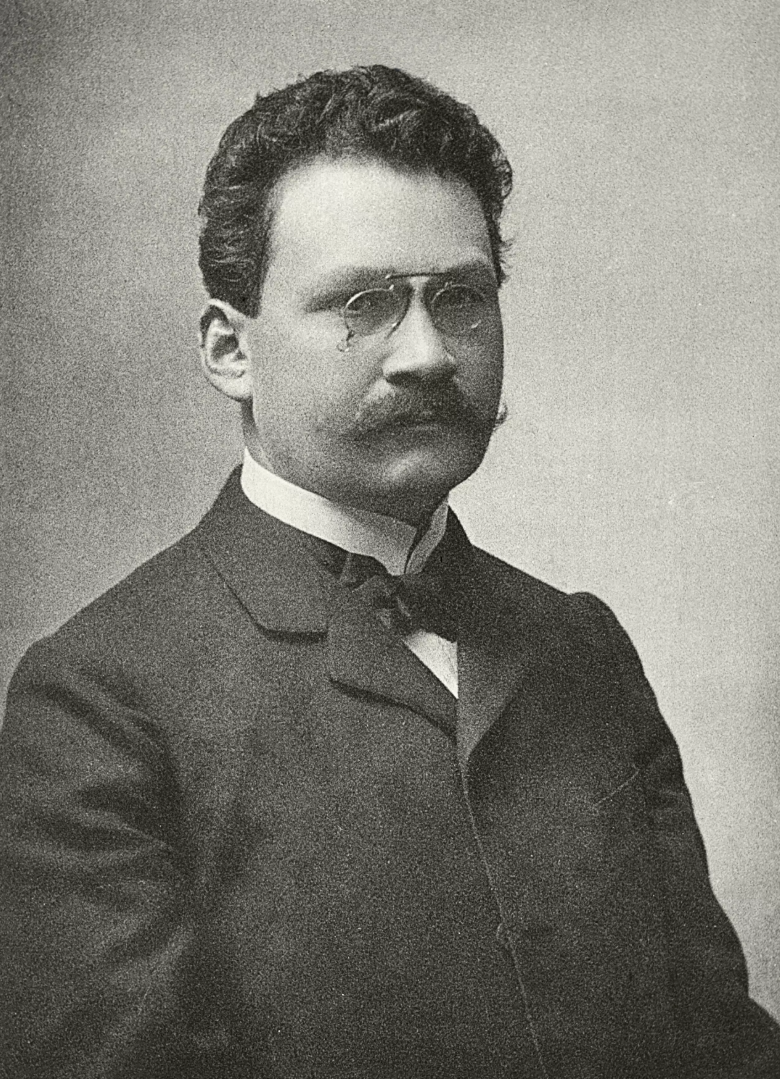

Hermann Minkowski (1864–1909) was another representative of the Göttingen mathematical school. He laid the mathematical foundations of relativity and established its connection with Lobachevsky’s geometry.
In the 1930s, professors of Jewish origin were persecuted and left Göttingen University. These included the well-known mathematicians Edmund Landau, Richard Courant, Max Born, Otto Toeplitz, Hermann Weyl and Emmy Noether.
The distinctive features of the Göttingen school were:
- unity of theory and practice;
- an interdisciplinary approach;
- its teaching system;
- its international character;
- its tragic end: the school’s destruction by the Nazis in 1933.
The spirit of Göttingen — freedom of thought, faith in reason and respect for science — proved stronger than any repression. The mathematics created there still underpins modern science.