
(On the 195th anniversary of his birth)
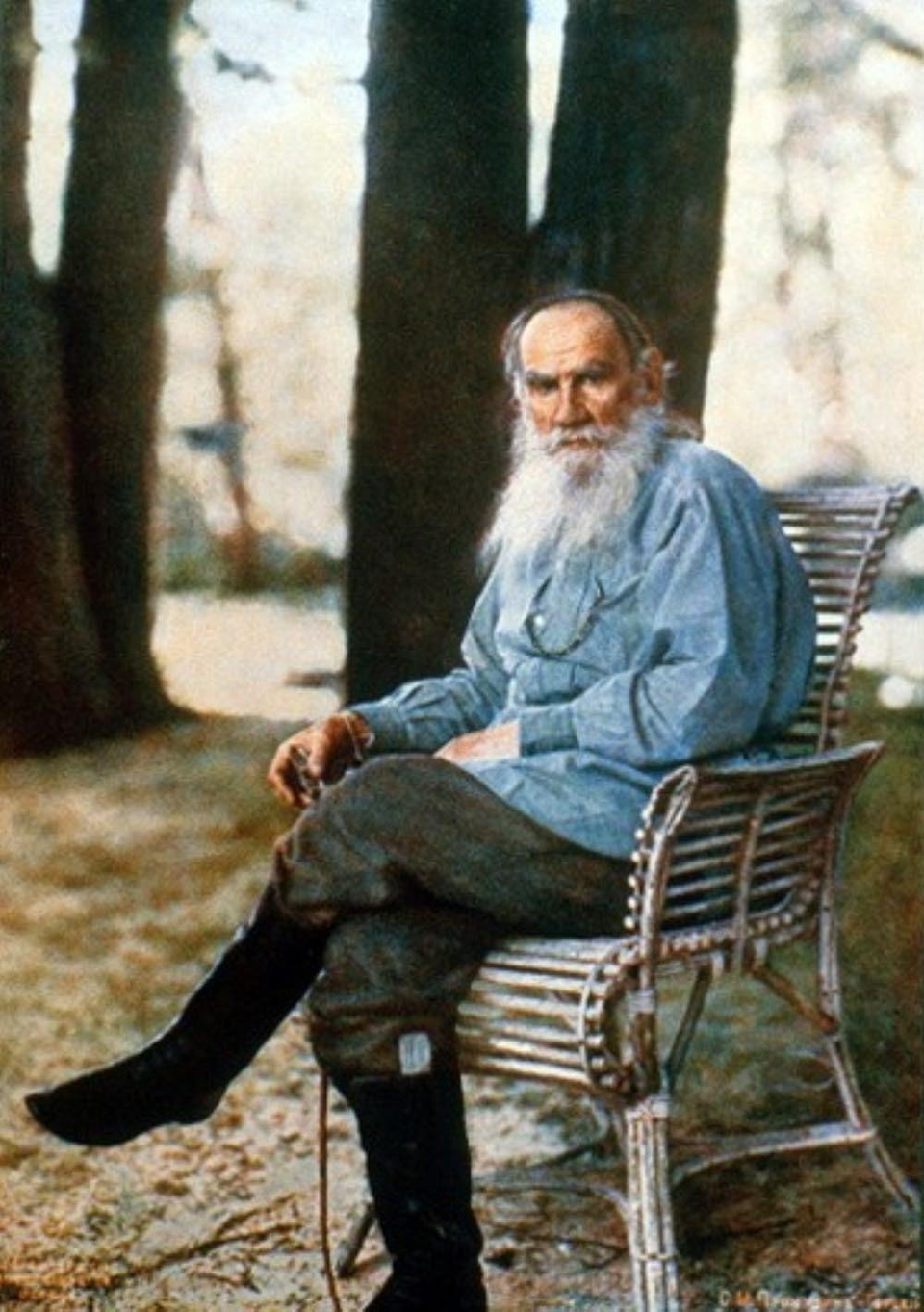

“A learned person knows a great deal from all kinds of books; an educated person knows everything currently in use among people; an enlightened person knows why they live and what they must do. Do not strive to be learned or educated; strive to be enlightened.”
“If a teacher combines love for the work with love for the pupils, that teacher is perfect.”
“Nothing is easier than being a university professor, and nothing is harder than being a teacher of the people: in the first case, every question and difficulty has already been anticipated; in the second, the breadth of the demands astonishes and terrifies us.”
Leo Nikolaevich Tolstoy
People of genius are brilliant in almost everything they undertake. The great Russian writer and philosopher Leo Nikolaevich Tolstoy held original views on education. An extensive literature is devoted to his work in public education. Yet not all of Tolstoy’s work and achievements have received their due attention and recognition. Almost no primary-school teachers, for example, know how to teach mathematics “the Tolstoy way” or have held his Arithmetic in their hands. The history of teaching methods also contains true gems of mathematical creativity: “L. N. Tolstoy’s problems”.
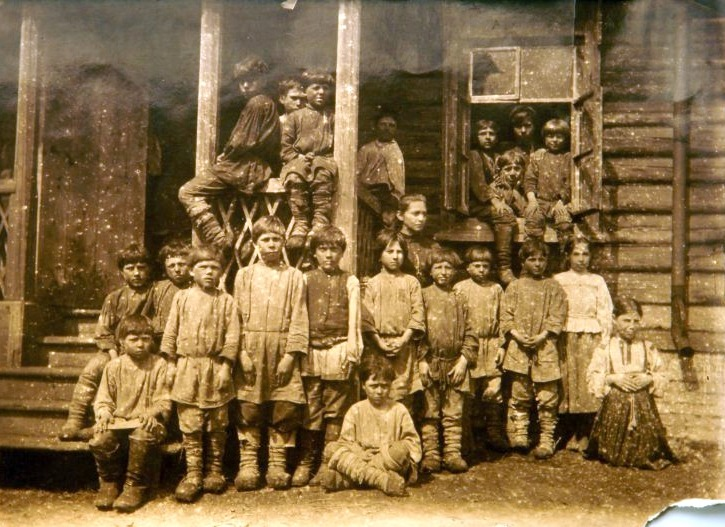

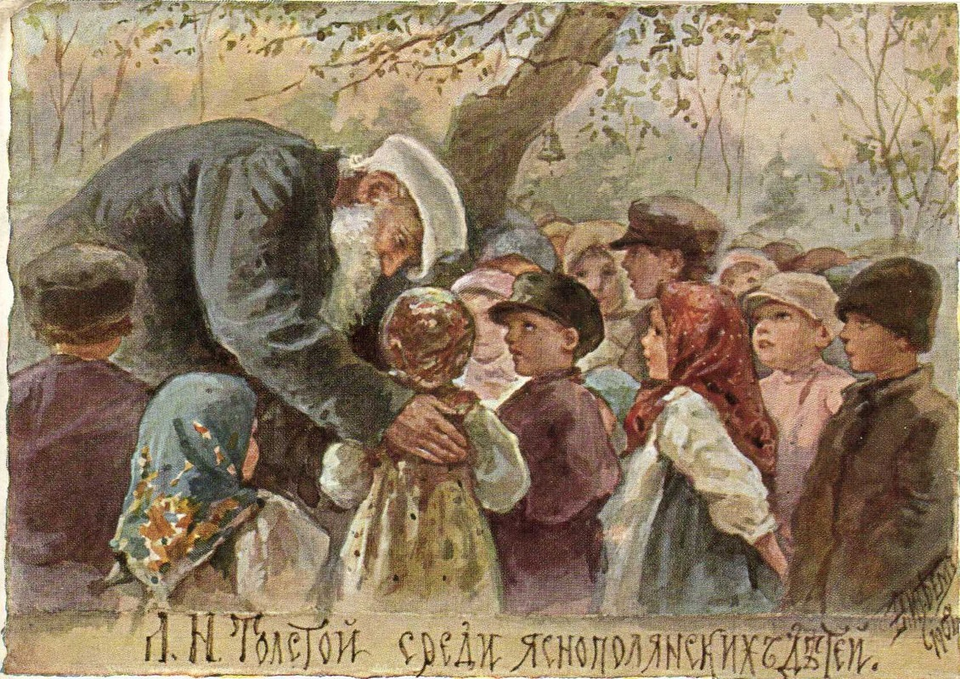
In 1859, as is well known, Tolstoy opened a school for peasant children at Yasnaya Polyana, one of the first schools for the people.
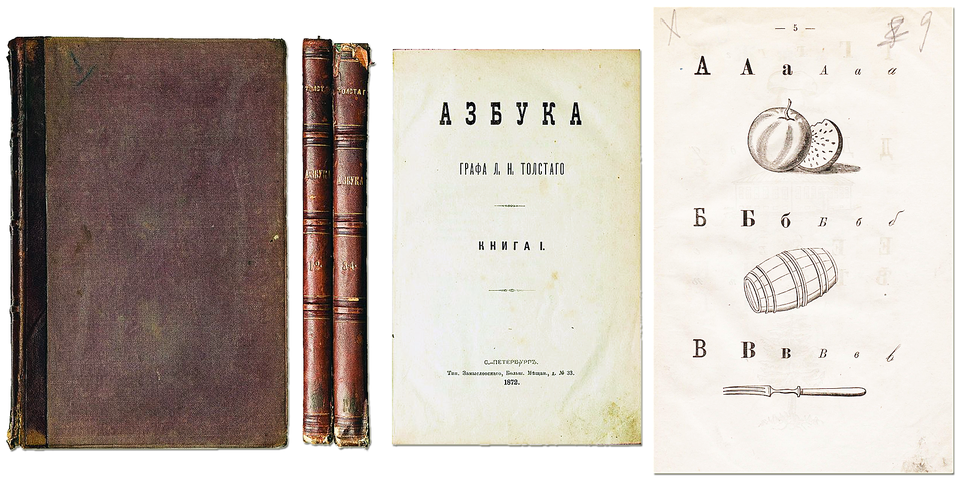

He taught mathematics and history there himself and conducted physics experiments. He wrote and published several instalments of his original ABC (1872), which included arithmetic sections. He organised these and published them in Arithmetic in 1874. Arithmetic later appeared in other editions too. In it, Tolstoy also gave valuable methodological guidance to teachers. His “Instructions for the Teacher”, in a systematic form, were included in the posthumous edition published in 1913.
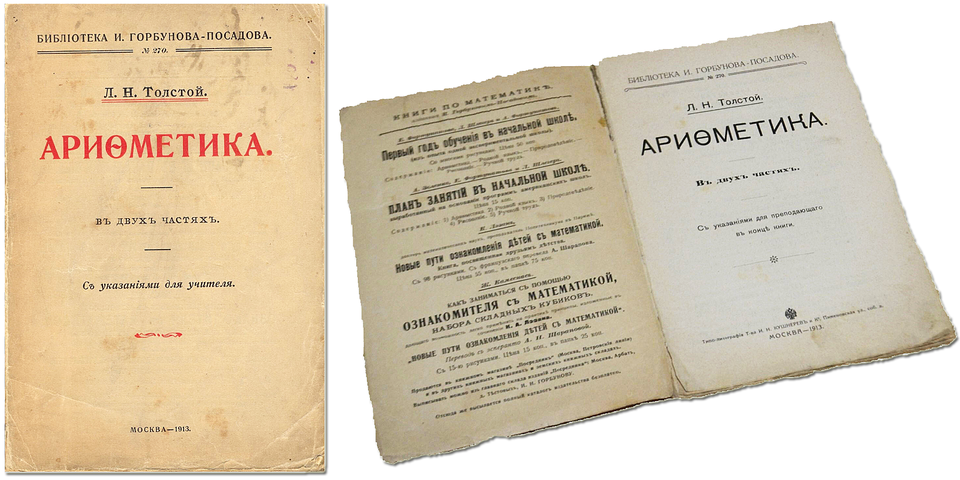

Publication was therefore preceded by many years of experience at the Yasnaya Polyana school, to which he returned several times. Practical experience alone, however, did not lead the count to write primary-school textbooks.
At the beginning of the 60s of the nineteenth century, he decided to leave literature and settle in the countryside. This was an era of important social reforms associated with the emancipation of the serfs. It was also a flourishing period for Russian national education, associated with K. D. Ushinsky, N. I. Pirogov and other educational reformers. Tolstoy too was inspired by the ideals of enlightenment. He studied educational organisation in Russia and abroad, conducted educational research and, in 1862, published the educational journal Yasnaya Polyana.
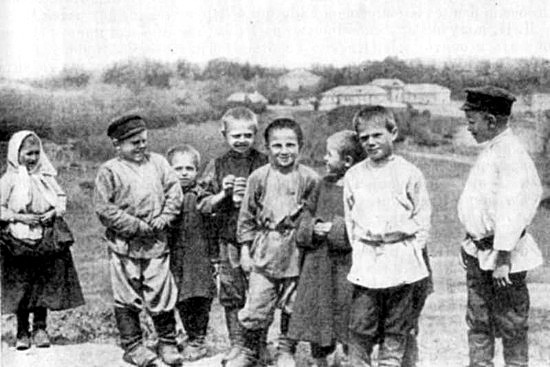

Tolstoy’s school is recognised as an original educational experiment, although it had no fixed teaching programme. There was no homework at Yasnaya Polyana. A pupil came to school carrying “only themselves, their receptive nature, and the certainty that today at school would be as enjoyable as yesterday”. Lessons took the form of free conversations between teacher and pupils. The school nevertheless achieved excellent results: children learned to read fluently in three months.
Tolstoy proposed important teaching principles: attending to each child’s individual characteristics and interests, and developing creativity, independence and thinking.
Tolstoy’s educational principles:
-
For a pupil to learn well, they must learn willingly. For them to learn willingly, 1) what they are taught must be understandable and interesting, and 2) their mental faculties must be in the most favourable conditions.
-
A pupil fails to understand because their time has not yet come.
-
(Very important.) The pupil must not fear punishment for poor learning, that is, for failing to understand. The human mind can function only when it is not suppressed by external influences.
-
The mind must not become tired. As soon as it is tired, have the pupil engage in physical movement.
-
The easier it is for the teacher to teach, the harder it is for pupils to learn. The harder it is for the teacher, the easier it is for the pupil.
His search for teaching methods led Tolstoy to the sound conclusion: “The task of mathematics is not to teach calculation, but to teach the methods of human thought used in calculating.”
Tolstoy’s Arithmetic
In content, Tolstoy’s Arithmetic differed from both the arithmetic textbooks of its own time and those that followed. The original ABC of 1872 consisted of four books, with arithmetic sections as follows:
Book I. Part Four. Counting. It contained “A Table of Four Numeration Systems”, “Numerals for Reading”, “Counting with Slavonic Numerals”, “Counting with Roman Numerals”, “Counting on an Abacus and with Arabic Numerals”, and “For the Teacher”.
Book II. Part Three. Counting. It contained “Addition and Subtraction”, “Problems”, and “For the Teacher”.
Book III. Part Three. Counting. It contained “Multiplication and Division”, “Problems”, and “For the Teacher”.
Book IV. Part Three. Calculating with Fractions. It contained “Addition and Subtraction of Decimals”, “Multiplication and Division of Decimals”, “Different Numeration Systems”, “Converting Fractions”, “Reducing to a Common Denominator”, “Addition and Subtraction of Fractions”, “Multiplication and Division of Fractions”, “Problems”, and “For the Teacher”.
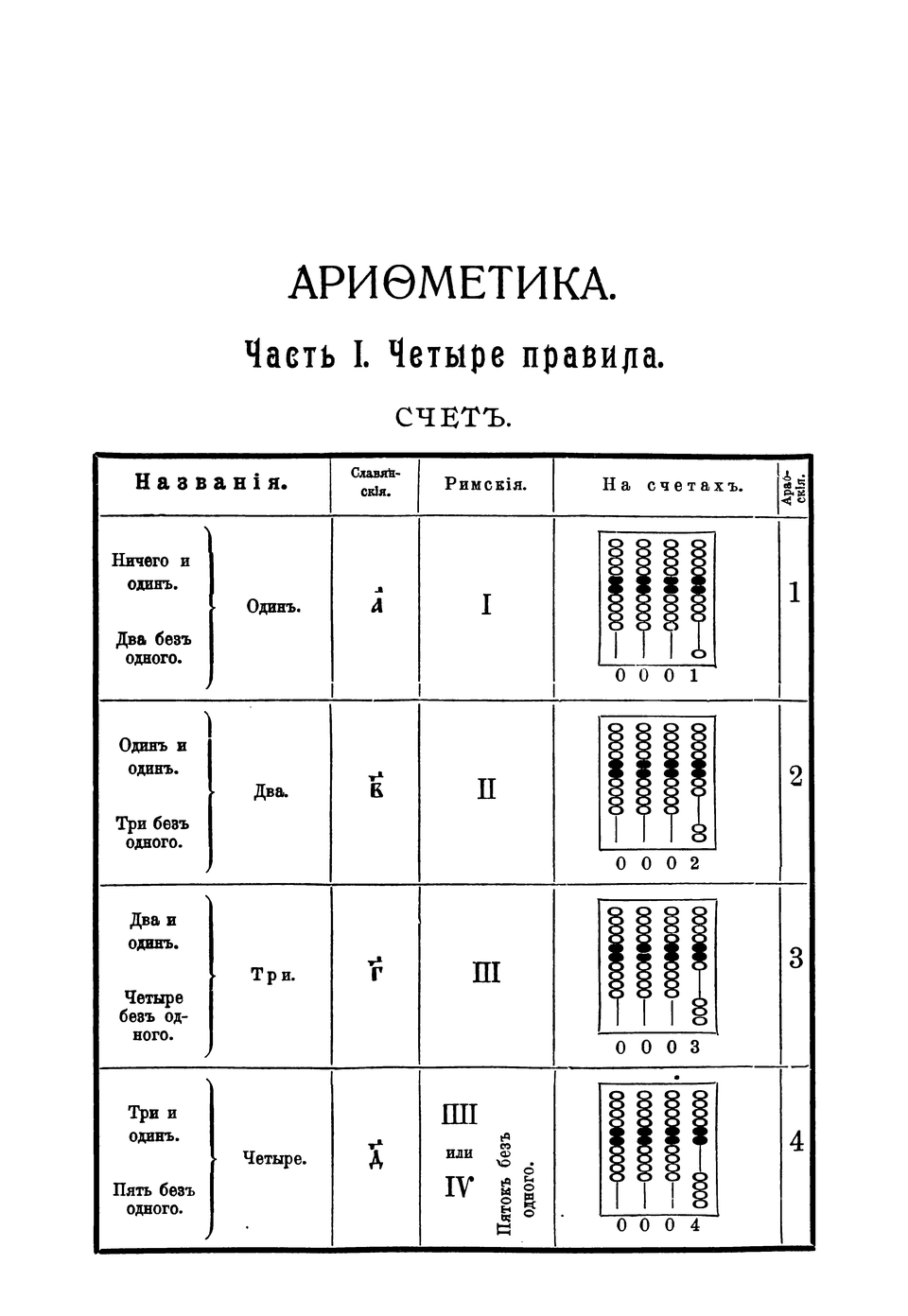

In the first book of the ABC, Tolstoy compiled “A Table of Four Numeration Systems”, giving number names and their notation in Slavonic, Roman and Arabic (Indian) numerals, along with drawings showing how every number up to 4500 is represented on a Russian abacus. Slavonic and Roman numeration were part of the school curriculum at that time. Each abacus exercise is accompanied by an explanatory drawing.
When introducing the Russian abacus, Tolstoy found a useful innovation: he drew the wires vertically rather than horizontally. This linked the visual representation of a multidigit number with the way it is written.
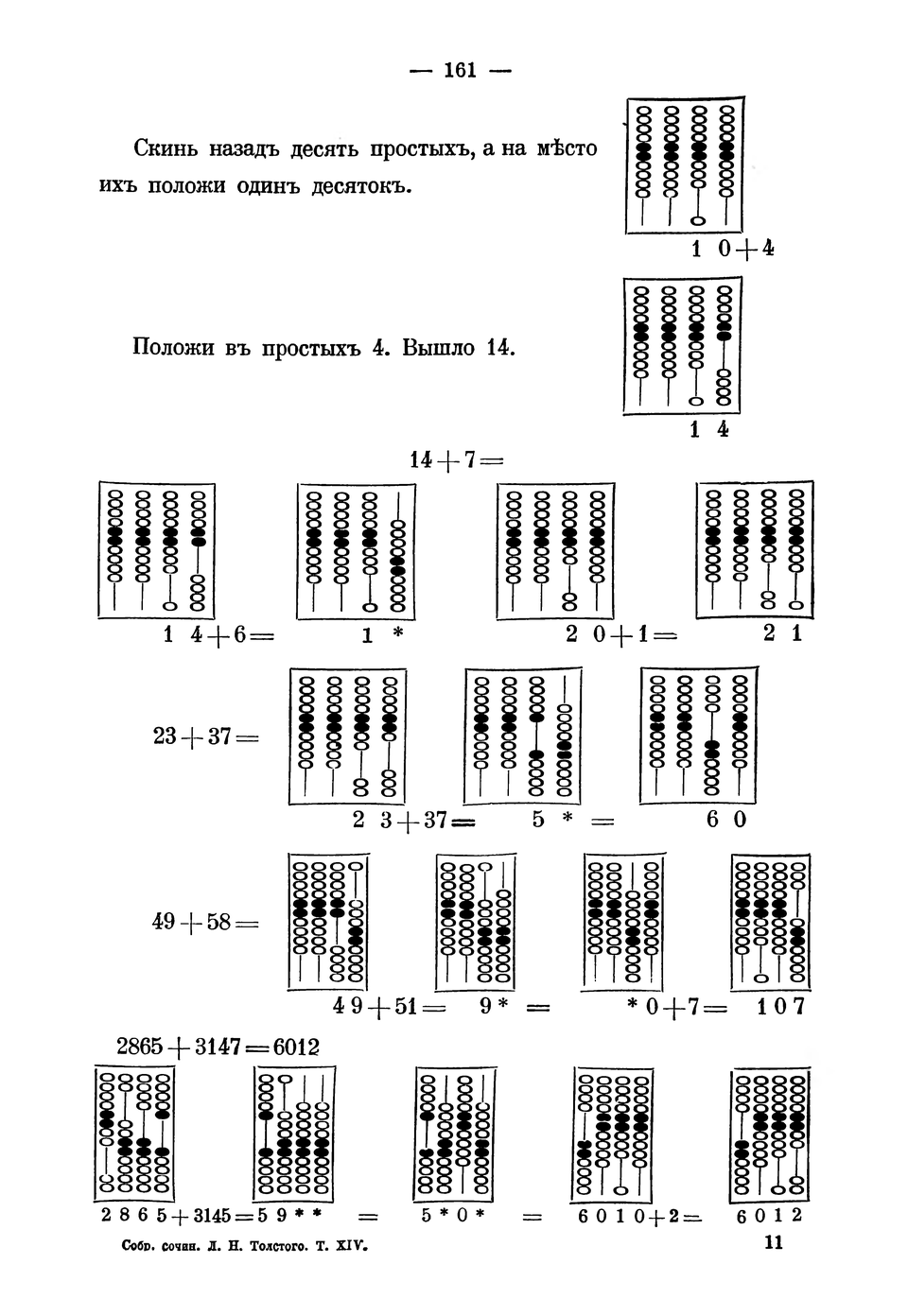

The section “Different Numeration Systems” was an entirely new addition to Russian school arithmetic. By putting the required number of beads on its rods, the Russian abacus could clearly demonstrate addition and subtraction in different number systems. The simplicity and usefulness of the decimal system can be understood only by comparing it with others. A similar principle is used in the Chinese suanpan, Japanese soroban and modern abacuses used in mental arithmetic.
The inconvenience of calculating with Slavonic and Roman numerals is convincingly demonstrated. Calculating “on an abacus” and “with Arabic numerals” is established as the principal method.
Tolstoy paid great attention to problem-solving but did not include complicated problems in his textbook, although he himself loved problems requiring considerable ingenuity. He insisted that problems be expressed clearly in simple Russian: “The difficulty of most problems in exercise books lies in the poor language in which the questions are stated.” Arithmetic contains excellent examples, as even Tolstoy’s critics acknowledged.
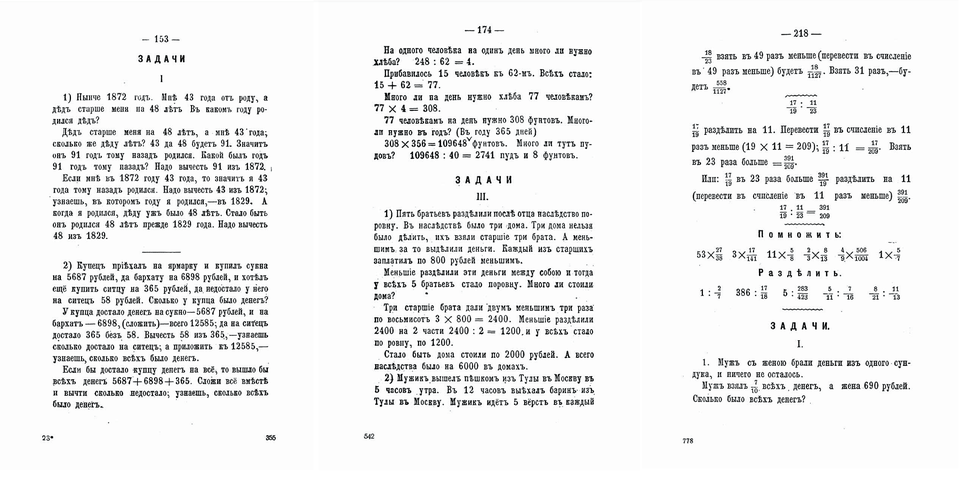

Problems from Arithmetic
-
The year is 1872. I am 43 years old, and my grandfather is 48 years older than I am. In what year was my grandfather born?
-
A merchant bought a forest for 3700 roubles. He cut it all down for firewood, obtaining 531 sazhens of wood. He sold the firewood at 8 roubles per sazhen. Did he make a profit or a loss, and how much? How much did he receive for all 531 sazhens at 8 roubles each?
-
Five brothers divided their father’s inheritance equally. It included three houses. The houses could not be divided, so the three eldest brothers took them, and the younger brothers received money instead. Each elder brother paid 800 roubles to the younger ones. The younger brothers divided the money between them, leaving all the brothers with equal shares. How much were the houses worth?
-
A husband and wife took money from the same chest until nothing remained. The husband took 7/10 of all the money, and the wife took 690 roubles. How much money was there altogether?
-
Two pipes are fitted above a barrel, and water flows into it from both. One pipe fills the barrel in 24 minutes, the other in 15 minutes. There is also a hole in the barrel through which all its water drains in 2 hours (2 hours = 120 minutes). Will the barrel fill, and how quickly, if water flows from both pipes while also flowing out through the hole?
Tolstoy was particularly fascinated by recreational problems. He collected them enthusiastically and knew a great many. He often set them for family members, acquaintances and guests. They found their way into many collections of arithmetic problems.
L. N. Tolstoy’s problems
Problem 1. “The Mowers”. A group of mowers must mow two meadows. They begin on the larger meadow in the morning. After midday they split: half remain on the first meadow and finish it by evening, while the others move to the second, whose area is half that of the first. How many mowers are there if one mower completes the remaining work during the following day?
Problem 4. “The Geese”. A flock of geese is flying along and meets another goose. The lone goose says, “Hello, one hundred geese.” The flock replies, “There are not a hundred of us, but there would be if you took our number, added as many again, then half as many, then a quarter as many, and you joined us.”
Criticism
Tolstoy’s selfless struggle to renew arithmetic teaching methods and win recognition for his Arithmetic ended in failure. This was largely due to the Church’s and reactionary press’s rejection of his philosophical views.
As soon as the ABC was printed, Tolstoy sent it to Viktor Yakovlevich Bunyakovsky, vice-president of the Academy of Sciences, with a letter asking him to examine its mathematical section. Bunyakovsky’s reply gave the book a generally favourable assessment, while offering criticism on particular points. Tolstoy wrote: “I received a 20-page letter about arithmetic from Bunyakovsky. He praises and criticises it, usefully pointing out that I was wrong to discard all the former methods for fractions.” Bunyakovsky’s review was the fullest, most objective and most qualified assessment of the great writer’s work on mathematics teaching, and also moral support from an authoritative mathematician. Bunyakovsky himself had written an Arithmetic textbook, which appeared in three editions in 1844, 1849 and 1852.
Tolstoy attached great importance to the letter. It was submitted to the Learned Committee of the Ministry of Public Education, whose special department considered approving the ABC as a manual for schools for the people at its meetings in 1873.
The commission gave the arithmetic section a negative assessment because “… there is no section on numbers with units; the author chiefly attends to training in the mechanics of calculation, neglecting the development of mental abilities; the exposition is fragmentary; some sections introduce new terminology used by no one and incapable of replacing the accepted terminology.”
Following the appearance of Tolstoy’s Arithmetic, the St Petersburg Pedagogical Society discussed it at four meetings in 1874. Its opposing speakers were V. A. Yevtushevsky, who criticised the textbook and considered Tolstoy’s methods outdated, ending his report with “Disaster comes when a cobbler starts baking pies!”, and the well-known mathematics educator General A. N. Strannolyubsky, who regarded them as rigorous and carefully considered. “Overall, Tolstoy’s work as a village-school teacher and a writer on education is highly honourable, deserves complete respect, and does not warrant the harsh final conclusion reached by Yevtushevsky last time.” Strannolyubsky argued that Tolstoy’s system was thoughtful and psychologically sound: every new concept was developed successfully, and the pupil was always placed in the position of an inventor.
In 1862, a seven-week teaching experiment was conducted in Moscow under the Moscow Literacy Committee to compare two systems of teaching literacy and arithmetic. In the experimental group, P. V. Morozov taught using Tolstoy’s system; in the other, the teacher Protopopov used Yevtushevsky’s. The experts were divided, however, and reached no conclusion.
Outcome
Tolstoy’s Arithmetic did not become a widely used textbook. After the 1874 edition, it was not published again during his lifetime. Following his death, with S. A. Tolstaya’s permission, two editions appeared simultaneously in 1913: Arithmetic in Two Parts, in I. Gorbunov-Posadov’s library series, and Arithmetic, published by Sytin.
Count L. N. Tolstoy nevertheless drew public attention to what and how primary schools should teach. He outlined an integrated mathematics curriculum: arithmetic alongside introductory algebra and geometry.
The issues he raised continue to be explored in primary-school teaching methods: studying arithmetic, elementary algebra and geometry together; avoiding excessive fragmentation of the material; studying addition with subtraction and multiplication with division; the role of problems in learning; and demanding more of the methods used to review earlier material.
The educational and mathematical teaching principles of Tolstoy’s system discussed here closely resemble many aspects of a mathematics teacher’s work and accord with modern primary-school educational standards. They seek to develop creativity in learning. As the great writer said: “If a pupil has not learned to create anything independently at school, they will always merely imitate and copy in life, since few people who have learned to copy know how to apply this knowledge independently.”