

I am opening a new series of articles on mathematical instruments with a brief historical overview. I will describe how tools of everyday activity became visual teaching aids and established a lasting place in the methods of teaching mathematics in modern schools.
There is no clear definition, so we need to specify what “mathematical instrument” will mean here. Mathematics is useful in practice because its subject comprises the quantitative relations and spatial forms of the real world, expressed in numbers and figures. Every application of mathematics involves these fundamental concepts.
Mathematical instruments, then, are technical devices used to study objects and phenomena through their numerical and geometric characteristics. They are used for calculation, measurement and the construction of figures. On that basis we shall classify them as calculating, measuring and construction instruments. We will discuss these categories further below.
The theory of instruments effectively forms a special branch of mathematics: “instrumental mathematics”. The theory and construction of instruments attracted many outstanding scientists, including B. Pascal, G. W. Leibniz, P. L. Chebyshev and A. N. Krylov.
Historically, the practical purpose of mathematics education has been to create and apply the tools people need in everyday life. Everyone has to perform calculations, measurements and constructions, and use technical devices, instruments and tables. One goal of mathematics teaching in modern schools is therefore to acquire the knowledge needed for practical activity, for studying related subjects and for continuing one’s education. At present, however, the requirements for pupils’ mathematical preparation and the curriculum do not reflect this adequately.
I believe that a teacher’s understanding of mathematical patterns in practical applications should shape mathematics teaching as a whole. This would enable the teacher to motivate pupils to seek patterns and apply them to practical problems.
Secondary-school mathematics syllabuses and teaching plans no longer allocate specific hours to practical lessons involving modelling and measurement. At best, these activities are assigned to extracurricular work or clubs. Soviet schools did allocate such hours, especially during the transition to polytechnical education. As early as the 20–30s of the XX century, teachers’ books and pamphlets on surveying work were published by G. A. Vladimirsky, M. A. Znamensky and N. A. Popov.
Beginning in 1937, the journal Mathematics in School published articles on measurement activities. Later, in the 50s, pupils’ broad range of skills specifically included using tables and calculating devices, handling drawing and measuring instruments, taking measurements and processing their results.
Even primary-school pupils carried out simple fieldwork: ranging straight lines, measuring distances and developing the ability to estimate by eye. In the lower secondary school, the syllabus described the types of activities and allowed teachers to decide when to conduct them.
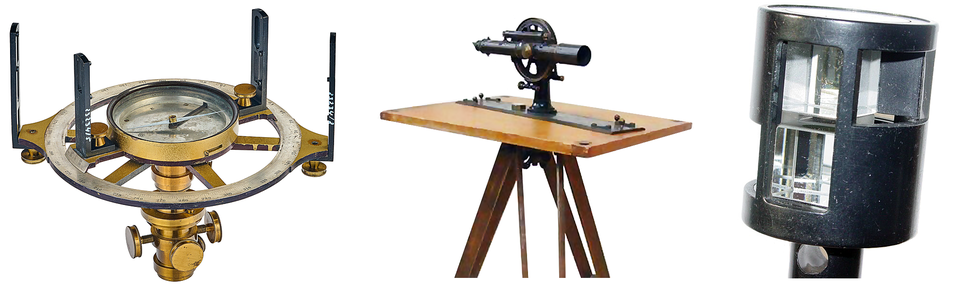

Geometry textbooks, such as N. N. Nikitin’s, described instruments including the astrolabe, plane table and surveyor’s cross. A system of mathematics teaching equipment, including devices and instruments, was also developed: for example, the Standard Lists of Visual Teaching Aids and Educational Equipment for General Schools (1977). Under that list, secondary-school mathematics equipment comprised:
● devices, models and instruments;
● printed teaching aids;
● screen-based teaching aids.
Some modern geometry textbooks, including those by A. D. Alexandrov and L. S. Atanasyan, contain illustrations of the same instruments, but do not provide for their study. The planned topic “Instruments for Calculation and Measurement” (grades V — VI) offers only introductory information about calculator use, tables and diagrams, rulers and protractors.
Mathematical instruments were thus one way to give school mathematics a practical orientation. As the goals of mathematics education changed, the instruments gradually fell out of use. Removing them from teaching practice may have been a methodological mistake.
Using instruments addresses many goals of mathematics and science education. Studying their invention and practical use can help bring this into focus. Models, devices and instruments can be used in different forms of instruction and at different stages of a lesson:
● when introducing concepts and proving theorems;
● when solving problems;
● when carrying out laboratory and practical work.
R. A. Khabib, for example, researched these questions: “If we examine carefully the principles on which instruments are designed, and try to identify the geometric properties underlying their arrangements, we can readily see how closely the design of these instruments is connected with geometric construction problems.
The idea of using construction devices and instruments in geometry teaching is highly productive: it shows pupils geometric properties in action. The reverse transition is equally important — from geometric properties to instruments and devices capable of realizing those properties.”
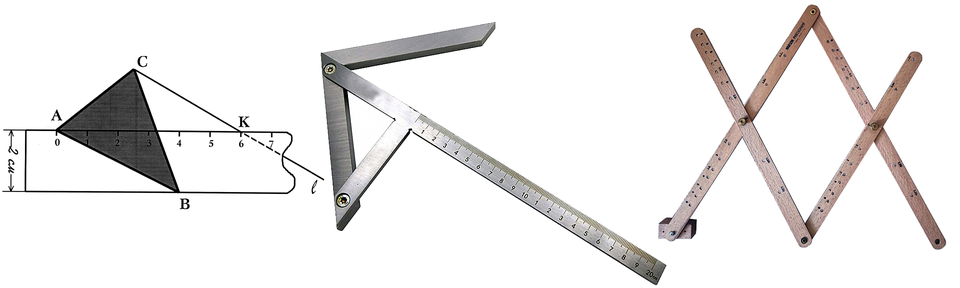

Many theorems studied at school underpin mathematical instruments. The “dividing angle” described by G. M. Mikhailov, for example, relies on the angle-bisector property in a triangle. Bibikov’s agrometer uses the equal areas of triangles sharing a base whose vertices lie on a line parallel to that base. A diameter gauge for circular bodies relies on the properties of the projections of the legs onto the hypotenuse. An inversor constructs the inverses of given figures, while a pantograph constructs homothetic figures. The slide rule relies on the properties of logarithms. The vernier and diagonal scales are based on similar triangles. Homothety is also used in plane-table surveying.
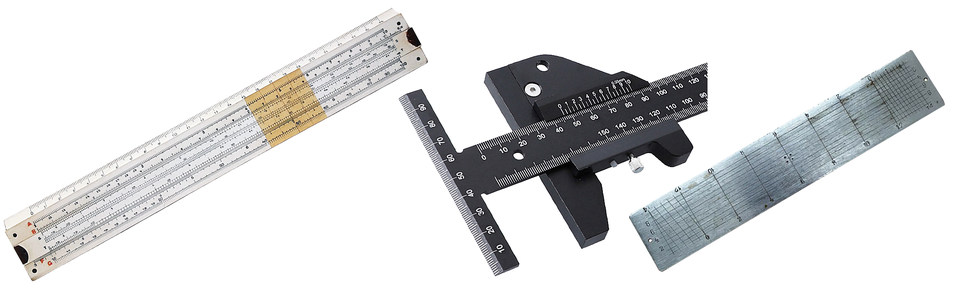

The theory underlying each instrument is clearest and easiest to grasp in a homemade version. Pupils should therefore be involved in making them. Where no teaching hours are available for this work, optional and elective courses can provide a solution. Planimeter theory, nomography and anaglyphs offer excellent material for mathematics clubs, while the theory of mathematical instruments provides a basis for substantial creative projects by pupils.
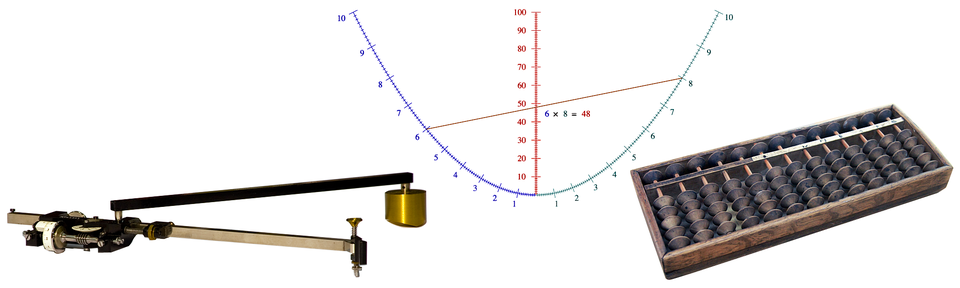

Schools in Russia and abroad have experience of using mathematical instruments. B. N. Delaunay, for example, wrote A Short Course in Mathematical Machines. Ya. I. Perelman described many useful instruments. The journal Historical and Mathematical Studies also devoted considerable attention to their history and theory. B. P. Erdniev wrote: “It is also instructive to note that in Japan, learning to calculate on the soroban — the Japanese abacus — is a fully established part of primary-school mathematics. Educators in that country directly connect children’s successful mastery of mathematical knowledge with sound instruction in abacus calculation.”
Instruments are designed to perform frequently needed calculations and measurements with a certain degree of accuracy. That accuracy is nevertheless adequate in practice. Their chief value is that they simplify laborious operations requiring complex calculations. People can use instruments without understanding the calculation process, but educational use calls for studying precisely their mathematical foundations.
During the XVII — XX centuries, considerable attention in Russia and abroad went to the practical development of calculating aids, devices, instruments and machines. Calculating machines were built, from the arithmometer to the electronic computer; planimeters measured areas, curvimeters measured curve lengths, and integrimeters solved differential equations. New branches of computational mathematics, including nomography, developed.
Students training to become mathematics teachers are no longer taught the theory and practice of mathematical instruments. As information and communication technologies (ICT) spread, the instruments’ role is shrinking. Future teachers will nevertheless encounter these questions in their professional work. They therefore need an introduction at least to the instruments named in modern school textbooks. This can be included in a course on the theory and methods of teaching mathematics, with fuller treatment in specialist electives. The history of mathematical instruments, for example, receives attention in the History of Mathematics course.
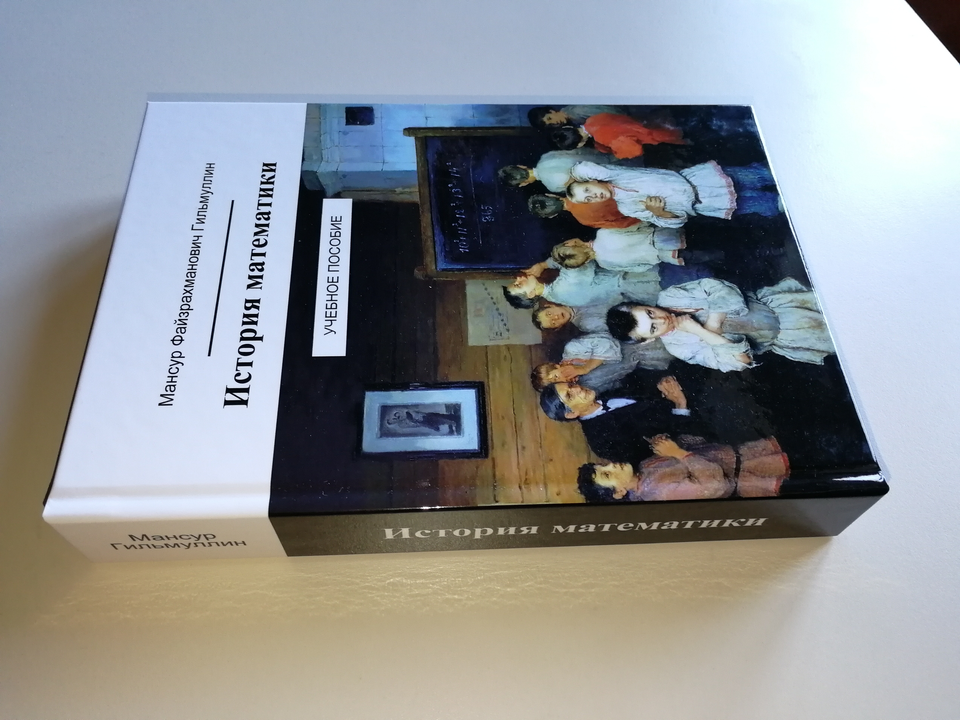

Unfortunately, information about the origins and mathematical foundations of instruments and devices is fragmented across books and journals. There are no books for teachers and pupils written specifically on this subject. Books by M. A. Znamensky and V. G. Prochukhaev contain some such information, mainly concerning field-measuring tools.
Instrumental mathematics once received considerable attention abroad as well. F. A. Willers’s Mathematical Instruments is a reference monograph on certain types of mathematical devices. It does not describe nonmechanical devices: optical, electrical or electronic.
This suggested the idea of collecting material in a single book on the origins of mathematical instruments and their use in mathematics teaching. The book gives information about each instrument: who invented it and when, the principles behind it, where it was used, what it was called, whether it was used in schools and whether it can be used today. Some of the book’s material will appear in the series of articles announced above.
The aim is not to describe their construction exhaustively or provide operating instructions. Without going deeply into technical detail, we need only explain each instrument’s operating principle and theory, since in the past only knowledge of that theory enabled people to exploit its full capabilities. Such work must clearly be integrated with the curriculum. At present, however, describing the specific teaching methods for mathematical instruments is not an immediate task. We shall therefore confine ourselves to their theory and practical application.
Their classification was introduced above: calculating, measuring and construction instruments.
Measurement produces numbers expressing mathematical properties: length, area and volume. Although all measuring instruments yield numbers, the characteristics they express may instead be physical, chemical or otherwise. We shall therefore exclude some physical devices and instruments, such as ammeters and pressure gauges, from the mathematical category. The physical principles of the devices are immaterial: they may be mechanical, optical, electrical or electronic.
Some instruments, such as angle-measuring instruments, are used in many sciences. Many calculating aids on paper — tables, graphs and nomograms — also operate at the boundaries between sciences. Since they represent numerical characteristics of mathematical models of real processes, they can be regarded as mathematical instruments.
Construction instruments are used to construct figures both on paper and in the field. Drawing instruments belong to this category as well. Geometric models and stereoscopic drawings may provisionally be included.
Some instruments combine measurement and construction. These are chiefly devices and instruments for fieldwork.
We will give fuller descriptions of instruments once used in mathematics education, beyond secondary school alone. They range from the simplest tools, such as rulers and compasses, to highly complex equipment, such as integrimeters, planimeters and astrolabes.
Each mathematical instrument will receive a separate article in the series.
Author: Mansur Gilmullin