


“It measures by itself,” said the great schemer Ostap Bender, selling an astrolabe to a locksmith for three roubles, “as long as there is something to measure.” People have always had something to measure. As soon as they learned to speak, count, obtain things and exchange them, they needed to measure their possessions. Questions then arose: how should they measure, with what, and what should they call it?
Several thousand years passed before the familiar units of measurement emerged. We routinely measure distance in kilometres, time in hours and purchases in roubles, without asking when and how these measures arose or what they originally meant. Yet the history of many measures is instructive, and they played an important part in society.
Tens of thousands of units of measurement are used in the world today. We shall not list them all. We want to tell the story of the origins and use of some, especially those once current in Russia.
The history of measures reflects the history of relations between peoples. Each people initially adopted its own measures. In the course of historical development, these spread to others, chiefly through wars. The conquered adopted the victors’ culture, while the victors themselves borrowed much from those they conquered, including their various systems of measurement.
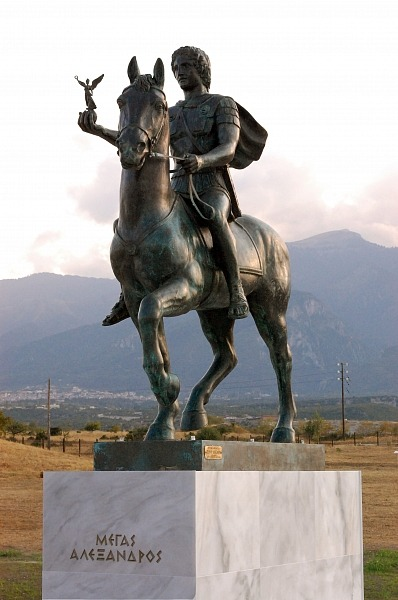

A striking example is the merging of ancient Greek culture with that of the Eastern lands conquered by Alexander the Great in the fourth century BCE. Hellenistic culture, drawing fruitfully on and developing the achievements of all the empire’s peoples, rose to a higher level. It influenced Roman culture and then that of all European peoples. Its influence reached Rus’ through Byzantium. Measures borrowed from ancient Greece, such as the carat and drachma, are still used in some countries. Traces of the Roman system survive in names such as mile and acre.
A second source of common measures is a shared language. Countries whose languages developed from Latin have common Latin names such as grain, yard and bushel. Many countries, including Rus’, used Arabic measures such as the arshin and charka. The reasons lie in the Arab conquests in Europe, Asia and Africa between the eighth and sixteenth centuries.
A third, perhaps the most important, factor in the mutual transformation of measurement systems was trade.
Length was the first thing people measured. Even in ancient Egypt, they practised geometry: “measuring the earth”. They used whatever was at hand — or foot — to measure. Different peoples gave these measures different names, but the essence of the process remained the same.
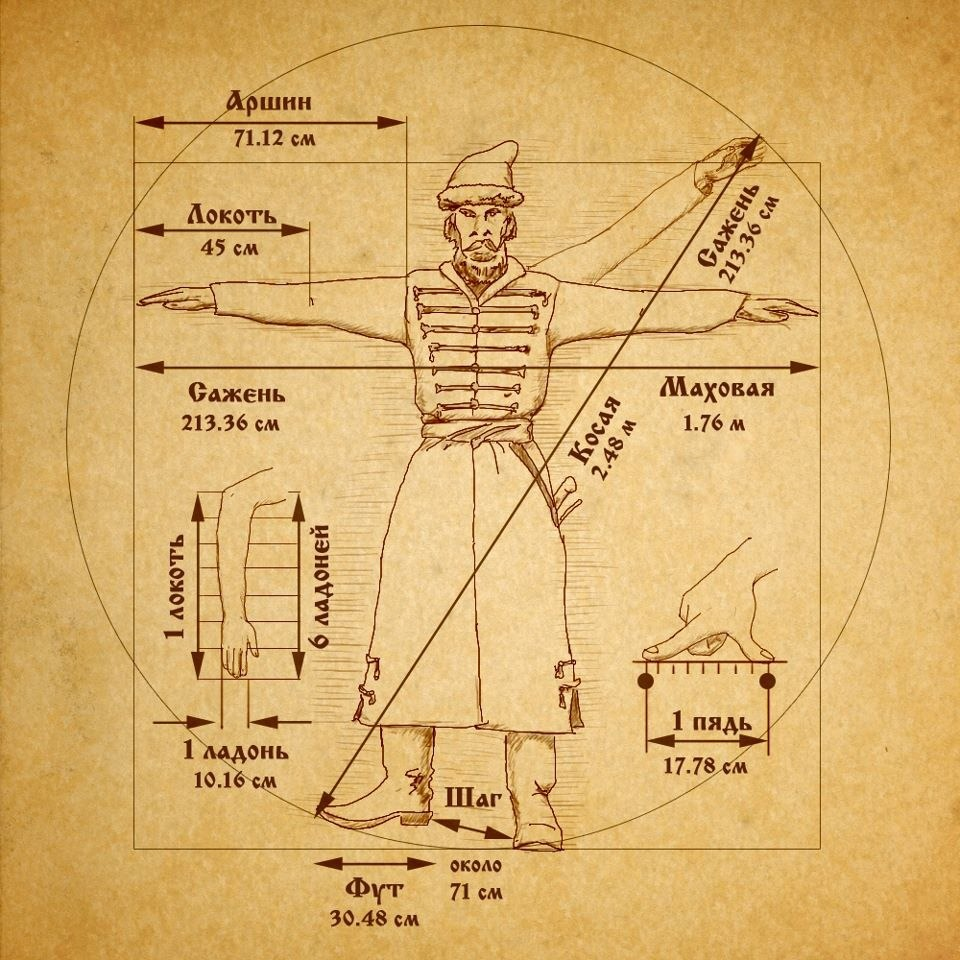

Russians measured in persts, vershoks, spans, arshins and cubits.
Perst is an old name for the index finger, whose width is about 2 cm. This gave rise to the Russian anatomical term for the duodenum, the “twelve-finger intestine”, 24 cm long. The vershok, known since the sixteenth century, equals the length of the two upper joints of the index finger, about 4.4 cm.
Pyad, or span, from the Old Russian pyast, meaning a fist or hand, is one of the oldest measures of length. The small span is the distance between the tips of the outstretched thumb and index finger, about 18 cm. The great span is the distance from the outstretched little finger to the thumb, 22 cm. It appears in Rus’ from the tenth century.
Lokot, or cubit, is an ancient measure of length used by many peoples. It is the distance from the tip of the outstretched middle finger to the bend of the elbow. It was used in Russia from the eleventh to sixteenth centuries, then displaced by the arshin.
Arshin is a measure of length from Eastern countries. Its name comes from the Persian arsh, “elbow”. It measures the whole outstretched arm from the shoulder joint to the final phalanx of the middle finger. According to Karamzin, it came into use in Russia with Persian cloth merchants. In different provinces, merchants measured their goods with their own arshin, deceiving buyers. To prevent confusion, a state arshin of about 71 cm was introduced: a standard wooden ruler with metal tips riveted to its ends and bearing the state stamp.
Sazhen appears from the eleventh century. Its name comes from syagat, “to reach something”, also the root of the Russian word for “unattainable”. There were two kinds: the arm-span sazhen and the oblique sazhen. The arm-span sazhen measured the distance between the fingertips of outstretched arms: 3 arshins, or 213 cm. The oblique sazhen ran from the heel of the left foot to the fingertips of the raised right hand, about 248 cm.
Shag, or pace, is the average length of a human step, 71 cm. Distances between cities were measured in paces as far back as ancient Egypt.
Verst comes from the word vertet, “to turn”. Originally, it was the distance from one turn of the plough to the next during ploughing, 1067 m. Under Peter the Great, a verst of 500 sazhens, or 1.07 km, was introduced. Early in the nineteenth century, black-and-white striped posts appeared along the Russian state’s main roads, marking distances in versts. Recall Pushkin’s line: “Only the striped verst-posts come into view.”
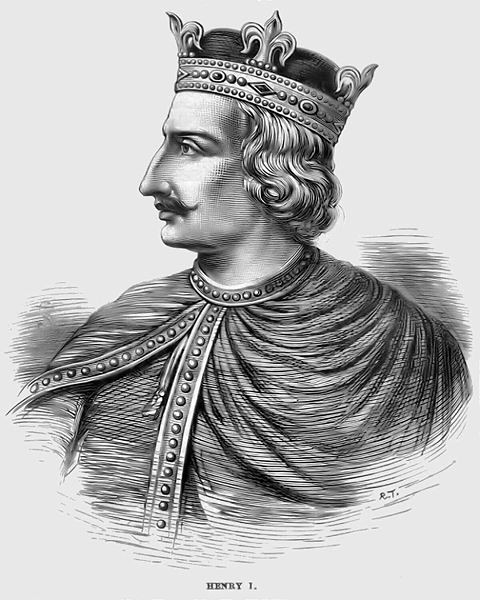

Royal personages also had a hand in measures of length. In England in 1101, the distance from the tip of King Henry I’s nose to the end of the middle finger of his outstretched hand was adopted as a unit of length. It is called the yard.
In the fourteenth century, King Edward II introduced the inch, equal to the length of three barley grains taken from the middle of an ear and placed end to end.
The foot equalled the arithmetic mean of the feet of 16 people leaving Sunday matins. Apparently different peoples had feet of different lengths, so their units differed: the English foot was 30.48 cm, the French pied 32.48 cm, and the Turkish ayak 30.5 cm.
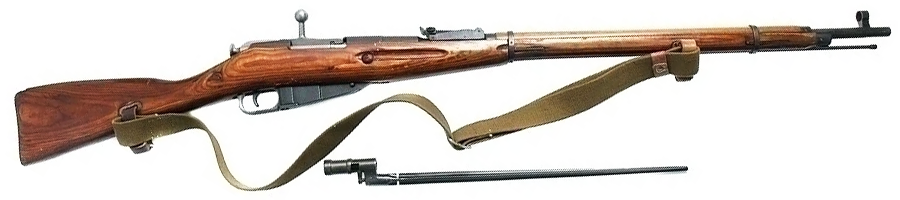

The choice of linear measures could be linked with weapons. The Chinese yin, for example, was the distance travelled by an arrow shot from a bow, 32 m. In the eighteenth century, the nautical league meant the range of a cannon shot against an enemy ship. This was adopted as the width of territorial waters and measured 5560 m. The line, from the Latin linea, “thread”, was based on the width of a wheat grain, about 2.54 mm, yet was internationally used for firearm calibres. The Mosin “three-line rifle”, with a calibre of 7.62 mm, served in the Russian army.
From the sixteenth century, state and privately owned lands were measured in desyatinas and chets, the latter equal to half a desyatina. Originally, a desyatina was a square with sides of 50 sazhens, one-tenth of a verst. The Book of Land Assessment of 1629 mentions a desyatina as a rectangle measuring 80 by 30 sazhens.
Area units often depended on how much land could be worked in a day. In Iceland, a dagslátta was an area from which grass could be mown in one day, 32 ares. In Persia, a joft was an area that a pair of oxen could plough, 40 ares.
A weight unit might equal a load that could be carried. In China, a dan was the load a person could carry on their shoulders, 60 kg; in Persia, a kharvar was the corresponding load for a donkey, 300 kg.
The oldest Russian weight unit is the grivna, or grivenka, amounting to 410 g. Its name is thought to come from a large silver coin used in Russia from the twelfth century. It was later replaced by funt, or pound, from the Latin pondus, “weight” or “heaviness”. A funt equalled 96 zolotniks, each about 4.3 g. Until 1927, Russia used the zolotnik system to specify precious-metal content, or fineness, per pound of alloy. The pud, a weight of 40 pounds, approximately 16 kg, appears from the twelfth century.
Naturally, vessels often supplied measures for liquids: Italy’s caraffa, a carafe, was 5.45 litres; Spain’s copa, a glass, 0.13 litres; and Germany’s Kanne, a jug, 2 litres. Now is a fitting time to meet Russian liquid measures too: 1 shtof = 2 bottles = 10 charkas = 1.23 litres.
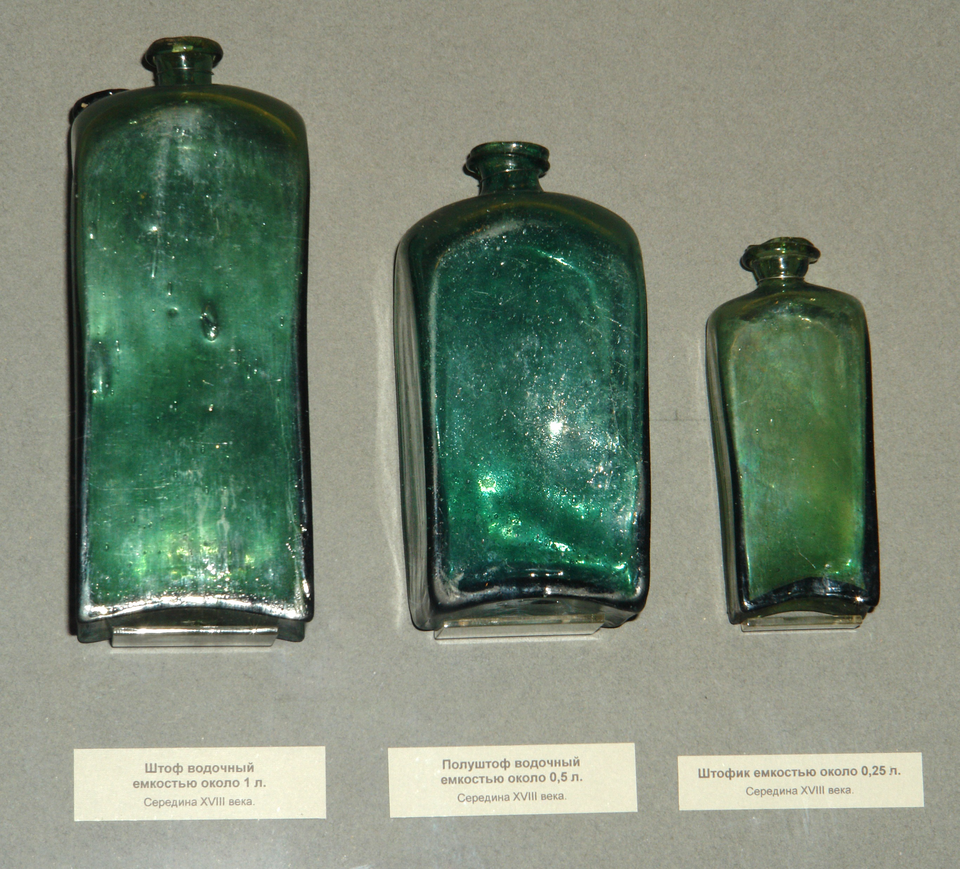

The shtof, from German Stof, is a four-sided glass vessel with a short neck, a “drinking measure” used since the eighteenth century. The bottle, from French bouteille, also came into Russian use in the eighteenth century. The charka, from Turkic cara, “large bowl”, has been used since the twelfth century. The shkalik, from Dutch schaal, “bowl”, was the smallest permitted measure for selling wine and vodka, used since the twelfth century and equal to 0.06 litres. It also had other names: kosushka and merzavchik.
Let us meet Monsieur Litre. Many know that a litre is a measure of volume equal to the volume of a kilogram of water at 4◦C. Almost no one knows, however, that it was named in honour of the Frenchman Claude Litre. He lived in the eighteenth century and made wine bottles. In 1763, Litre proposed measuring liquids with a unit later named the litre.
Few measures have retained their size across different countries from antiquity to today. Among them are the foot as a length and the ounce as a weight. More often, the same measure has different values in different countries. One example is the barrel, widely used in trade for liquids and dry goods. Depending on the country and commodity, it ranges from 35 to 300 litres. Oil and petroleum products are measured in barrels on today’s world market. In England and the USA, one oil barrel is about 160 litres.
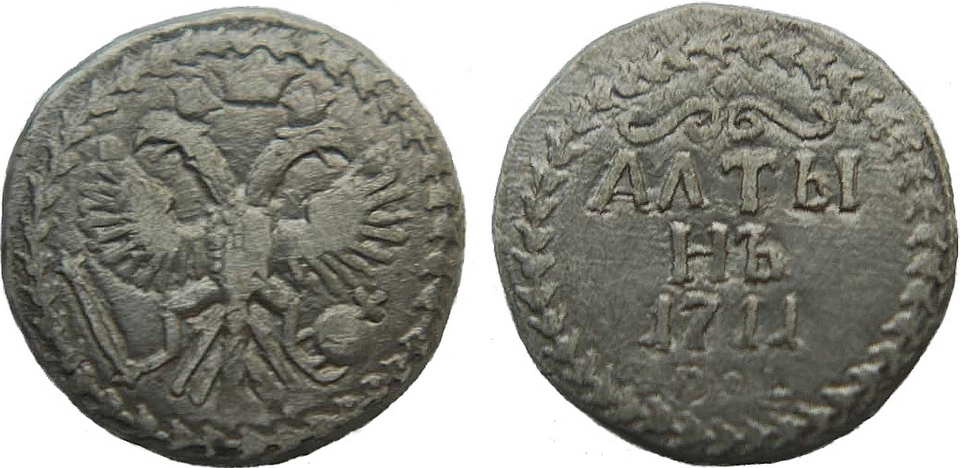

Among many peoples, weight units shared names with monetary units: the French livre, English pound and Russian grivna. The word denga first appears in chronicles relating to 1381 and was then used for centuries as a coin denomination. Six dengas made one altyn, worth three kopecks. Altyn comes from the Tatar alty, “six”, so a denga equalled half a kopeck. The first use of rouble dates to the thirteenth century. The word comes from the verb “to chop”. In later centuries, the rouble as a state-wide coin contained varying amounts of silver.
Before minted money in Rus’, the Slavic tribes used furs in exchange: vekshas, squirrel skins; kunas, sable and marten skins; and nogatas, fox, wolf and bear furs. For large purchases, however, they used grivnas, necklaces of silver or gold. Later, metal ingots of about half a pound were cast in their place. Thus a grivna was about 200 grams of silver, a nogata one-twentieth of it, and a kuna one-fiftieth, or 4 g of silver.
The economic importance of accurate trade measures and weights has always been understood. In Rus’, the church initially supervised them, from the tenth century. With the formation of the Muscovite state in the fifteenth century, supervision passed to the civil authorities.
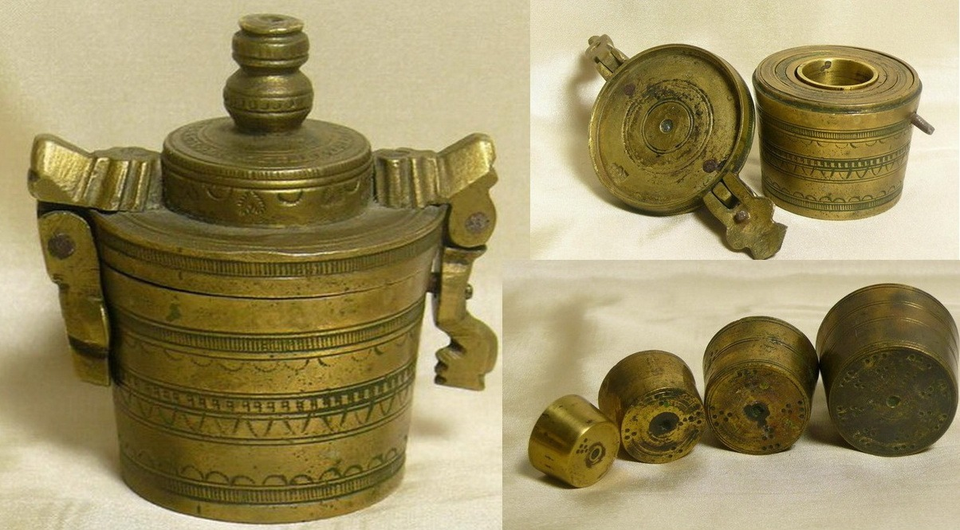

In 1550, “stamped copper buckets” were distributed. For inaccurate scales and weights, merchants’ goods were “irrevocably confiscated for the great sovereign”, and the merchants and their families were exiled. By the late seventeenth century, using measures without the eagle stamp was prohibited on pain of death. Equally strict measures were observed in all countries.
Measures once varied enormously between countries and even between regions of the same country. This diversity chiefly complicated trade. In 1801, France introduced the metric system. It became international in 1875 and was adopted in Russia in 1918. Almost all old measures were converted into it.
A familiar song says, “Do not look down on seconds.” The same can be said of every measure. Each has a venerable history deserving respect and study.