
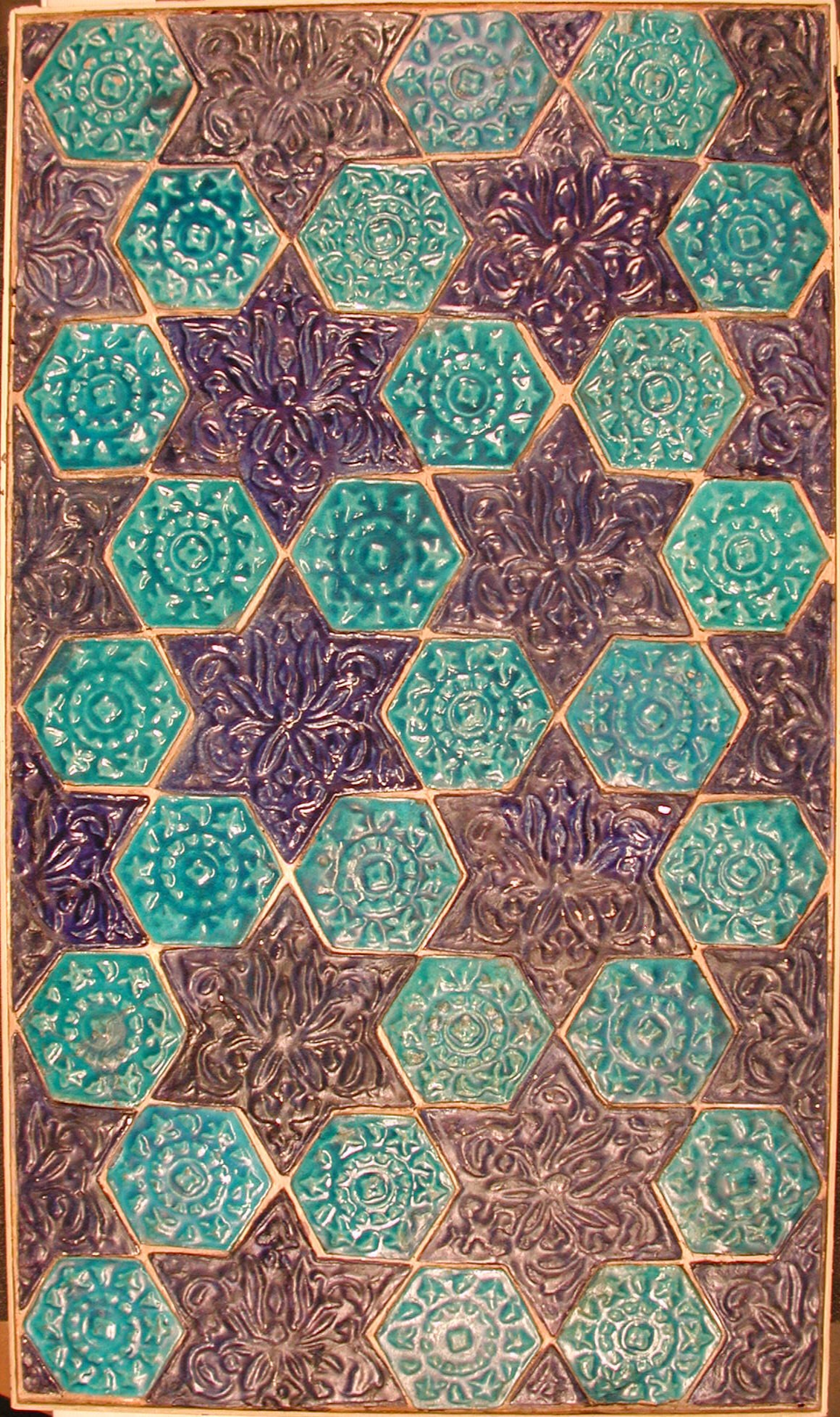
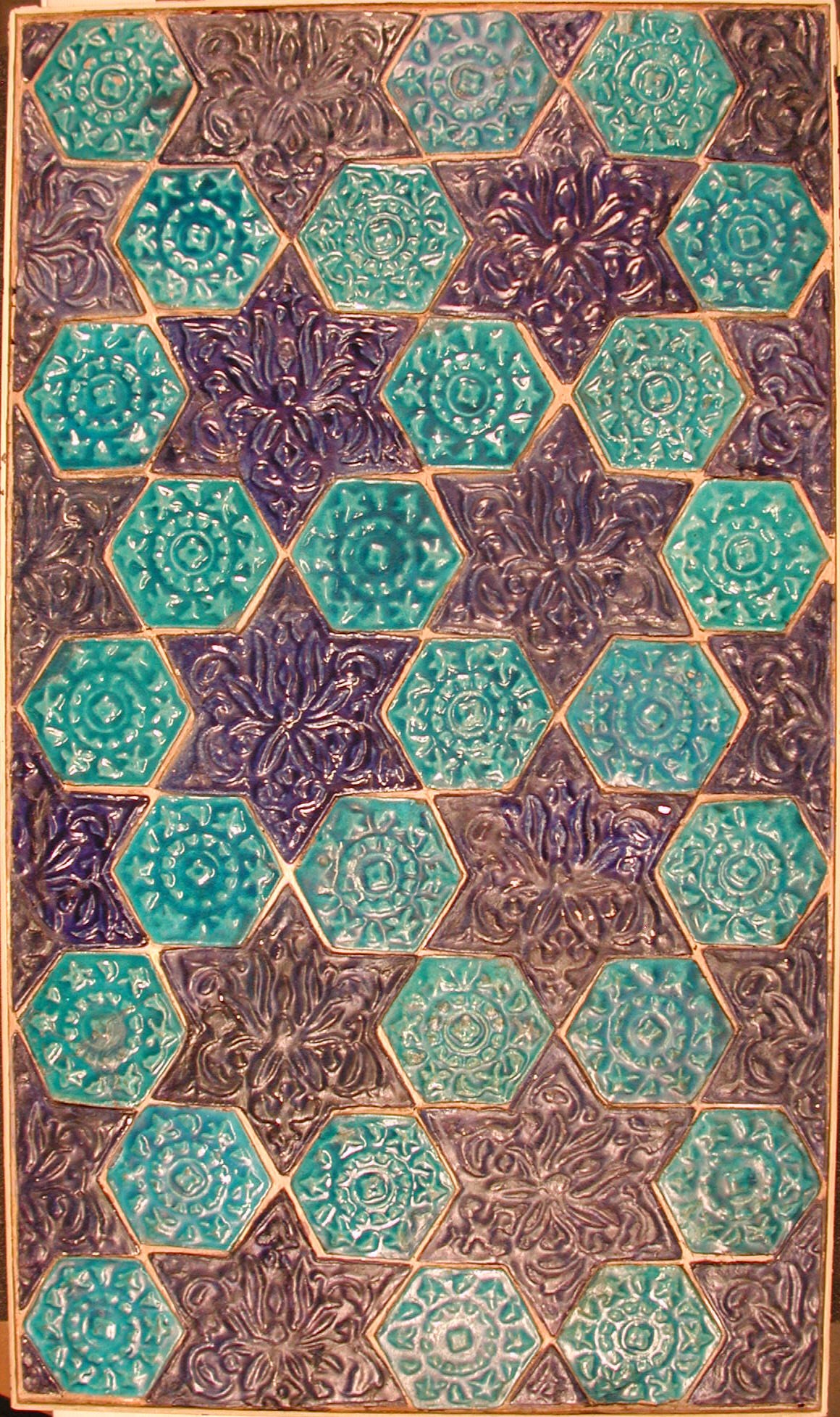
Geometric ornament in Islamic art is one of the most beautiful encounters between art and mathematics. These patterns decorate mosque walls, mausoleum portals, domes, minbars, wooden panels, ceramics and manuscripts. At first glance they seem merely elegant decoration, but a rigorous order underlies them: symmetry, compass-and-straightedge constructions, polygon properties, division of the circle and recurring tiling schemes.
Geometric patterns are one of the three main nonfigurative forms of decoration in Islamic art, alongside calligraphy and plant ornament. Especially well known are girih patterns (girih). The Persian word girih means “knot”. It describes complex interlaced strapwork in which lines pass from one figure to another, creating the impression of continuous weaving.
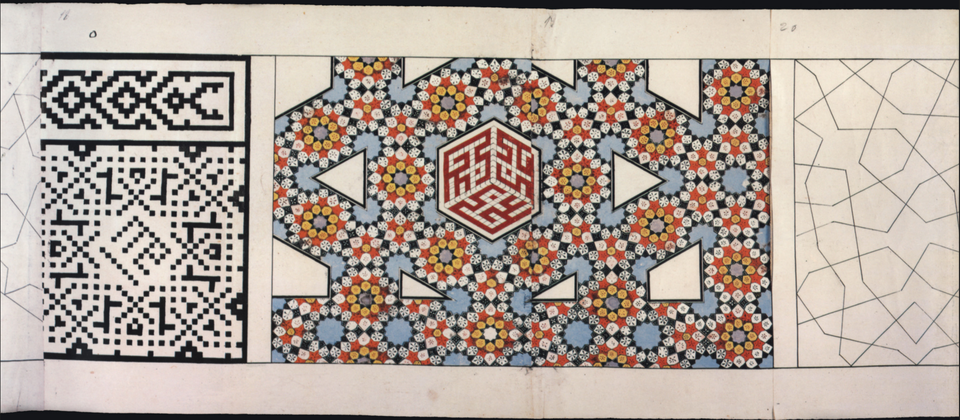
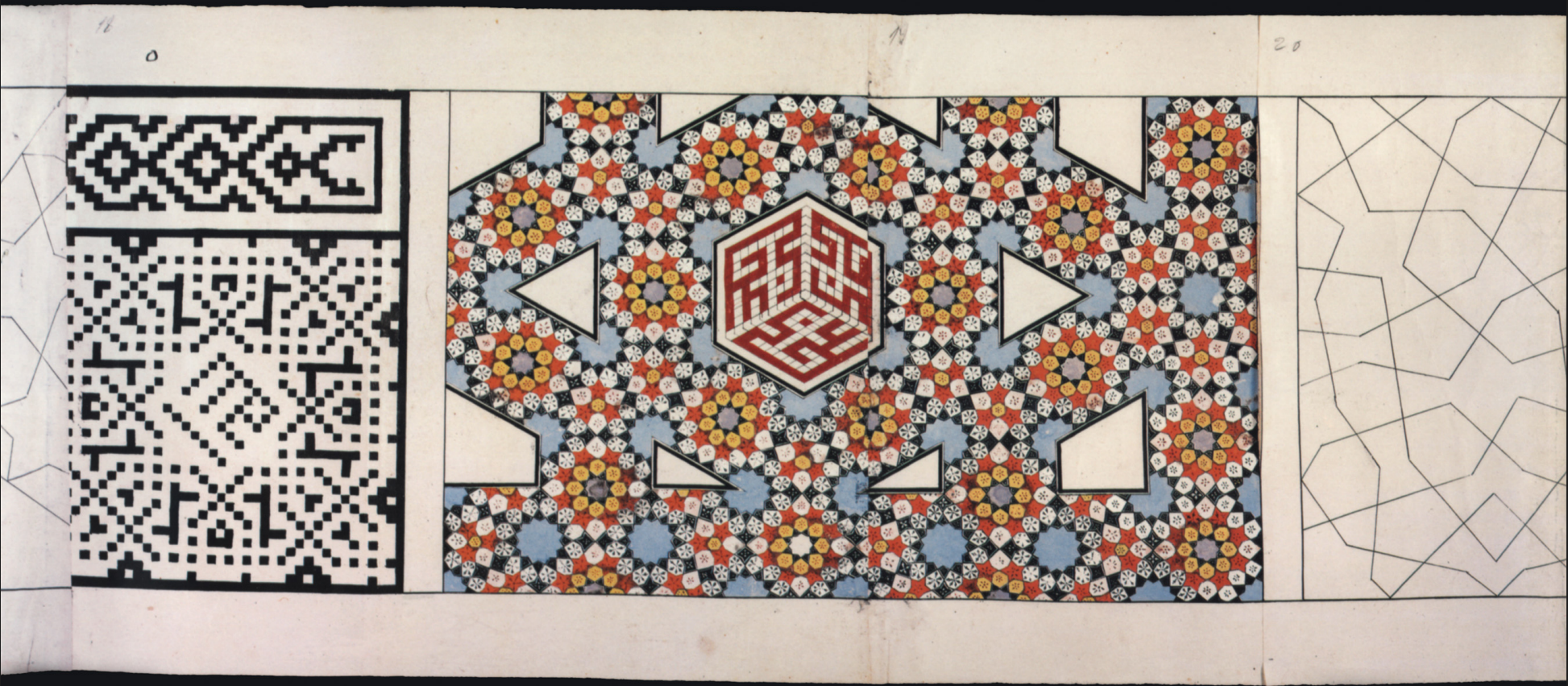
Star-shaped geometric patterns in Islamic art are known from as early as the VIII century. Over time, craftspeople learned to construct increasingly complex compositions of polygons, stars and interwoven bands. A particularly important record is the Topkapi Scroll, an album of geometric drawings and ornamental schemes usually dated to the XV century. For historians of art and mathematics, its value lies in showing both completed patterns and the logic of their construction.
Pentagonal and decagonal geometry is particularly important in girih: pentagons, decagons, and five- and ten-pointed stars. This also brings in the golden ratio.
If a regular pentagon has side a, its diagonal is
where
The golden ratio therefore arises naturally in star patterns: as soon as a regular pentagon enters the construction, the number φ appears with it.
The golden ratio was already known in ancient geometry. Euclid describes it as dividing a segment in extreme and mean ratio: the whole segment is to the larger part as the larger part is to the smaller. During the Renaissance, this proportion gained renewed prominence through Luca Pacioli’s On the Divine Proportion (De divina proportione). The notation φ became established much later, in the early XX century.
For a regular decagon, another relationship is convenient:
where R is the circumradius and a is the decagon’s side.
These two formulas suffice to show why patterns with pentagonal and decagonal structures are so closely related to the golden ratio.
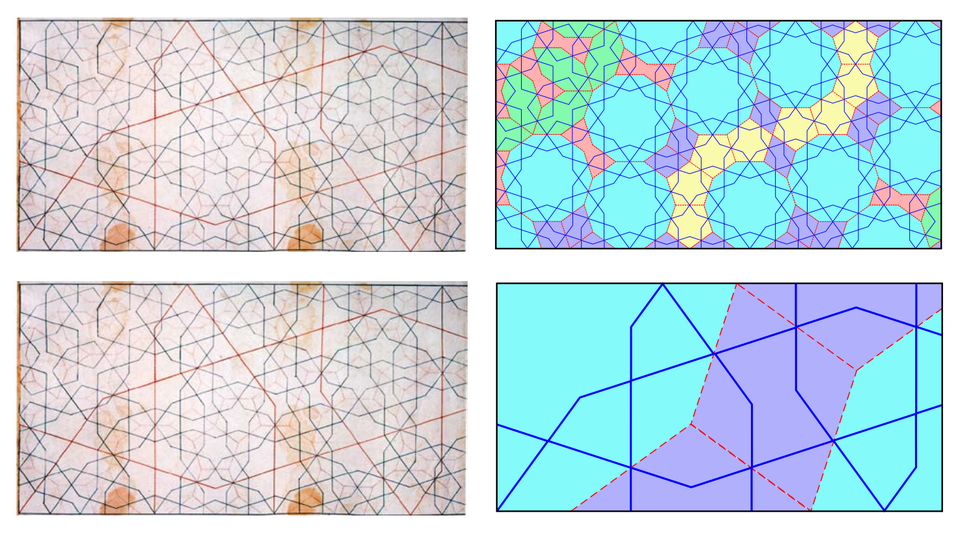
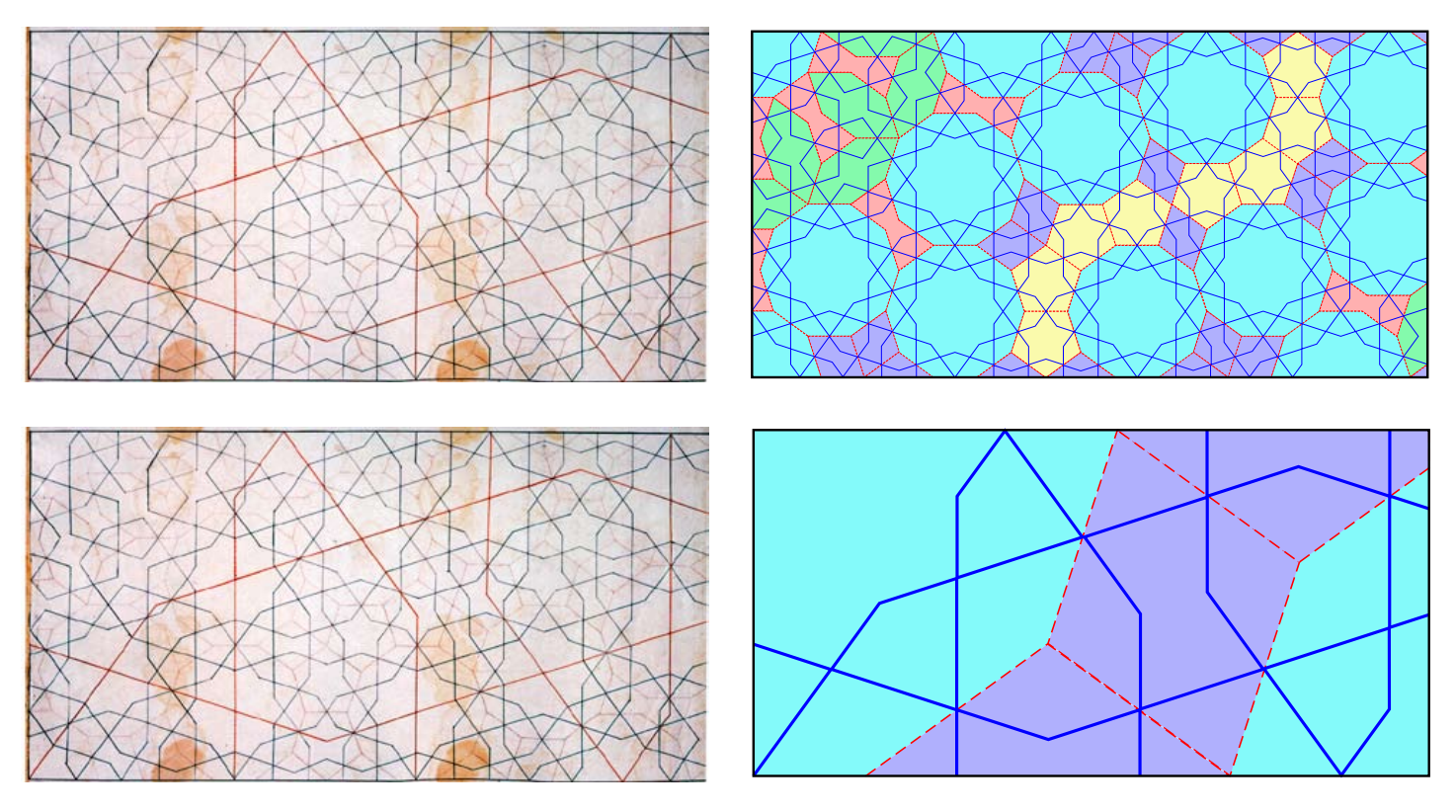
In 2007, physicist Peter Lu and mathematical physicist Paul Steinhardt proposed a highly influential interpretation of Islamic ornament. Their hypothesis was that, by about 1200, some ornamental practices may have shifted from local constructions to using a set of standard figures — girih tiles. They identified five basic shapes: a decagon, pentagon, elongated hexagon, rhombus and “bow tie”. Internal lines can be drawn on these tiles so that the pattern continues without breaks when adjacent shapes are joined.
This gave rise to the famous comparison with quasiperiodic tiling, particularly Penrose tiling. A quasiperiodic pattern has order but does not repeat periodically like ordinary floor tiles. In physics, a related idea is that of quasicrystals: structures with rigorous order without ordinary periodicity. Dan Shechtman discovered such structures and received the 2011 Nobel Prize in Chemistry for this discovery. The Nobel Committee specifically emphasized regularity without repetition, as opposed to a familiar periodic crystal lattice.
To show where this hypothesis becomes particularly controversial, Lu and Steinhardt considered specific architectural monuments as well as the Topkapi Scroll. A central example is the Darb-i Imam complex in Isfahan. Its main structure dates to 857 AH (1453), and the portal’s elaborate mosaic ornaments became a major focus of debates over girih, quasiperiodicity and the dates of individual panels.
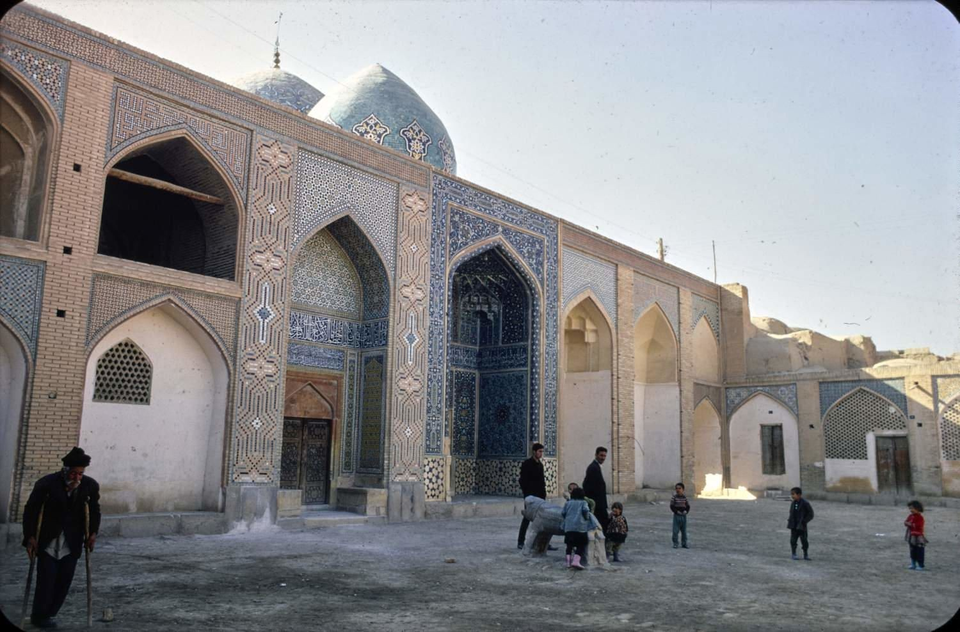
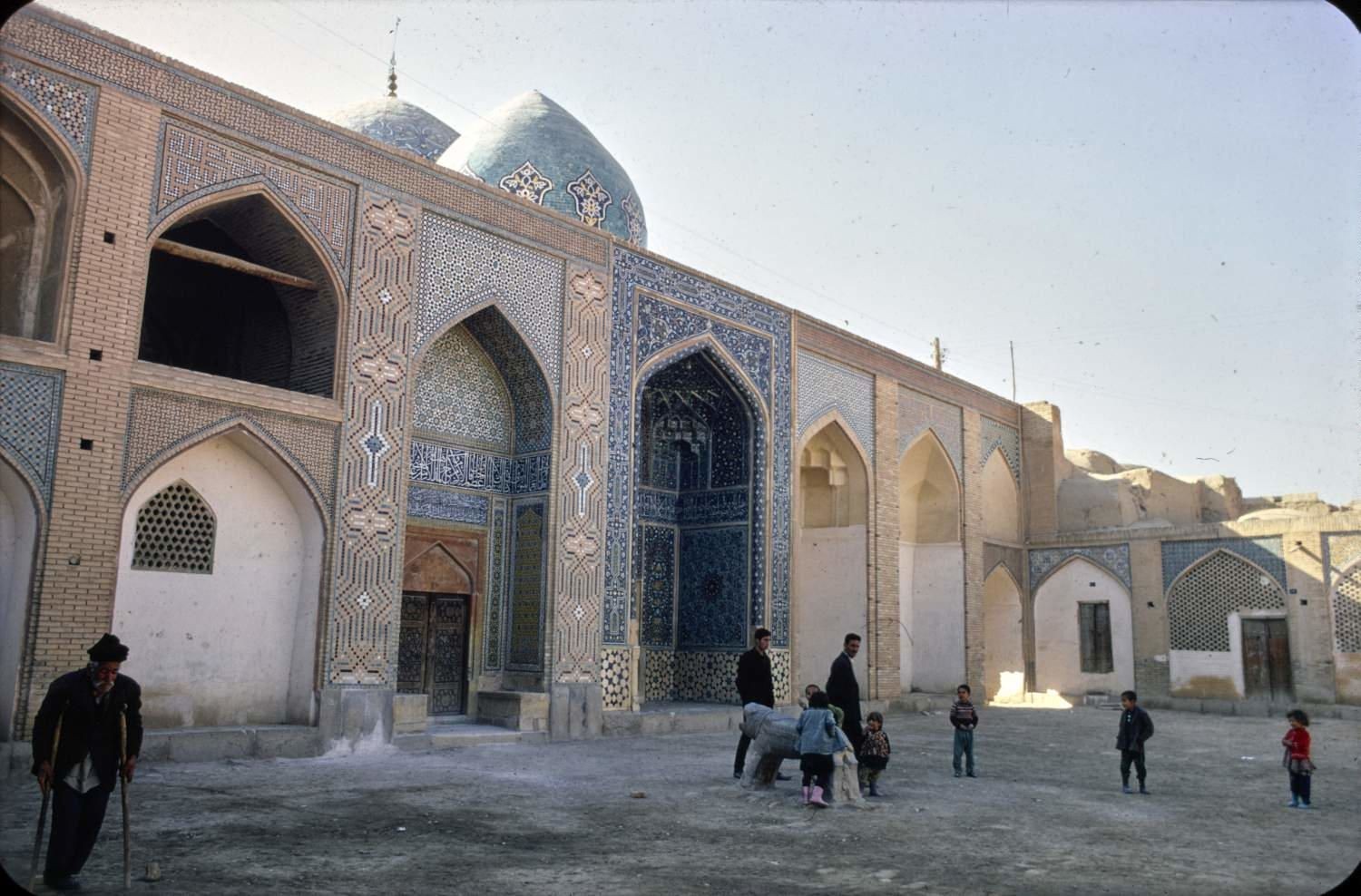
An important scholarly qualification is needed here. Lu and Steinhardt’s article prompted discussion. Emil Makovicky argued that the famous Darb-i Imam pattern should be considered periodic rather than quasiperiodic. Later, L. Lauwers added another qualification: the widely cited date 1453 applies to the complex’s main building, whereas he proposed dating the disputed panel itself to 1715–1717. A more accurate statement is therefore that some Islamic patterns are indeed close in spirit to quasiperiodic structures, while the degree of that resemblance, the construction methods and the dates of individual examples remain under discussion.
This does nothing to diminish medieval craftspeople’s achievement. Even leaving the boldest interpretations aside, we see a remarkable combination of practical experience, geometric intuition and artistic taste. These makers did not use modern mathematical language, but they could recognize structure and work with symmetry, repetition, rotations, subdivisions of figures and complex grids. Their ornament is geometric thought embodied in stone, wood, plaster and ceramics, far beyond “naive decoration”.
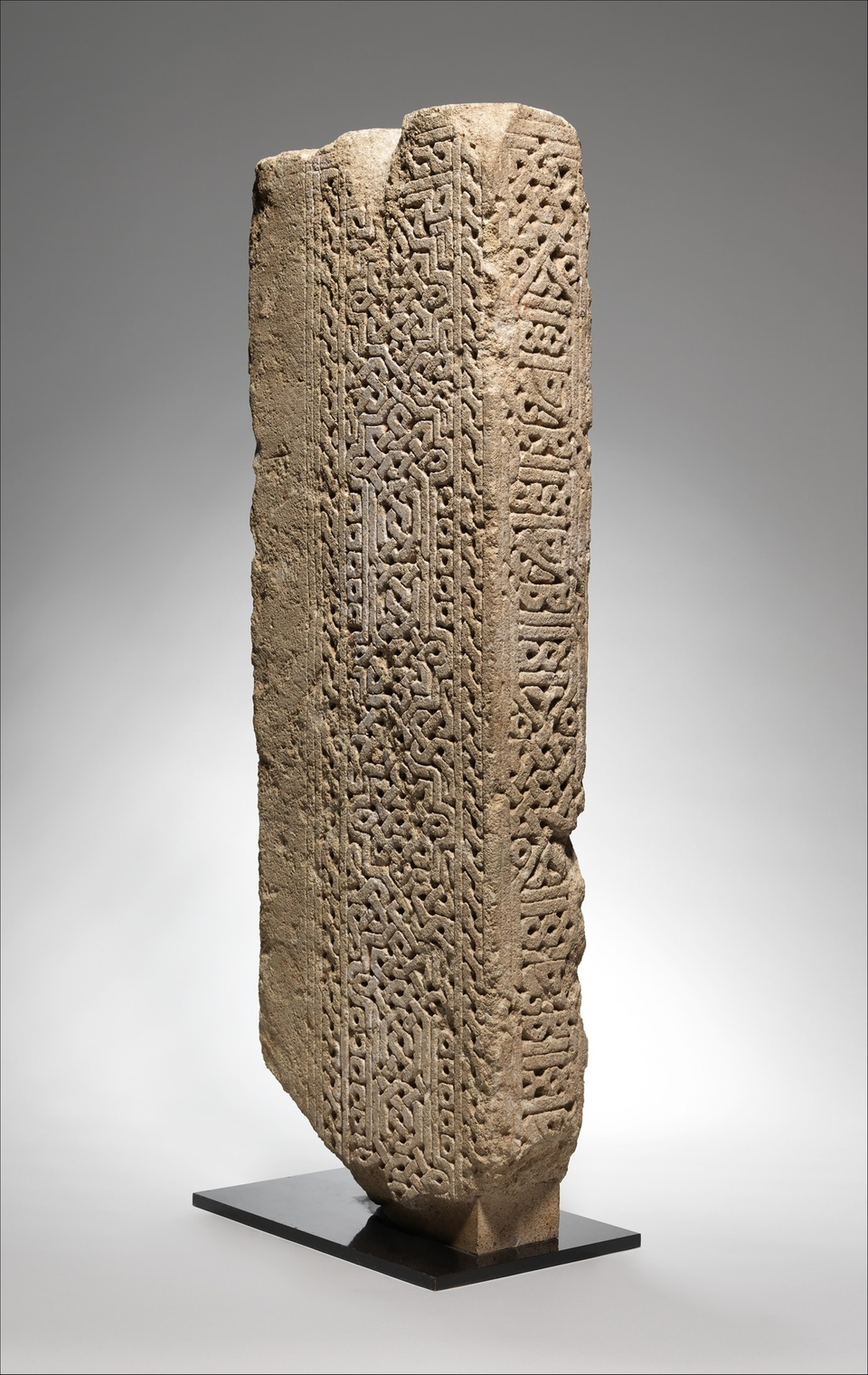
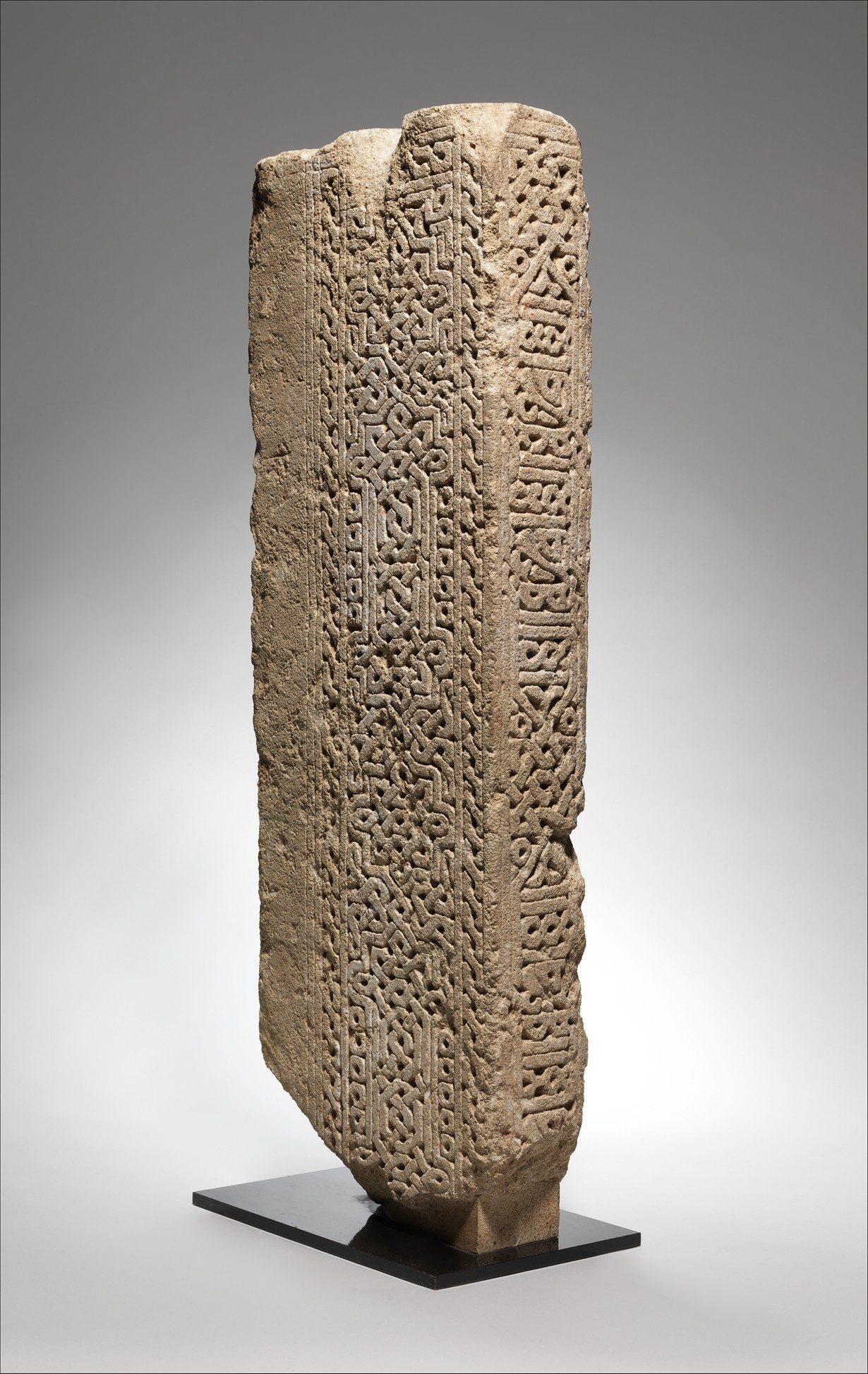
Ornament becomes a distinctive language here. It organizes a surface as well as filling it. Its power lies in mathematical beauty arising from order, measure and the internal relationships between parts, rather than a random collection of elements.
In this sense, Islamic geometric ornament is a beautiful example of mathematics living beyond the textbook. Mathematics can inhabit architecture, a pattern’s rhythm, a sense of symmetry, and a design that repeats while subtly changing, as well as formulas and diagrams.